Apr
07

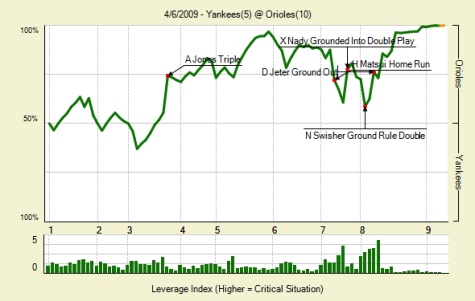
WPA chart of yesterday’s game

By Joseph Pawlikowski


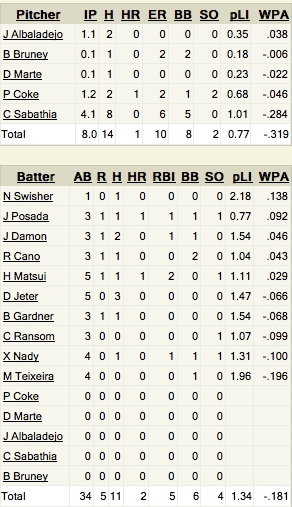
In case you’re wondering what in tarnation that graph and those numbers mean, you can check out this article for a damn fine explanation. The quick, quick version: it’s called Win Probability Added (WPA). It uses historical data to determine how important each game situation is to the ultimate outcome. For instance, it looks at all situations where, say, the home team has a runner on second and no outs in the bottom of the 7th while up by three runs. Using data from the game’s past, it can determine how many times a team in that situation went on to win that particular game. Then, say, the next hitter singles and drives home the runner. The situation changes to runner on first, no outs, bottom of the seventh, up four runs. That win probability will be higher than the previous scenario, so the batter is credited with the positive change.

The bars under the graph represent the Leverage Index. This is, quite simply, how important that particular at bat was. It represents the swing in the most successful play and the least successful play.

Check out the play log sorted by WPA change. It was easy for everyone to determine the two plays which cost the Yanks the most: the Xavier Nady double play and the Derek Jeter groundout. The latter is a shame, of course, because Jeter had such a good game otherwise. The third, though, might not have registered as having been as important as other plays, but when Mark Teixeira reached on a fielder’s choice in the eighth inning, the loss of the inning was apparently devastating. As you can see from the Leverage Index, it was an important situation, so losing the out there was big.

While the Yanks dominated the negative end of the WPA chart, they also had a number of enormously positive contributions. Specifically, the Matsui homer, the Swisher double, the Jeter single in the third, the Nady double, and Cano’s seventh-inning single were of great importance to the team. What’s strange, you might see, is that Jorge Posada’s 7th inning walk was more important than his sixth-inning home run. This is because it came with the team down 6-1, so it didn’t do much at the time. It did build the foundation, though, for the Yanks coming back to within 6-5 before blowing it.

WPA isn’t going to give you a perfect measure of a player’s skill and abilities, but it does provide a narrative for the game. We know that Tex’s 8th inning grounder was devastating, and we know that Matsui’s homer was nearly a game-changer. This is to say that WPA is interesting, even if it doesn’t give us a further insight into skill and ability.

Posted on Tuesday, April 7th, 2009 at 11:30 am in Game Stories.

RSS feed | Trackback URI

73 Comments »

Matt says:

Nick Swisher is so clutch.

 
Raphy says:

Can you determine the WPA within one play?
Nady being thrown out at home, should be charged to him, not Jeter.

 
Expired Milk says:

What’s strange, you might see, is that Jorge Posada’s 7th inning walk was more important than his sith-inning home run. This is because it came with the team down 6-1, so it didn’t do much at the time. It did build the foundation, though, for the Yanks coming back to within 6-5 before blowing it.

Thats a shot at Arod

random says:

Thats a shot at Arod

fuck you

 
Expired Milk says:
random says:

ha don’t take it personally, i don’t really care.

I was just enjoying reading your insightful comment, and then was assaulted by that unfunny-unoriginal “shot” joke that just won’t die


A.D. says:

So will this tell us statistically that A-Rods homeruns (which only come in blowouts or early in games) aren’t important?

 
anonymous says:

All of Mickey Mantle’s home runs were grand slams with the team down 3 runs in the 9th inning with 2 outs.

Yup. All 536 of them. He drove in 2,144 runs on those 536 9th inning, 2 out homers.

You know how many runs ARod drove in with his 553 career homers?

482.

Sweet Dick Willie says:

He also had 18 WS HRs and 40 RBI, vs A-Rod’s – oh yeah, I forgot.

steve (different one) says:

A-Rod has hit a home run in every single World Series AB he has had.

Sweet Dick Willie says:

But alas, he has also struck out with the bases loaded in every one of his WS ABs.

steve (different one) says:

that was a shot at…oh, forget it.

(Comments wont nest below this level)


Only one of our 5 pitchers with a positive WPA… not good.


I love this post, BTW, and think a postgame WPA graph should become a regular feature.

Moshe Mandel says:

I dont know how fangraphs would take that, wouldn’t they want people to come to their site? Maybe a link in the game wrap-up to the graph?

We’re RAB, now officially an arm of the Evil Empire itself, the YES Network Blogging Network.

We don’t ask permission. We take shit.

Thomas says:

What’s strange, you might see, is that Jorge Posada’s 7th inning walk was more important than his sith-inning home run.”

Clearly, Evil Empire.

FL Yank says:

Very well done my friend.

/golf clap


I’ve already gone through this with them. We link to them, so s’all good.

Joe to Fangraphs: You have 24 hours to give us our money. And, to show you that we’re serious… you have 12 hours to give us our money.


Chip says:

I agree, this is the best statistical porn I’ve ever witnessed. How great would it be if someone created a site that streamed the WPA and pLI of ongoing games so you can get a feel of how big a particular situation is.

See, comments like that give the anti-stat people their ammunition.

I don’t need a WPA graph to “get a feel of how big a particular situation is.” I don’t even need Joe Morgan or Jon Miller in my earhole telling me how big this AB is. The game itself does a fine job of giving me that feel.

What I need a WPA graph for is to serve as an after-the-fact snapshot to help me remember how important (or unimportant) a situation is, when my fallible memory fails me (as it inevitably will).

The other thing I need a WPA graph for is to analyze whether we’re making the correct strategic choices. More on that in a second.

During the College World Series last year they showed the WPA for every at bat in the Finals. It was a regular part of the on-screen score, right next to the count, outs, etc. I got excited, I thought ESPN was going to start showing WPA during their MLB games, but alas.

I thought ESPN was going to start showing WPA during their MLB games, but alas.

Rome wasn’t built in a day.

Took a whole weekend to knock that shit out.


Chip says:

How is that giving anti-stat people ammunition? I mean if you don’t appreciate the beauty of stats, then just don’t pay attention to it. I’d like to know things like how big Swisher’s double was or thinking to myself that maybe they should pinch hit Swisher for Nady because this could be the turning point of the ballgame (via pLI) and Nady has been historically terrible against this guy. Maybe it’s just me but I think it’d be wonderful

I was just saying you’re giving the anti-stat people ammunition by your statement that it would be great to have live WPA and LI data “so you can get a feel of how big a particular situation is.”

The Kruks and Morgans of the world like to say that statnerds just simulate a spreadsheet printout of the game and enjoy that. Your comment isn’t the same, but it’s in the ballpark of “Man, if we could just stream the stats straight to our monitors, we don’t even need the game!” meme they love to use.

Just ribbing you a little.

Chip says:

Haha yeah, well not all of us have the insight granted to us by the Hall of Fame so we have to find alternative ways to enjoy the game.


BklynJT says:

It looks like they got the graph from FanGraphs. Is this something that can be generated from the FanGraph site for any game?


Cam says:

I agree. I don’t post that often but I felt compelled to say just how much I liked this graph. I think it’s very interesting to see which things throughout the course of a game hold the most importance. For example while watching the game, to me, the thing that single handedly killed any Yankee momentum was the Jeter ground out. But it’s just nice to see it this way.


StephenH says:

Can this data be used over a full season to try to get at the always elusive “clutchiness” of a player?

It is. Fangraphs has individual WPA data for each player.


BklynJT says:

Maybe a slight correlation, but its definitely not as cut and dry. The situation itself (at-bat) isn’t whats necessarily being captured in the graph, but the win probably as a result of the at-bat.

ie. A Nady strike out would have less of a – WPA than the GIDP in that situation, but regardless he was NOT clutch at that moment.

True.

That’s also why the WPA can’t assign blame for the WPA added or lost with pinpoint accuracy, just general accuracy, such as the Nady play. His out on the basepaths gets lumped in with Jeter’s negative WPA since it was his AB.

Over the course of a season, it becomes pretty negligible, but in small samples WPA can’t really account for multiple or non-traditional assignments of blame for a play.

BklynJT says:

If I was Jeter, I would be all over Nady for screwing up my WPA stats. (closet stat whore)


I’m not sure if the FanGraphs log does this, but if you score at home with the WPA Excel sheet (which I’d use and pretty up with graphics if the macros ran properly on a Mac), you can assign the blame of that out to Nady.


dan says:

He means the little vertical green bars under the WPA graph is the situation.


So do I blame our 3rd Base coach or Nady for the base running gaffe?

anonymous says:
 
 
dan says:
Expired Milk says:
 
 
GG says:

Have to blame Nady…HE JUST STOPPED!!!!

 
Double-J says:

Last year it would have been Bobby Meacham, but because of the pro-Swisher context this yeah, you have to blame Nady…

Double-J says:
Chip says:

I don’t blame Nady for over running the base. I blame him for not breaking for home. That’s not an easy throw for the third baseman. I know the chances of them screwing up that play are minimal but he really had nothing to lose at that point


GG says:

Why would they not use the replay on the Izturis hit to Damon that was fan interfered? That would be the perfect thing to have it for. Should not have been ruled a HR.

Sweet Dick Willie says:

If the ball is over the wall, which it appeared to be, then the fans are allowed to “interfere” with it.


Why would they not use the replay on the Izturis hit to Damon that was fan interfered? That would be the perfect thing to have it for.

You have a point. Perhaps it was reviewable, it wouldn’t have hurt to take a look.

Should not have been ruled a HR.

Yes, it should have. We at home DID get the benefit of watching it replayed in slowmo, and it was most definitely a HR and should have been ruled a HR. All instances of fans touching the ball happened both after Damon put a glove on it and happened over and behind the wall and not in the field of play. Nobody touched Damon’s arm nor glove, and the only fans to touch the ball did not reach over the wall and break the plane. All that happened in the stands.

Not interference. It was a legit HR.


Hey Chris C. and SDO, let’s reopen this can of worms.

Brett Gardner’s 8th inning sac bunt changed the game situation from

a runner on 2nd with no outs and the Yankees trailing by a run with the #9 hitter at the plate
to
a runner on 3rd with one out and the Yankees trailing by a run with the #1 hitter at the plate.

This changed the Win Expectancy for the Orioles from 62.5% to 76.2%. Meaning the Orioles became about 14% more likely to win the game (when comparing this game to similar games throughout history) because of Gardner’s sac bunt. Gardner’s sac bunt gave him a WPA of -0.038 on the play.

Thoughts?

 
BklynJT says:

Can we find the WPA for that at bat if Gardner made an out without advancing the runner? I’m sure it would have been much more than 14% drop off. I’m personally against sac bunts, but a definite gray area. If Jeter could just drive the ball there, the Orioles WPA would of dropped to around 50%, and even though Jeter would get most of the credit for that change in WPA, you would definitely have to credit some of that to Gardner even though he was previously credited for increasing the Orioles WPA.

 
steve (different one) says:

what is the win expectancy if he beats out the bunt?

steve (different one) says:

and the win expectancy if he strikes out?

The win expectancy (for the Orioles) would probably go down a decent amount if he beats out the bunt, and would go up a lot if he strikes out and thus makes an out without advancing the runner.

However, I’d guess (just my theory, don’t know how to run WPA what-if scenarios) that the increase in win expectancy for the Orioles if Gardner makes an out without advancing the runnner (i.e. runner on 2nd with one out vs. runner on 3rd with one out) is probably so much smaller than the potential decrease in win expectancy for the Orioles if Gardner hits or walks or somehow doesn’t make an out that the team is probably best served gambling on the hit or walk.

Meaning that the surety that you’re decreasing your chances of winning a small amount by sac bunting means is probably not the best thing to do. Yes, you could potentially decrease your chances of winning an incrementally larger amount by swinging away and striking out or grounding/popping/flying out in a manner where the runner doesn’t advance, but the upside of the gamble is significant enough and the downside of the surety is significant enough to make the gamble the smart play.

Who knows WPA/WE well enough to give us the other changes for the non-sac-bunt outcomes of Gardner’s AB?

steve (different one) says:

using this chart:

http://www.tangotiger.net/welist.html

when Gardner came up, the O’s WE was .605
when Gardner sacrified it was .632

if Gardner K’s, it would be .702
if Gardner is safe on a bunt, it would be .462

according to this chart at least, it looks like Gardner’s bunt did not “cost” as much as you said above.

it had a negative WE for the Yankees, but the upside of beating out the bunt was also quite significant.

i think this is one of those situations, where a WE Matrix that is calculated based on a bunch of AVERAGES, might not apply to the specific batter. Gardner has a very specific skillset that could skew these numbers.

at worst, i think it’s like you said earlier, a “push”.

let me add that Girardi was not asking Gardner to bunt a runner from 1st to 2nd. that is a MUCH less defensible situation, and it is the situation where i think the anti-bunting crowd (rightly) gets their ammunition. there is a big difference between moving a runner from 1st to 2nd and from 2nd to 3rd.

Thanks for the numbers. Yeah, probably a push.

Oh, and you’re dead freaking right about the bunting 1st to 2nd. I personally disagree with bunting the runner from 2nd to 3rd, but it’s defensible. The other bunt is abhorrent.


Chip says:

What would have been the gain for runners on first and third, no outs and the #1 hitter at the plate and the Yankees trailing by a run?

BklynJT says:

Depends, is the #1 hitter a double play machine? aka Mr. GIDP himself.

Chip says:

I don’t think that WPA takes into account who exactly is at-bat, just the lineup spot

 
steve (different one) says:

sure, but even a DP in that situation would have tied the game.


Jason says:

Is anyone else as mad about Jeter not getting a flyball with a runner on 3rd and one out as I am.

I read a good article at losjankees.com about it. This really hurt the Yanks last year.

Chip says:

Derek Jeter hits more groundballs than almost any other player in the majors. It’s just what he does so it didn’t surprise me all that much that he didn’t hit a fly ball. Derek Jeter’s value is in his ability to get on base, hit the ball to the right side, keeping up a rediculously high BABIP and play shortstop (badly) all in one package.


Name (required)
E-mail (required - never shown publicly)
URI
Your Comment (smaller size | larger size)

You may use <a href="" title=""> <abbr title=""> <acronym title=""> <b> <blockquote cite=""> <cite> <code> <del datetime=""> <em> <i> <q cite=""> <strike> <strong> in your comment.

If this is your first time commenting on River Ave. Blues, please review the RAB Commenter Guidelines.

Trackback responses to this post