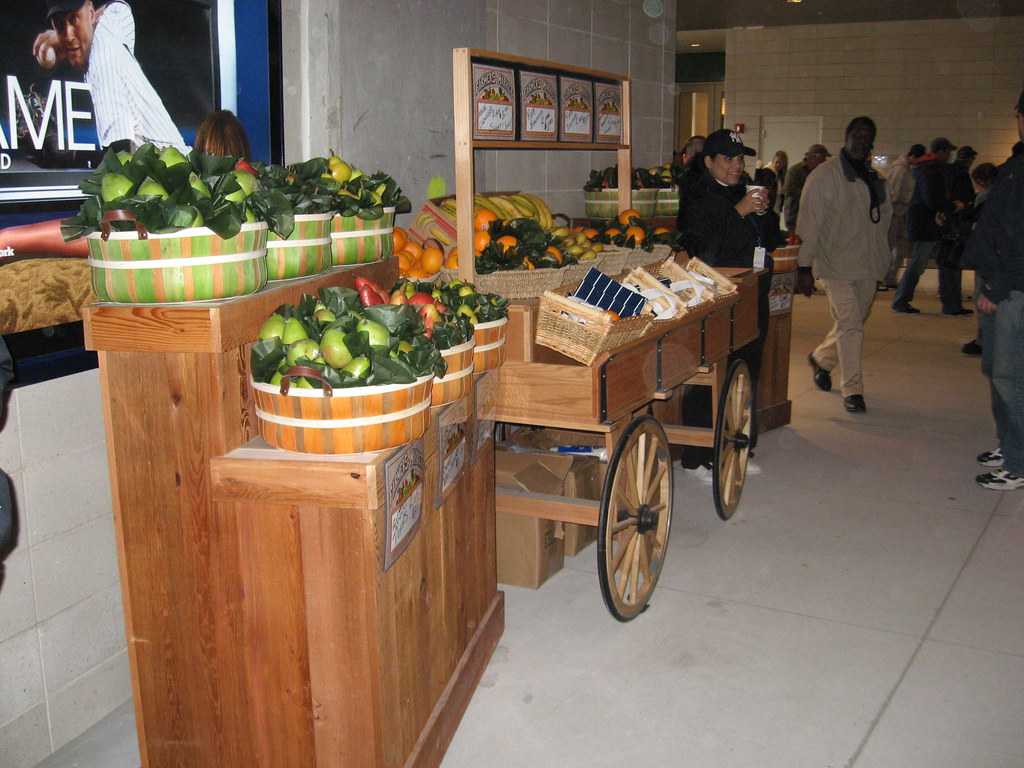
A fruit stand grows in the Bronx
ByThe Yankee Stadium Farmers Market on a cold April day. (Photo by Benjamin Kabak)
I first saw this odd fruit stand right inside Gate 4 at the new Yankee Stadium on a cold day in April, and it seemed fairly gimmicky to me. After all, bananas were two for $3, and both navel oranges and Anjou pears carried the same price tag. For nearly one-third the price, I could just grab a banana at the fruit store on the way to the subway before heading up to the game.
Yet, over the course of the season, these fruit stands have become quite successful, and yesterday, The Times’ Manny Fernandez explored the stadium fruit stand phenomenon. Apparently, fans turned off by the high prices — and more importantly, the high calorie counts — of the regular stadium fare are turning to the fruit stand for relief.
At Yankee Stadium this week, in the entrance hall just beyond Gate 4, the fruits were arranged in baskets and trays on a wooden pushcart and on two other displays. It is a place of only-in-New York moments: men and women, some in Yankee pinstripes, shorts and sneakers, some holding tall half-empty cups of beer, squeezing fruit and asking if the peaches were fresh.
Several customers said the stand was a pleasant surprise. In the third inning of a game on Tuesday against the Texas Rangers, Randy Ian Brandoff, 33, an executive at a private jet company, had trouble deciding between a nectarine and a peach, and walked away with one of each. A few minutes later, Ronnie and Carole Meyer, a retired couple from Bloomington, Minn., bought two bananas. “There’s too much greasy food,” said Mrs. Meyer, 64, adding that she and her husband would probably have bought popcorn had they not found the fruit stand.
Angela Mangels, 31, a health-conscious architect from Long Island, was not planning to eat anything at the stadium. “I don’t normally buy anything at ball fields,” she said. She bought two nectarines, an apple and a banana at the stand for $6.
As Fernandez relates, the fruit isn’t as local as one would prefer. The stand is run by a Los Angeles-based fruit importer and distributor, and the fruit is shipped in from Washington, California, Oregon and even New Zealand. “I’m thrilled that it’s there,” Michael Hurwitz, the head of New York’s very successful Greenmarket program, said. “I just think that there’s a great opportunity to support our regional economy and our regional growers, particularly in this economy. You could have New York State apples, you could have New York State peaches, you could have New York State pears.”
The company, Melissa’s Produce, defended its cross-country shipping by citing the weather. A spokesman said that fall may bring some local apples as well.
Meanwhile, the fruit stand sells around 200 pounds of produce a game, and even at a mark-up of nearly 300 percent in some cases, that’s still an impressive total. Who would have thought we’d see the day a fruit stand thrives inside a baseball stadium?


That’s pretty cool. I’d much rather eat 2 bananas and a couple apples than those garlic fries.
Tell me about it. Most of the stuff they sell in the stadium is stuff I won’t eat unless I have to. The Mets did a much better job with their food options, as Ben wrote about previously.
When dealing with large corporations like the Yanks, there are typically insurance/liability requirements that are mandated by those firms for obvious legal reasons. Many of the local farmers wouldn’t be able to meet those minimum standards.
Also, local produce has a much rougher, less polished look than the factory farmed stuff you see there and get in most supermarkets. I think the Yanks wanted an appealing stand, not rough looking stuff sold out of a cardboard box.
I frequent the Union Square market (and others) and love the overall idea and their produce. Its real food, sold by real people, as opposed to the stuff you get elsewhere. But I think criticizing the Yanks for using a more professional firm is both impractical and unreasonable. They’re not going to assume the liability themselves when other firms are lined up to take their place. And those local farmers in all likelihood wouldn’t put up the professional looking display you see above.
Nice piece Ben, and I’m going to make a point of visiting the stand next time I’m at the stadium. I just disagree with your criticisms.
Also, local produce has a much rougher, less polished look than the factory farmed stuff you see there and get in most supermarkets. I think the Yanks wanted an appealing stand, not rough looking stuff sold out of a cardboard box.
But it’s generally healthier, because it’s more perishable and less chemicalized (since it’s not traveling as far and expected to be consumed quicker).
We need to retrain consumers to stop buying apples based on how shiny they are and focus more on how healthy and tasty they are.
As somebody who’s been in the food biz for 20 years, I’ll just say ‘good luck’. What you’ve described is where my personal tastes tend to run, and I’ve tried to incorporate those items into my business many times and the stuff simply doesn’t sell. You can’t give people a speech each time before they buy a snack, they’ll just choose what ‘looks good’ to them. You can’t run a successful business giving people stuff they don’t like.
I agree, although I’m not an expert in farming. Can’t imagine NY apples, peaches, or pears are in season in April-May and Sept-Oct
The Artist: “When dealing with large corporations like the Yanks, there are typically insurance/liability requirements that are mandated by those firms for obvious legal reasons. Many of the local farmers wouldn’t be able to meet those minimum standards.”
I know nothing about insurance/liability issues that might be involved with the sale of produce at baseball stadiums, but a quick google search reveals that several stadiums do offer locally-grown produce, so apparently this is a viable option.
See: http://www.fmlink.com/ProfReso.....808-2.html: “Providing business opportunities to the local community can also have a positive impact on the environment. Several stadiums, such as Fenway Park, utilize locally-grown produce. This requires less shipping, uses a lower amount of energy and creates less pollution. Ballparks like Turner Field and Citizens Bank Park also offer organic options, which reduce the amount of synthetic pesticides and fertilizers released into the environment.”
The Artist: “And those local farmers in all likelihood wouldn’t put up the professional looking display you see above.”
Other concerns may be viable, but I think this is stretching it a bit. That display isn’t exactly a million-dollar endeavor, I’m pretty sure a nice display could/would be constructed if the Yankees were to contract with someone to sell locally-grown produce. The Yankees themselves or local produce companies could buy that kind of display, not to mention that going locally-grown doesn’t necessarily mean going to some tiny little company or collective. Companies like Whole Foods and Trader Joe’s sell locally-grown produce, don’t they? I mean, come on, it’s a couple of fruit-carts, it’s not like it’s some irreplaceable work of art.
If consumers in those markets demand those products, then that’s great and I’m not criticizing them. I’m just saying that the Yanks did nothing wrong here. A fruit stand alone was so unusual that Ben wrote two pieces on them. An organic fruit stand would be even more unusual, and deal with a market that would be even smaller.
If I was the Yanks, I would have made the same choice. If this stand is a success, maybe they expand the options down the road.
Yeah… Look, like I said, I don’t have experience in the foodstuffs area, and I agree with you and everyone else, it’s great that the Yanks even offer this option, whether it’s locally-grown or not. I just think they probably could go with locally-grown produce if they want, and I thought a couple of your supporting arguments were kind of stretches.
As far as how attractive those products are to consumers, isn’t there a pretty persuasive argument that posting a sign stating “organic” or “locally-grown” over the product effectively counters any appearance deficiencies (i.e. shine or size/shape of fruit)? That type of product sells, and sells at higher prices, than do mass-produced, non-local or non-organic products, no?
“If I was the Yanks, I would have made the same choice. If this stand is a success, maybe they expand the options down the road.”
Agreed. Either way, good for the Yankees for offering this option.
This conversation is way over, but I just read something relevant and I just wanted to post it in a comment here for the sake of posterity.
http://newyork.grubstreet.com/.....1;20090831
It’s a trick!!! The Evil Empire just wants you to have options, so you’ll enjoy yourself and come back…getting even more money and more fans so they can continue to buy big name players like Jeter!!!
Unlike Andrew I am a garlic cheese fries guy, but I love the fact they’re providing options–reasonably priced I think. That guy getting four pieces for $6 at an airport would be fair, so at YSIII I think it’s fair too.
Hope the ‘local’ complaints don’t drag it down.
“I’m thrilled that it’s there,” Michael Hurwitz, the head of New York’s very successful Greenmarket program, said. “I just think that there’s a great opportunity to support our regional economy and our regional growers, particularly in this economy. You could have New York State apples, you could have New York State peaches, you could have New York State pears.”
Agreed. Might I suggest:
http://www.treehugger.com/file.....otment.php
or
http://www.nytimes.com/2008/05.....wanted=all
Those articles are always interesting, but why are they obligated to point out they’re not white people?
Any chance of me visiting the fruit stand is demolished by the presence of the Carl’s Philly Cheesesteak stand.