Archive for Death by Bullpen

Aug
31

Joe Girardi & Restraint

Posted by: | Comments (46)

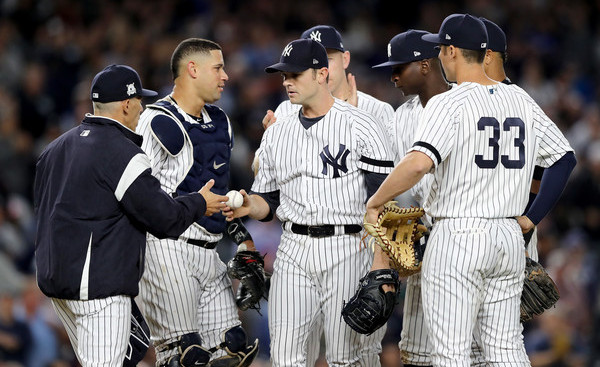
Deceiving top picture is deceiving. (Elsa/Getty Images)

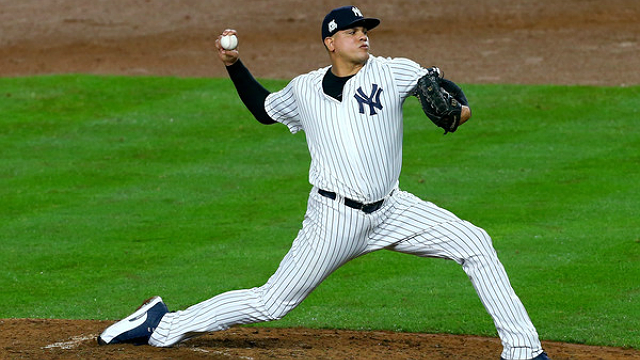
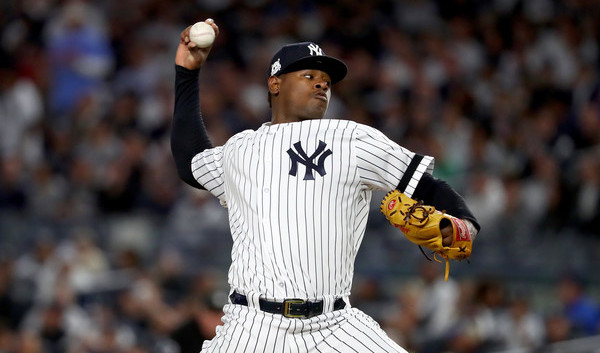
On the surface, a 5-2 win doesn’t seem like anything out of the ordinary. Three-run leads are pretty substantial, even against a great lineup like the one the Red Sox ran out there. Of course the game never felt like the three-run lead was all that significant, mostly because the Sox had runners on base pretty much all night. Ultimately, the relief quartet of Cory Wade, Boone Logan, Rafael Soriano, and Mariano Rivera got the final nine outs to preserve the lead, but it’s what Joe Girardi didn’t do that’s worth talking about.

After throwing 18 pitches on Sunday and 19 pitches on Saturday, David Robertson was unavailable out of the bullpen last night according to Girardi. Those pitch totals aren’t extreme by any means, so in all likelihood Robertson could have actually pitched without it being too big of a deal. He might not have been able to go more than an inning, but pitching three straight days isn’t exactly unheard of. Instead, Girardi showed some restraint and rested one of, if not the best setup reliever in all of baseball. He gave the ball to inferior pitchers against a great lineup in a relatively close game.

Now, it’s easy to back off a key reliever in a generic August game, when you’re facing some middling fringe contender in a game everyone will forget by the morning. It’s another thing to do it in a game like last night’s. Consider…

  1. It’s the Red Sox!
  2. The Yankees had won just two of twelve against Boston coming into the game.
  3. CC Sabathia hadn’t beaten the Sox all year and just gutting out 128 pitches in six innings.
  4. First place was kinda sorta on the line. It was either tie things up or fall two back in the loss column.
  5. It’s the Red Sox!

It wasn’t a must win game, but it was definitely a pretty big game considering how the season series has played out so far. Girardi could have easily handed the ball to Robertson in the eighth inning and I don’t think any of us would have had a problem with it. Instead, he took his foot off the gas and looked at the big picture, which is something he’s done during his entire tenure as Yankees’ manager. We can quibble about individual moves until we turn blue in the face, but Girardi’s overall bullpen management is clearly a strength, and games like last night are reason why Robertson will be fresh and (theoretically) more effective later in the season and potentially into the playoffs.

Categories : Death by Bullpen
Comments (46)
Aug
30

Losing Al Aceves

Posted by: | Comments (43)

Photo credit: Jim Mone/AP

The bullpen was not in great shape. Brian Bruney had been lights out, but he’d also gotten hurt. Jose Veras, who showed plenty of potential in the second half of 2008, had an aversion to leaving men on base. Damaso Marte couldn’t keep the ball in the park. Edwar Ramirez‘s changeup magic had worn off. All told it added up to a horrific month for the Yankees bullpen: a 6.46 ERA, 5.41 FIP, and 4.53 xFIP through the first month of 2009. If that team was going to contend it had to improve the bullpen. With one move at the end of April it accomplished just that.

On May 4th, after the Red Sox knocked around Phil Hughes for four runs in four innings, Alfredo Aceves made his season debut. He had made his major league debut just a few months earlier, in August of 2008, and he had thrown a quality 30 innings by season’s end. The peripherals weren’t pretty — 3 BB/9, 1.2 HR/9 and just 4.8 K/9 — but the results impressed. Since the Yankees had a full rotation and bullpen to start the 2009 season he started in Scranton, but he was sure to take the shuttle at first opportunity. The poor bullpen provided that opportunity, and Aceves quickly filled the void.

His appearance against the Red Sox was good, not great, though he did manage to strike out seven in 4.1 innings. During his next few appearances he began to earn Joe Girardi‘s trust. He finished two straight games during Walkoff Weekend against Minnesota. He pitched two innings, three innings — whatever it took. He even threw four innings in relief of an ineffective Joba Chamberlain on July 5th, earning a save in the process. While he did hit a few rough patches later in the year, he was generally among the Yankees’ most effective relievers that year. His presence helped the Yankees go from worst bullpen in April to one of the best by season’s end.

During the 2009 season Aceves experienced back issues. They cropped up in late July, and bothered him through his rough patch in August. He stayed mostly healthy that year, though, but in 2010 he finally succumbed. While delivering a pitch against the Red Sox he aggravated his back and left the game. Reports of his rehab and recovery persisted throughout the season, but every time he got close he suffered another setback. But hey, he’s a pitcher and that kind of thing happens. Best to move on and try again next season, right?

There was no indication of what came next. Maybe it had to do with how he approached his rehab. Maybe there were unreleased details regarding the bike accident that broke his collar bone during the off-season. For whatever reason, the Yankees decided to not tender Aceves a contract this past off-season. It came as something of a shock, given how effective he’d been when healthy and how relatively little he’d cost. It’s not often that you see a player who makes less than a million dollars non-tendered.

Making matters worse, the Red Sox ended up signing Aceves later in the off-season. Things got worse still when Aceves went through a normal spring training and appeared perfectly ready to start the 2011 season. Rock bottom has come recently, as Aceves has been a key member of the Red Sox bullpen. In August he’s been at his best, allowing just two runs while striking out 18 and walking five in 14.2 innings. As a reliever this year he has a 2.15 ERA in 67 innings, holding opponents to a .190/.259/.326 line. It’s one reason that Boston’s bullpen has overcome the question marks it faced earlier in the season.

The Yankees aren’t necessarily missing Aceves’s presence in the bullpen. They rank third in the majors with a 3.02 ERA, and fourth with a 3.30 FIP (just a single point behind the Red Sox). They have their late innings covered by David Robertson and Rafael Soriano, and they have a band of other relievers who have stepped up and have pitched exceedingly well in their roles. In fact, if the Yankees had kept Aceves they might have missed out on one of their most effective relievers this season.

Cory Wade did not start the season in the Yankees’ farm system. In the off-season he signed a minor league deal with Tampa, but they did not recall him by his opt-out date. The Yankees, shorthanded in the bullpen after injuries to Soriano and Chamberlain, scooped him up and added him to the major league roster. In 28.1 innings he’s shown good stuff, resulting in a 2.22 ERA. He’s had the peripherals to go with it, too, a 3.43 FIP and 3.49 xFIP despite a below average strikeout rate. Aceves’s numbers line up comparably: 2.15 ERA, 3.80 FIP, and 4.27 xFIP as a reliever. With those numbers in mind, Wade just might be the better option in 2011. Yet if the Yankees had kept Aceves they might never have discovered this hidden gem. Maybe he would be the one helping Boston’s bullpen currently.

Losing Al Aceves was sad at the time, given all he had contributed in 2009. It hurt plenty when the Red Sox signed him, and hurt even worse when he started to help their bullpen. But it wasn’t all bad for the Yankees. They have one of the best bullpens in the league. Not only that, they discovered one of their most effective relievers at a time when they might not have, had Aceves been on the roster. This doesn’t excuse the Yankees’ decision; they refused to pay Aceves half a million, yet spent $8 million on Pedro Feliciano. But there is a silver lining in this. If they can knock around Aceves in this series, well, maybe the issue will finally lay at rest.

Categories : Death by Bullpen
Comments (43)
Aug
16

The Ever-Changing Bullpen

Posted by: | Comments (28)

Uh, David. Whatever you do, do not turn around. (AP Photo/Eric Gay)

One of the best and worst things about baseball is that almost nothing goes according to plan. Not in a single game, not in a typical three-game series, and certainly not over the course of a full season. Players perform in a way other than expected (for better or for worse), guys get hurt, players get traded, all sorts of stuff happens. No roster entity is more volatile than the bullpen, which is basically just a collection of guys working from one small sample to the next.

When the season started, Mariano Rivera was being setup by Eighth Inning Guy™ Rafael Soriano and Joba Chamberlain in the seventh. David Robertson was the world’s most overqualified sixth inning reliever, Boone Logan the shaky lefty specialist, Luis Ayala the extra guy, and Bartolo Colon the long man. Phil Hughes‘ suckiness and shoulder issues forced Colon into the rotation and brought a cache of spare part relievers to the Bronx: Lance Pendleton, Amaury Sanit, Buddy Carlyle … all made appearances at one time or another. Ayala’s injury brought Hector Noesi into the fold.

Because of Soriano’s early season ineffectiveness and eventual injury, Joba and Robertson moved up a rung on the bullpen totem pole. Both performed well, very well in fact, then all of a sudden Joba was down for a count with a torn elbow ligament that required season-ending Tommy John surgery. In the span of three weeks, the Yankees lost their two primary setup guys. Given the importance the team (or at least Joe Girardi) seems to place on these stupid bullpen inning assignments, you’d think the Yankees were headed for certain doom, but nope.

Robertson, even when Soriano and Joba were healthy, had developed into the best reliever in the American League (leads the league in fWAR), a legitimate All-Star with the second highest strikeout rate in baseball at 13.59 K/9 (min. 40 IP, second only to Craig Kimbrel’s 14.11 K/9) and one of the lowest batting averages against (.179). His walk rate continues to improve as well, and is gradually approaching normalcy…

Since June 5th, the date of Joba’s last appearance, Robertson has walked a total of seven batters unintentionally in 24.1 IP. That’s a 2.59 uIBB/9. He’s walked a batter in only five of those 25 appearances as well, so he’s certainly gotten that part of his game under control. Robertson’s been amazing, but he’s only part of the story because of the rest of the bullpen fell into place behind him.

The Carlyles and Sanits and Pendletons of the world were replaced with Cory Wade, who’s been so effective for the Yankees that both myself and Hannah wrote about him recently. Boone Logan has turned things around since a mid-June series in Cincinnati, improvement that has more to do with him dropping his arm slot just a bit (check out the release points) to get some more bite on his slider than it does some pep talk with Alex Rodriguez. Ayala is the “only in an emergency, last arm in the bullpen” kinda guy, and Noesi is the de facto long reliever. He should be starting in the minors, but that’s another post for another time. Oh, and Soriano’s back from his injury and pitching well, and has assumed seventh inning duties now. He’s the Seventh Inning Guy™ now.

Other than the closer in the ninth inning, I hate the whole concept of assigning relievers to specific innings because the manager manages the game to arbitrary endpoints (why are outs 22-24 any different than 19-21?). I hope that at some point Soriano pitches well enough to take back the eighth inning, freeing up Girardi to be a little more liberal with his use of Robertson. Having him start an inning fresh with no outs and no one on base is pretty much a waste given his propensity to pitch out of jams. I think this is another post for another time as well, so let’s leave it at that.

Anyway, the moral of the story is that once again, the bullpen is a dynamic entity over the course of a 162-game season, changing as needed to accommodate injury, poor performance, etc. Only three relievers (Robertson, Mo, and Logan) have spent the entire season on the active roster, everyone else (a total of 12 others relievers) has been either hurt, demoted, released, or all of the above. The Yankees started the year with a set formula, and now it’s entirely different and probably even more effective than originally expected.

Categories : Death by Bullpen
Comments (28)
Aug
14

The Forgotten Reliever

Posted by: | Comments (14)

Jeter, Teixeira...... Wade, Nunez. (copyright Amanda Rykoff)

There are lots of cool things about Yankees pitching, AJ Burnett’s terrible hair notwithstanding. Mariano Rivera. Bartolo Colon. CC Sabathia. But you know what? These are all pretty big names in the scale of baseball, and especially when talking about general Yankee successes. When you consider the good fortune that Yankees pitching has had so far, there also needs to be some consideration given to some slightly smaller pitching names as well. I’m not even talking about strikeout/leverage machine (and 2011 All-Star) David Robertson or never-a-top-100 prospect (but 10-game winner) Ivan Nova.

How about Cory Wade? On the scale of successful ballplayers on the Yankees that no one talks about, he’s gotta be up at the top or near it. Wade was drafted in the 10th round by the Dodgers in 2004 and pitched a full reliever’s season in 2008 in the bigs, posting a pretty 2.27 ERA in 71 IP. However, after a slightly less impressive 2009, he spent the year bouncing between the Dodgers (where he posted a 5.53 ERA in 27.2 IP) and AAA Albuquerque. He was granted free agency after that and signed with the Tampa Bay Rays in November of last year, then was assigned to AAA Durham. There, he worked in relief, posting a sparkling 1.23 ERA and a pretty nice 3.34 FIP, to go alone with a K/BB ratio over 5. He did all of this in about 40 innings, and then used a clause in his contract to opt out on July 11th. This is where it gets good.

Let me set the scene for you. Rafael Soriano has just gone on the DL with elbow soreness and is not expected back until the All-Star Break. Joba Chamberlain has just gone on the DL two days before, with a strained flexor. Currently taking their places are the ever famous Jeff Marquez (minor league ERA: 3.97, FIP: 4.37) who has just been claimed off waivers from the White Sox, and Amauri Sanit (ERA: 5.21, FIP: 4.73) from AAA. Meanwhile, you are Brian Cashman, and your arch-enemies, the Rays, have just released a really good reliever from their system. That’s exactly what you need! Excellent! The Yankees signed Wade two days later, had him pitch 1.2 innings in SWB and then called him up to the big leagues.

Since then, Wade’s been nothing short of awesome. He’s a perfectly solid middle-reliever and has handled both high-leverage situations and garbage time equally well. In fact, out of his 21 appearances, he’s only posted a negative WPA in 4 of them, and has gone 2-0. His other numbers are similarly impressive, albeit the small sample of only 23.1 IP is worth nothing: 2.31 ERA, 3.09 FIP, 3.32 xFIP, 6 ER, 18 Ks. His 1.5 BB/9 and 6.9 K/9 are good for a healthy 4.5 K/BB ratio. His 79.2 LOB% is a bit high, but certainly within reason, and his .254 BABIP is the highest he’s ever had. 40.6% groundballs contributes.

Part of it is mental: as a Yankees fan, I feel comfortable watching Cory Wade pitch the sixth or the seventh in a one-run game. I feel like he is a safe guy to give the ball to despite the fact that I’ve never heard his name before this. But part of it is in the numbers: those are legitimately strong stats. He’s racked up about half a win in fWAR, which is nice to have in only 23 innings. He’s given up only six earned runs in that span. Plus, he’s not yet valuable enough to where Girardi is considering him a one-inning guy only: he’s had three outings where he threw two innings, and one more outing when he threw three. He also isn’t constrained to a particular role, such as an eight-inning guy or a closer. In a way, his namelessness contributes even more to his success.

As has been mentioned before, the Yankees have been extremely successful and extremely lucky when it comes to pitching this year, and this makes for endless words for us bloggers looking for something to talk about. As the season winds down, we’ll see more and more of how these players shape up come September and eventual October/playoff baseball. Cool thing is, your name doesn’t have any correlation to have could you can be. Throw strikes, get batters out, win. It all works the same no matter who you are: Mariano, Sabathia, or a castoff from the Rays.

(Yankees Baseball Daily helped me think this up. Check it out.)

Categories : Death by Bullpen
Comments (14)
Aug
08

Cory Wade, Secret Weapon

Posted by: | Comments (34)

(Elsa/Getty Images)

It’s the same story every year. The Yankees start the season with a collection of seven relievers, and inevitably some guys are ineffective and/or get hurt. By the end of the season the bullpen corps looks a lot different than it did in April. Joba Chamberlain threw just 28.2 IP before Tommy John surgery ended his season, and Rafael Soriano threw just 15 IP before landing on the DL with a less severe elbow injury. Luis Ayala spent some time on the DL, and Bartolo Colon went from long-man to number two starter.

Through the first 113 games of the season, the Yankees have cycled through miscellaneous relievers like Buddy Carlyle, Amaury Sanit, Steve Garrison, Kevin Whelan, Jeff Marquez, Sergio Mitre, and Lance Pendleton, but only one has really impressed: Cory Wade. Signed to a minor league deal back in June, Wade surfaced with the big league team soon thereafter and gained Joe Girardi‘s trust in short order. He retired the first eleven men he faced as a Yankee, including six as part of two perfect innings in his second appearance, in extra innings against the Rangers.

Wade’s effectiveness has kept him around longer than the Carlyles and Sanits and Whelans of the world, and he’s turned into a bit of a secret weapon out of the bullpen during the second half. Consider that …

… he’s the new fireman.

In four of his last six appearances (including the last three), Wade has entered the game with at least one man in scoring position and often multiple runners on base. He’s allowed just one of the eight runners he’s inherited in that time to score, and on the season he’s stranded ten of the 11 runs he’s inherited. Wade’s a good fit for that role because he gets ahead of hitters (66.2% first pitch strikes, better than the 59.2% league average) and misses bats (9.6% swings and misses), plus he has a small (reverse) platoon split both this year and for his career. He’s not just a matchup guy. Injuries and hyper-effectiveness have moved David Robertson into a more prominent late-inning role, but Wade has quietly stepped in as Joe Girardi’s get-out-of-jams specialist.

… he’s the relief version of Freddy Garcia.

Like last night’s starter, Wade will lull hitters to sleep with his offspeed stuff because he has a below-average fastball. He’s thrown his heater (which has averaged 88.7 mph this year) just 44.6% of the time this season, instead relying on his low-80′s changeup and high-70′s curveball to do most of the work. We’ve also seen him drop his arm slot to throw a slider. It’s not the greatest arsenal in the world, but it works because Wade doesn’t have to go through the lineup multiple times. Unpredictability is a great thing, especially in short bursts.

… he’s flexible.

The Yankees have the ability to keep Wade around for a while should he continue to perform. The Dodgers non-tendered him after last season because he was having some injury problems, but Wade won’t be eligible for arbitration until after next season. That means he’s under team control for dirt cheap through 2015. As far as I can tell, he also has a minor league option remaining. That last part is unofficial though, so don’t hold me to it. Either way, Wade also gives the Yankees some roster flexibility for the bullpen.

* * *

Middle relievers tend to have very short shelf lives, even good ones. Wade has done a bang-up job for the Yankees so far, but it is only 20 IP and he’s a long way from establishing himself as a bullpen stalwart. For now, the Yankees will enjoy his unexpected production, using him to bridge the gap between the starters and Robertson/Soriano in the late innings.

Categories : Death by Bullpen
Comments (34)
Jul
20

Using Boone Logan properly

Posted by: | Comments (60)

(AP Photo/Paul Sancya)

Last night Boone Logan did part of his job, the big part of his job, well. He came into a high-leverage situation and got what should have been a bunch of outs, but thanks to the stadium, and his own poor reaction time, the Rays squeaked across two runs and took the lead. Logan was clearly responsible for the botched comebacker, though he did induce poor contact on the play. In terms of pure pitching, though, there are no complaints, despite him facing two right-handed batters.

Logan vs. righties

It’s no secret that Logan, like most lefty relievers, is more effective against same-handed batters. He has faced 448 lefties in his career and has held them to a .249/.324/.364 line, while righties have hit .313/.390/.486 against him. While there are certain lefty relievers, such as the Cubs’ Sean Marshall, who can handle full innings of work, Logan, with nearly 200 innings of career work, has clearly defined himself as a left-hand only kinda guy. Why, then, was he facing right-handed hitters?

No platoon advantage

There is a surefire way for managers to make his opponent pay for bringing in a LOOGY. Since the rules dictate that any pitcher brought into the game must face at least one batter, the manager can pinch-hit for his lefty, thus turning the platoon advantage in his favor. Joe Maddon did just that last night, not only with Sam Fuld, but also with the next batter due up, Reid Brignac. In fact, it was an utterly predictable move. Neither Fuld nor Brignac is a good hitter, and Maddon has been known to maneuver like this in the past.

With two weak hitters due up, why didn’t Girardi go to Cory Wade instead? He wouldn’t provide a platoon advantage, but he doesn’t have a significant career lefty/rigthy split. Girardi could have used him against the two lefties and then saved Logan for Johnny Damon, who is a far greater threat than the two batters before him. That makes enough sense, and it very well might have been the right move. But it certainly wasn’t the only move.

LOOGYs facing righties

Girardi knew that Maddon’s bench was bare. When Logan was announced, Maddon sent up Justin Ruggiano, a 29-year-old with a career .233/.269/.381 line. In place of Brignac he sent up Elliot Johnson, a career .194/.252/.317 hitter. So while he negated the lefty-lefty matchup, he also sent up two horrible hitters. Even someone like Logan should be able to retire these guys (which he essentially did). It’s not as though it were Evan Longoria up there.

Because of the one-batter minimum, this is a situation LOOGYs face often. They’ll come into the game set to face a lefty, and the opposing manager will pinch-hit. But, because he’s pinch hitting from his bench, chances are the replacement is not as good as the original hitter. A good manager will consider his opponent’s bench before bringing in a LOOGY, to make certain that he’s not running into a regular starter who had the night off. I can’t say for certain that Girardi did that, but I’d bet that he did.

It is part of a LOOGY’s job, then, to face right-handed bench players. It’s unreasonable to ask them to face righties and switch batters who normally hit near the middle of the order. That’s asking for trouble. But I find it difficult to complain when the opposing manager gains the platoon advantage by pinch-hitting two guys who have terrible MLB track records. A LOOGY has to be able to retire guys like that. And, again, Logan essentially did.

Using Logan against righties

If pitchers like Logan have to face righties, they might as well face slap-hitting righties with poor MLB track records. That’s exactly what Logan faced last night. In fact, it appears that’s the type of righty he’s faced for the most part this year. Despite his pitching in a few mop-up situations, he’s still faced just 39 righties to 68 lefties, and has held them to a .200/.272/.200 line. That is, he’s allowed zero extra base hits and only seven hits overall to right-handed hitters.

His success is largely a product of luck; he’s shown an inability in the past to retire righties, and we shouldn’t think that just because he’s fared well in these 39 instances that he’s all the sudden cured. But as I look at Logan’s play log I see a bunch of poor-hitting righties: Derrek Lee, Mike McCoy, Yorvit Torrealba, Franklin Gutierrez, Orlando Cabrera, and Aaron Hill. Most of the better righties he’s faced, such as Kevin Youkilis and Miguel Cabrera, have come during garbage time, when the Yanks were either up or down big.

It’s certainly possible, then, that Girardi is putting Logan in a position to succeed. Again, he’s faced just 39 righties this year in 107 total chances, or 37 percent. Last year it was 78 of 169, or 46 percent. You can learn a lot about a guy in a year, and it appears that Girardi has learned not only to limit his usage against righties, but also limit it to poor-hitting righties.

While in an ideal world Logan would never face a righty, it’s simply a reality of the game. Thankfully, Girardi has placed him in situations this year that favor him. When he does face a righty, it is, for the most part, a poor hitting one. When he faces a quality one, it has come in mop-up duty. Last night was a further example of that. The Yanks lost the lead, due in no small part to Logan’s poor reaction time, but he did pitch well against light-hitting righties. It’s something that can be expected of him, even as a LOOGY.

Categories : Death by Bullpen
Comments (60)

For the final installment of our mid-season review, we’ll turn to the bullpen. It’s far tougher to compare the relievers to their peers on an individual level, since there are 139 qualified relievers and likely many more when we set the bar lower to include LOOGYs and the like. There are often only granular difference between relievers as well, making it harder to rank them on that list of 139. Really, only Craig Kimbrel, at 2.0 WAR, stands out from the pack. But the Yankees have a few guys at the top of the list, so let’s take a look at them, and then look at the bullpen as a hole.

Mariano Rivera

(Tony Gutierrez/AP)

He might be 41, but that didn’t stop Rivera from commanding a two-year contract this winter. He’s shown few, if any, signs of slowing down lately. It seems that every year since about 2007 he’s had a few more small injuries than in the past, but that doesn’t stop him from pitching between 60 and 70 innings while leaving the competition beholden. This year he’s getting it done in typical Mariano fashion.

ERA: 1.85, 14th. He might have blown a few saves this year, but overall he’s held opponents mostly scoreless. This is right around the range of his ERA from the past few seasons, too, which is all the more encouraging.

FIP: 2.08, 7th. This is a surprise, because Rivera defies FIP. He is one of the rare pitchers who can always limit his BABIP, since opponents consistently make poor contact. But this year his BABIP is .295, which is a good 30 points above his career average, and about 70 points higher than last year. STill, he’s managed to keep his walks way down and the ball in the park, which goes a long way.

WAR: 1.3, 5th. Even with just 34 innings, Rivera has still provided immense value. Remember, leverage gets factored into WAR for relievers, so that’s where he gets much of his edge. Yet, he hasn’t been the best relief pitcher on the Yankees this year. That would be…

David Robertson

Photo credit: Paul Sancya/AP

For the past few years Robertson has established himself as a mainstay in the bullpen. He might walk a few too many batters, but he has a knack for figuring out how to get a strikeout when he needs one the most. Then again, he just gets a lot of strikeouts in general. All in all, as you’ll see, he’s been the most valuable member of the Yankees bullpen this season.

ERA: 1.27, 4th. Robertson might put men on base with frequency — he does have a 5.86 BB/9 — but he doesn’t typically let them come around to score. His strikeouts help fuel his superb ERA.

FIP: 1.74, 3rd. Typically we see FIP favor those who don’t allow many walks. How, then, has Robertson managed the third lowest FIP in the league, with 20 points separating him and the 4th ranked reliever? By not allowing homers. As in, any. Guys just aren’t making good contact off him this year, and it has made him all the more valuable. I can only wonder, though, if it’s sustainable throughout the whole season.

WAR: 1.4, 3rd. As with Rivera, this is all the more impressive because of his low innings total. While it might seem like he warms up in every game and gets into every other, he has just 35.1 innings this year. That’s 20 fewer than Jonny Venters, who is in 2nd with a 1.4 WAR (he wins on fractions). Robertson has been an absolute revelation this year. It goes to show that the Yankees didn’t necessarily need a bridge to Mo in the form of an 8th inning man. They just needed someone who could get big strikeouts in big spots.

The bullpen as a whole

There have been plenty of other top performers in the bullpen, and they’ve added up to one of the better units in the league. Best of all, as we saw in this morning’s starting pitching post, they haven’t had to work overly hard, either.

ERA: 3.11, 5th. Thanks to unexpected contributions from guys such as Luis Ayala and Cory Wade, the Yankees have kept their bullpen ERA low. As we discussed this morning, that likely has something to do with the above average defense. But that shouldn’t take away from what they’ve accomplished.

FIP: 3.44, 7th. Even when we remove fielders from the equation, the bullpen has done a fine job in its own right. Perhaps not quite as well as the ERA indicates, but it’s still good nonetheless. The could stand to walk fewer batters as a group, but then again a lot of that is directly attributable to Robertson.

WAR: 3.5, 4th. It’s tough not to love this ranking, especially given where the starting pitchers grade out. They’re sopping up tons of innings, and the bullpen has done a great job filling in the rest. Even better, they’ll stand to improve greatly if Rafael Soriano comes back as something resembling even his 2009 self. A lefty might be an area of nominal need, but really the Yankees have everything they need with the current bullpen.

Categories : Death by Bullpen
Comments (21)
Jul
13

The Boras Double Standard

Posted by: | Comments (15)

Scott Boras, on Francisco Rodriguez: “Closers don’t make good setup men. Does anyone want an unhappy setup man in their clubhouse?”

Yup.

Categories : Death by Bullpen
Comments (15)
Jul
07

The bullpen is currently bare

Posted by: | Comments (41)

Steak goes on the Meat Tray, and the Meat Tray should probably stay in the bullpen. (From Flickr user dulouz cats via Creative Commons license.)

The biggest complaint last night was not about Phil Hughes‘s shaky first. It wasn’t about his inability to put away batters, nor his lack of a clean inning. In fact, it had little to do with Hughes at all. Running through the comments on the game recap and on other social outlets, such as Facebook and Twitter, the biggest complaint was the mere presence of Sergio Mitre. That has something to do with Hughes, since he only pitched five innings and forced the bullpen to enter the game early. But everyone seems willing to overlook that and heap the blame on Mitre, whose disastrous inning proved to be the difference* in last night’s game.

If you don’t believe in the fallacy of the predetermined outcome, that is.

Having Mitre in the game was surely a problem, but given the situation and roster composition it’s hard to argue with his presence. Take a gander at the 40-man roster and see if there are any better alternatives. The only pitchers who aren’t in the majors have something that makes them something of a worse choice than Mitre. They have:

Dellin Betances: It’s pretty clear why he’s not in the MLB bullpen.

Andrew Brackman: He hasn’t transitioned well to the AAA bullpen, so AA is a greater possibility than the majors.

Steve Garrison: He’s currently getting shellacked at AA. He throws with his left arm, so if the Yanks thought he could help in the pen he likely would have been up at some point during this big bullpen shuffle. An early season injury has cost him, and his last start skews his numbers a bit.

Brian Gordon: He certainly could be helping the Yanks out of the bullpen right now, but it’s understandable why they have him working as a starter in the minors. We’ve already seen this season how important pitching depth can be.

Ivan Nova: Same deal as Gordon. He’d probably work very well in the bullpen, when he could focus on his fastball and curveball. But his best starts this year have come when he mixes all four of his pitches, so it’s probably best at this point to have him continue doing that in the minors. They’ll need him for a start sooner or later, anyway.

Pants Lendleton: He’s only two years younger than Mitre, and I have a hard time making a case that he’s as good.

Ryan Pope: Dude just got demoted to AA from AAA, so he’s far removed from the issue at this point.

Kevin Whelan: He’s on the seven-day disabled list in AAA.

Perhaps at a point later in the season we’d see Nova or Gordon taking Mitre’s spot. But for now, with nearly three months of baseball left to play, preserving starting pitching depth takes a slight precedence over the bullpen. That’s probably the biggest reason why Mitre is on the roster right now.

Regarding the complaints that he should not have been the one to enter the game, I find it hard to disagree. The Yankees had other options at that point, and a 3-0 lead is far from insurmountable, especially with the A lineup. Girardi could have gone to Cory Wade, who didn’t pitch in Tuesday’s game, or Hector Noesi, who hasn’t pitched since Sunday (and threw just two pitches in that game). Maybe Girardi didn’t want to use Wade, since Cleveland hit him around on Monday. I don’t quite buy that, but it’s not enough to raise a stink. But when it’s combined with the non-use of Noesi — he’s pitched just 6.2 innings since mopping up for Freddy Garcia against Boston in early June — it becomes an issue. There is little reason to trust Mitre over Nova, especially in a game that the Yanks can still salvage.

The hand wringing is likely for naught, as the Indians did have a strong hold on the game. Even if Noesi or Wade had entered the game in the eighth and held the Indians scoreless, the Yanks would have faced Chris Perez to open the ninth. He’s been good this season, but has a propensity to walk guys and doesn’t strikeout many (at least this year). But he shut down the Yanks immediately upon entering the game, and I imagine, since he’s done it most of the season, that he would have held down the top of the order at the start. And so that three-run rally might not have even gotten off the ground if Mitre didn’t allow those two runs in the eighth.

For the time being Sergio Mitre is the unfortunate product of the Yankees bullpen situation. Three of the seven guys they’d counted on to start the season are on the 60-day DL, and two aren’t coming back this season. That means the Yanks have some mixing and matching to do, and Mitre gives them just one more option. He’ll be gone soon enough, as the Yankees shop at the deadline and perhaps get Rafael Soriano back. We can gripe in the interim, and rightfully so. But until the Yankees make an acquisition or get back a pitcher from the DL, he’s going to be sitting in the bullpen and sometimes agitating us with his presence.

Categories : Death by Bullpen
Comments (41)
Jul
04

Mariano Rivera’s Road Woes

Posted by: | Comments (10)

Mariano Rivera blew his fourth save of the season yesterday, nearly as many as he blew last year (five) and more than he blew in 2008 and 2009 combined (three). All four blown saves have come on the road and three of the four have been one-run leads, the other a two-run lead. Unsurprisingly, Rivera’s home/road splits are pretty drastic this season…

Of course stats like ERA and opponent’s AVG/OBP/SLG don’t tell the whole story. Those are output stats, they just tell us about the results and not what led to them. The process is what is really important, and Rivera’s underlying performance shows us there’s nothing to be concerned about…

The sample size is essentially the same in terms of batters faced, and Mo’s strikeout and walk numbers on the road are for all intents and purposes identical to his career numbers (8.21 K/9 and 1.80 uIBB/9). His ground ball rate is right in line with his rate since 2002 (53.4%), when the data started being recorded. The only significant difference between his home and road performance this year is the number of balls that are dropping in for hits, an astronomically high 43.9% away from Yankee Stadium. That’s almost 18% higher than his career average.

Furthermore, let’s look a little deeper at those four blown saves. Other than the first one against the Blue Jays on April 19th (a legit blown save that featured a double into the gap and some hard-hit singles), they were all of the death by a thousand cuts variety. The ninth inning on April 24th went walk, strikeout, strikeout, bloop single, ground ball past a diving Mark Teixeira into the corner for a double. The tying run scored but the second runner was thrown at the plate by several steps. One hard hit ball, and it was beat into the ground.

The May 18th blown save went ground ball out, single up the middle, single on a ground ball through the right side, sacrifice fly to tie, pop-out to end the inning. And then there was yesterday, which went strikeout, ground ball out, walk, single off the handle of the bat, single on a ground ball through the right side, ground ball through the shortstop’s legs, runner out at the plate. If Mo was giving up rockets all over the field and balls over the fence, I’d be concerned. Right now it’s just a case of sample size and dumb luck with ground balls having eyes more than anything.

It’s worth noting that Rivera’s trademark cutter is completely unchanged this year. The velocity is the same as it’s been over the last few seasons, comfortably in the low-90′s, and the pitch is still getting three-plus inches of horizontal break and just north of five inches of vertical “drop.” Batters are swinging and missing at Mo’s cutter 7.8% of the time this season after whiffing at it 8.0% of the time over the last two years. There are no red flags here, so don’t bother worrying.

Categories : Death by Bullpen
Comments (10)