Archive for Defense
Shifting against Adrian
Posted by: | CommentsAlthough he has yet to sign a long-term contract extension, it’s pretty much a foregone conclusion that Adrian Gonzalez will be a Boston Red Sox (Sock?) for a very long time. That’s bad news for Yankees fans, because we’re going to be stuck seeing one of the game’s very best hitters 18+ times a year for the better part of the next decade. I don’t think he’ll be the next David Ortiz (a.k.a. a stone-cold Yankees killer), but I don’t think anyone would be surprised if he turns into that guy.
Gonzalez has a reputation as an opposite field hitter and deservedly so. He’s hit 48 homers to the opposite field over the last three seasons, six more than anyone else in baseball. His .535 wOBA to the opposite field is second only to Ryan Howard’s (.606) during that time. Of course Gonzalez can certainly pull the ball as well, posting a .374 wOBA on balls hit in that direction since 2008. He’s just more productive when he’s driving the ball the other way.
The chart to the right shows the percentage of ground balls Gonzalez has hit to each field over the last three seasons. This is slightly different than the data found on FanGraphs’ splits page because their stuff is expressed as a percentage of the balls hit to that specific field. My rates are based on all balls put in play, regardless of field. Capisce? Capisce.
Anyway, the chart shows that nearly one out of every four balls Adrian has put in play since 2008 has been a grounder to the right side. Another 13.2% have been grounders back up-the-middle, so that’s more than 36% of his balls in play being hit on the ground between the shortstop’s approximate location and first base. For every 25 balls he’s put in play, just one is a grounder to the opposite field. Those are some drastic percentages, something the Yankees can exploit by using an infield shift.
On the flip side, here’s similar data for Gonzalez’s fly balls. Almost two out of every ten balls in play over the last three years has been a fly ball to left, plus another 13.1% to center. That means 31.1% of his balls in play have been a fly ball to left-center-ish field. Between that and the ground ball tendencies mentioned in the last paragraph, two out of every three balls Adrian puts in play are either a fly ball to left/center or a grounder to the right side/up-the-middle. Pretty good odds.
I’m not sure how teams have been playing Gonzalez over the last few seasons, but there appears to be a very real advantage to be gained by employing some … let’s call it “optimized positioning.” Based on Adrian’s batted ball tendencies outlined above, I’d align my fielders like so when he’s at the plate…
Obviously this isn’t terribly precise, so don’t kill me over the artwork. Rather, it’s just a general defensive alignment based on what Adrian is likely to do on a given ball in play. The brown splotches are non-catcher fielders by the way, and the original spray chart comes from Texas Leaguers. The quick-and-dirty explanation is that I would shade the center fielder over towards left-center while employing the full-blown infield shift. That means the second baseman on the right field grass, the shortstop playing where the second baseman usually is, and the third baseman playing short. If a ball is squibbed down the third base line, so be it. It’ll happen every so often, but you’re trading that occasional extra hit for (theoretically) several additional outs elsewhere.
The Yankees do have a nice advantage in the outfield when it comes to combating Gonzalez’s opposite field tendencies because Brett Gardner and Curtis Granderson can flat out get after balls. Nick Swisher, the least rangy of the outfield trio, will see the fewest fly balls off Adrian’s bat come his way. Perhaps Grandy’s and Gardy’s speed means they won’t have the shade towards left so dramatically.
Would the Yankees do something like this? Who the hell knows. I would expect to see the infield shift employed before the outfield shift, though I suppose there’s a chance they’d do both simultaneously. The important thing is that the pitcher keeps the ball down in the zone. If he doesn’t and ends up elevating a ball to Gonzalez, it’s not going to matter where the fielders are positioned.
Another measure of Teixeira’s defense
Posted by: | CommentsWhen the Yankees signed Mark Teixeira in December of 2008, it meant two upgrades for the Yankees. The first came on offense, where Teixeira’s bat would represent an improvement over the aging Jason Giambi. In his final two Yankees seasons Giambi’s numbers dropped a bit, and he came to bat only 868 times in those two seasons. Teixeira would bring not only a superior bat, but also durability. But the most significant upgrade came on defense. Giambi was known as a statue before he even signed his $120 million contract. Teixeira was considered one of the game’s premier defensive first basemen. I can’t count the number of times I said, “I sure is nice to have a real first baseman” in 2009.
Defensive metrics did not agree with what Teixeira’s reputation, and what our eyes, told us. In 2009 Teixeira produced a 0.9 UZR, which ranked him 12th in the majors. That might not have been as ridiculous sounding had Miguel Cabrera not finished with a 3.5 UZR, fifth in the majors. Much as our eyes can deceive us, I don’t think that they deceive us to the level it would require for Cabrera to be a better defensive first baseman than Teixeira. After the 2009 season I recall a lot of ill feelings towards UZR, because of Teixeira’s situation specifically. The stats did not match what our eyes told us, and so we blamed the stats.
In 2010 UZR ranked Teixeira a bit worse. He finished with a -2.9 UZR, 14th in the majors. There might have been a number of good defensive first basemen ahead of him, but it’s doubtful that he finished more than a win worse than, for instance, Ike Davis. Maybe Teixeira isn’t the league’s best defensive first basemen, but after watching him for over 150 games in each of the last two years, and watching him frequently enough during his pre-Yankees seasons, I’m fairly confident that he ranks in the top five.
While UZR is still a widely used defensive metric, it does contain flaws. Almost all defensive metrics will, since we’re still figuring out how to best quantify defense. Perhaps the most aggressive in the pursuit of fielding knowledge is Baseball Prospectus’s Colin Wyers. He has spearheaded BP’s effort to create a more effective defensive stat, and after reading a number of his columns on the topic I see his point. With observation stats such as UZR and DRS there can exist significant range bias. Total Zone, the fielding stat used on Baseball Reference, takes the observation out and instead uses the play-by-play logs to determine defensive value. It’s here that Teixeira excels.
FanGraphs just added Total Zone (with location) data for the 2010 season, so we can see where he ranks compared to his peers. Surprisingly to UZR, but unsurprisingly to Yankees fans, Teixeira finished with a 13 TZL, which ranks him second in the majors. The only first baseman to finish better was Daric Barton, and we know he’s a top-notch first baseman. In 2009 he had a 10.1 TZL, which ranked fifth. But instead of sitting behind Miguel Cabrera (-4.4), he was behind only Albert Pujols, Adrian Gonzalez, Todd Helton, and Lyle Overbay. That’s a list a bit easier to accept.
This isn’t necessarily an indictment of UZR. After all, the correlation between UZR and TZL in 2010 was .75, so they’re pretty close to one another. What it makes me wonder more than anything is why UZR views Tex so differently. Barton, for instance, led the league in both TZL and UZR. Of the players with worse than -1 UZR, all but two — Tex and Todd Helton — also had a negative TZL. What about Tex’s game causes UZR to rate him so poorly relative to what we see? I don’t have an answer, but I do hope that this sheds a little light on current defensive metrics. Maybe UZR isn’t flawed for everyone. Maybe its biases affect different players in different ways.
Five biggest outs of the 2010 season
Posted by: | CommentsEarlier today we went back and looked at the five biggest hits of the Yankees’ season using WPA, so now we’re going to go back and look at the five biggest outs/defensive plays of the campaign. You’re not going to see the same kind of huge win probability swings just because it’s very difficult for one defensive play to increase a team’s chances of winning that much. Sometimes though, getting that one out can be a whole lot more stressful than getting that one big hit. I hate to ruin the surprise, but the greatest closer of all team will be featured prominently…
May 26th: Mo gets Denard Span to bang into a double play
Things weren’t going so well for the Yankees in late-May. Their inaugural trip to Target Field was coming on the heels of five losses in six games, and the team was struggling to score runs. Although this game started on the 25th, it was actually completed on the 26th because of a rain-induced suspension of play in the fifth inning. The Yankees were leading one-zip on a Derek Jeter solo homer when Mariano Rivera came to the mound in the ninth. He sat down J.J. Hardy to lead off the inning, but then walked pinch hitter Jim Thome, who was immediately replaced by pinch runner Alexi Casilla. Denard Span was at the plate as the winning run, but Casilla never attempted to steal second and get himself into scoring position. Mo got Span to ground the ball to second, resulting in a game ending 4-6-3 double play. The WPA of this play was 0.22.
August 11th: Mo gets Josh Hamilton (video)
The state of Texas was not kind to the Yankees in 2010, and in fact this game took place after David Murphy’s walk-off single the night before. With the Yankees up by a run to start the ninth, Elvis Andrus gave the Rangers some hope with a leadoff triple, putting the tying run 90 feet away with the heart of the order coming up. Michael Young popped up the first pitch of his at-bat to shallow right, too shallow for Andrus to score. Texas would have still been able to tie the game by making an out at this point, and they had the eventual MVP coming to the plate. To make matters worse, Rivera fell behind Hamilton 2-0. Mo gave him his trademark cutter, but Hamilton tapped the ball back to the pitcher, again keeping Andrus anchored to third. Because it took the opportunity to score a run on an out away, the WPA swing of Hamilton’s at-bat was 0.25. Vlad Guerrero grounded out to end the game two pitches later, but Hamilton’s out was key.
May 26th: Andy gets Joe Mauer to bounce into a twin killing (video)
A few hours after Span grounded into his twin killing, Andy Pettitte got the reigning MVP to do the same. The score was tied at two in the eighth inning, but Andy was still out there since his pitch count was barely over 80 (83 to be exact). Backup catcher Drew Butera led the inning off with a double, and he then moved over to third to when Alex Rodriguez botched a Span sacrifice bunt attempt. Runners were at the corners with no outs, and the meat of Minnesota’s lineup was coming to the dish. Orlando Hudson lined a pitch back to Andy for the first out, but like I said, it was just the first out. Pettitte fell behind in the count to Mauer, putting him one ball away from a bases loaded situation. Instead, Mauer made weak contact on a slider away, resulting in a garden variety 6-4-3 double and one amazing fist pump from the old man. Mauer’s GIDP resulted in a WPA swing of 0.25.
June 23rd: Mariano’s Mona Lisa (video)
Okay, I confess, this isn’t just one out, it’s three consecutive outs. But they all happened in the same inning, and they each resulted in one of the highest individual defensive WPA swings of the season. I figured it was only right to lump them together, since together they represent the mastery of Mariano Rivera.
The Yankees were in Arizona and up a run in the tenth inning after Curtis Granderson‘s solo homer, but things started to get tenuous rather quickly. Stephen Drew led off the inning with a single, then ended up at third after The Justin Upton doubled. With the winning run at second and a base open, Mo intentionally walked Miguel Montero (2-for-3 in the game and 13-for-33 with five doubles and two homers in his previous eight games) to create the force at any base with still no outs. This is when the master went to work.
The first out of the inning was completely harmless as Chris Young popped up a 1-1 pitch behind the plate, with Frankie Cervelli making the catch. Adam LaRoche followed Young, and after another 1-1 count, the first baseman popped the pitch up to third base, invoking the infield fly rule. Two men down, but the bases were still loaded. Mark Reynolds ended 54.7% of his plate appearances with a walk, a homer, or a strikeout in 2010, but only two of those would have been helped him in this spot. Instead, he went with door number three. Rivera got Reynolds swinging at a pitch off the plate, stranding all three runners and preserving the win. The WPA swings were rather remarkable: 0.20 (Young), 0.27 (LaRoche), and 0.28 (Reynolds). The last two were the third and second biggest outs of the season, respectively, and they came back-to-back. Oh, and that was Mo’s second inning of work on the night. Insanity.
Sept. 14th: Mo to Golson to A-Rod (video)
Despite all of his success, Mo needed a little help in making the biggest defensive play of the 2010 season. Jorge Posada had given the Yankees a one run lead with a long solo homer in the top of the tenth, but Carl Crawford led off the bottom half with a single. As expected, he stole second base but only after Evan Longoria flew out to deep center. The tying run was in scoring position, and a blown lead would have been rather demoralizing since the Yanks were coming off four straight losses and seven in their last eight games.
Matt Joyce had proven to be a thorn in New York’s side earlier in the season, and this time all he needed was a little bloop or a seeing eye single to knot things up. Rivera ran the count full, and on the sixth pitch of the encounter Joyce lifted a routine fly ball to Greg Golson in right. Crawford tagged up and once the ball settled into Golson’s glove, he took off for third. Unfortunately for him, the outfielder decided to give everyone a free look at the gun show. He threw Crawford out the third, ending the game in perhaps the most unexpected way possible. The combination of the fly out and throw out at third resulted in a WPA swing of 0.29. That throw still amazes me.
The Yankees’ defensive improvement since 2008
Posted by: | CommentsBrian Cashman has been running the Yankees since 1998, but it wasn’t until the after the 2005 season that he gained autonomy and full control of the baseball operations. Ownership was constantly dipping its toe in the baseball ops pool before then, and the Tampa faction of executives and team officials were meddling as well. The three-year contract Cashman signed after 2005 changed all that, but he was still stuck with the same team. Jason Giambi was just four years into a seven year contract and bitter old Gary Sheffield was still around. Carl Pavano was still under contract, ditto Bernie Williams and Jaret Wright. As much as he probably wanted to, Cashman couldn’t just flip a switch to make these guys go away.
It took a few years for Cash to get rid of those guys and replace them with players he wanted, but by the end of the 2008 season the process was pretty much complete. Sheff, Bernie, and Wright were long gone, and the contracts of Pavano and Giambi had mercifully expired at long last. That allowed Cashman to seek younger players at several positions, and he did just that by acquiring Nick Swisher and signing Mark Teixeira. Robbie Cano had established himself as no worse than a legit everyday second baseman with the potential for more, and one of the outfield spots was going to Melky Cabrera or Brett Gardner, whoever happened to be playing better at the time. And that was just that one offseason.
As a result of all the new blood, the team’s defense improved. It was hard not to, frankly. The Yankees were probably the worst defensive team of the decade up to that point, and bringing in just average defensive players would have been a big time help. The table on the right compares the team’s defense from 2006 through 2008 (a period starting when Cashman got his autonomy and ending with a host of albatross contracts expiring) to the defense they’ve played since. I used UZR/150 instead of straight UZR because we’re dealing with a three-year sample vs. a two-year sample, so the rate stat makes more sense. In fact, they always do, but I digress.
The scary part is that this data does not include the 2005 Yankees, which may have been the worst defensive team in the history of baseball. If we include them, we’re looking at an improvement of 70.4 runs saved per 150 defensive games, a simply staggering amount. As it stands, the Yankees made what amounts to a five win improvement defensively thanks to the moves made in recent years, all because a few more of batted balls are converted into outs on a nightly basis.
Just three of the team’s eight fielders on Opening Day 2006 were playing the same position on Opening Day 2009, though we really should consider it four because of Alex Rodriguez. He was on the shelf in early ’09 recovering from his hip procedure, but he obviously would have been at the hot corner in Game One if healthy. The other holdovers were Jorge Posada, Derek Jeter, and Cano. The entire outfield alignment changed during that three year period as did the first baseman.
The change continues as well. The presumed 2011 Opening Day defensive lineup figures to have just four players playing the same position that they did on Opening Day 2009, and that includes A-Rod. The entire outfield alignment changed again, going from Johnny Damon-Brett Gardner-Xavier Nady (LF-CF-RF) to Gardner-Curtis Granderson-Nick Swisher. Jorge Posada has been replaced behind the plate by Russell Martin. Just the infield remains intact, as they will for at least the next three seasons.
The cool part is that the Yankees made all this defensive improvement without sacrificing offense. In fact, they actually got better with the bats. They led baseball with a .353 wOBA from 2006 through 2008, an offense that was 15% better than league average according to wRC+. That improved to a .356 wOBA in 2009 and 2010, 19% better than average. Younger, more athletic players led to better defense and even improved what was already the game’s best offense, who’d a thunk it?
Jeter, Cano Teixeira take home Gold Glove awards
Posted by: | Comments
Three Yankee fielders — but arguably not the most deserving one on the team — took home AL Rawlings Gold Glove Awards this afternoon. Derek Jeter took home his fifth award while Mark Teixeira captured his fourth overall and second straight Gold Glove. Robinson Cano, an MVP candidate in his own right, grabbed his first at second base. Brett Gardner, with his 12 assists and an AL-leading 22.3 UZR in left field, was not honored.
In addition to the three Yankee winners, Ichiro Suzuki took home his record-tying 10th straight Gold Glove while Joe Mauer nabbed his third straight award and Mark Buehrle and Evan Longoria both won for the second straight year. Rays left fielder Carl Crawford, now a free agent, won his first award and Seattle’s Franklin Gutierrez took home the honors as well.
“It is particularly gratifying to be recognized for defense, as it is something I take a lot of pride in and am constantly working to improve,” Jeter said in a statement this afternoon.
The Gold Glove, of course, usually lead to a lot of hand-wringing because the awards aren’t a true measure of defensive prowess. Unlike the Cy Young, MVP and Rookie of the Year awards chosen by the BBWAA, baseball’s players and coaches vote on the Gold Glove winners, and the award is as much a popularity contest based upon name recognition and offensive production as it is on defensive ability. As Tim Marchman wrote last year, we should give the Gold Gloves the same deference movie buffs give the Academy Awards.
If we were going to nitpick the awards, though, we can. Based on UZR — a flawed metric — the following fielders should have won: Gardner, Crawford and Suzuki in the OF; Daric Barton at first base (Mark Teixeira had a negative UZR in 2010); Mark Ellis or Orlando Hudson at second; and Kevin Kouzmanoff at third. Pitchers and catchers should be assessed on non-UZR metrics. Gutierrez is an excusable choice but Brett Gardner wuz robbed.
And because it’s much in the news these days, this award shouldn’t impact the Yanks’ contract negotiations with Derek Jeter. His winning simply highlights how the Gold Glove process is broken. Few, if any, Yankee fans would put forward a compelling argument that Jeter deserves the award, but baseball seems content to allow the process to move forward without any attempt at achieving an objective standard. It simply means we won’t put much stock in the award.
Anyway, congrats to the three Yankee winners. Deserved winners or not, this team’s defense has come a long way since the mid-2000s.
Photo Credit: AP Photo/Bill Kostroun
Gardner takes home top honors in Fielding Bible Awards
Posted by: | CommentsThe voting for the 2010 edition of the Fielding Bible Awards are out, and Brett Gardner took home the top spot among all leftfielders. He was either first (six votes) or second (four) on all ten ballots, topping Carl Crawford by a not-small margin (96 to 86). It didn’t factor into voting, but Gardner did finish with the highest UZR (+22.3) and UZR/150 (+39.7) in baseball this season, regardless of position. Pretty sweet.
As for everyone else, Mark Teixeira finished fourth, Robbie Cano sixth, and Curtis Granderson eighth at their respective positions. All of the other regulars were no-shows in the top tens, unsurprisingly.
Link Dump: Defensive metrics, Greinke, Papelbon and Berkman
Posted by: | CommentsA few Sunday morning links for your reading pleasure:
Tim Marchman of SI.com addresses the problem with defensive stats and I couldn’t agree with him more. While there is some value in the various defensive stats and the other stats that derive from them (WAR, VORP, etc.) I don’t think we can throw these out there every time to prove that Player X is better than Player Y simply because he has a better WAR. The data isn’t 100% reliable as is shown by different metrics for these stats. I don’t know that there will ever be a perfect fielding metric as it will always have some subjectivity, having one uniform stat would be a good start.
Zack Greinke is unhappy in Kansas City. Let the speculation begin, especially in New York. I’m sure this offseason will be full of Greinke trade rumors, and whether or not the Yankees are involved they will be linked. I think the Royals should trade him, looking for a Teixeira to the Braves type of package as they won’t go anywhere while Greinke is under his current contract and look at what the Tex trade has done for Texas. While he is more than just a rental, the Royals should strike and get as big a package as possible. From the Yankees perspective I’d just go all in on signing Cliff Lee and let Greinke go elsewhere. The cost will simply be too much if he does go anywhere.
Another blown save by Jonathan Papelbon (and a doozy) and another article questioning whether he should be demoted with Daniel Bard taking over as closer. As a Yankees fan I can only dream the Sox decide to put Papelbon in the 8th. That would be beyond fantastic. When Papelbon has been bad this year he has been really bad, but I don’t think it’s time to go to Bard. I hope both Yankee and Sox fans get their wishes and the switch is made. I can’t imagine what we’d hear coming from Papelbon’s mouth if it happened, but I would get my popcorn ready if it goes down.
Here’s an article about one of the newest (and already hated by some) Yankees, Lance Berkman. It’s mainly about what he went through at the trade deadline and what he’s gone through since. Pretty interesting to note the teams he was ok going to and those he wasn’t. I can’t imagine why San Diego was ever interested in him, were they going to put him in the OF? Scary thought. Anyway it’s an interesting take from his point of view and also take note of the comments below the article. Only a few fans have commented but they seem to show what a class act Lance was and expect him to help the Yankees in a big way. So do I.
Looking at the defense of Yankee catchers
Posted by: | CommentsOne of the Yankees’ obvious weaknesses this season is their defense behind the plate. Jorge Posada has long been a butcher back there, and even though Frankie Cervelli was voted as the organization’s best defensive catcher several years in a row by Baseball America, extended playing time in 2010 has exposed him as no better than average defensively. At least for now, I mean, he could always improve with more reps and experience.
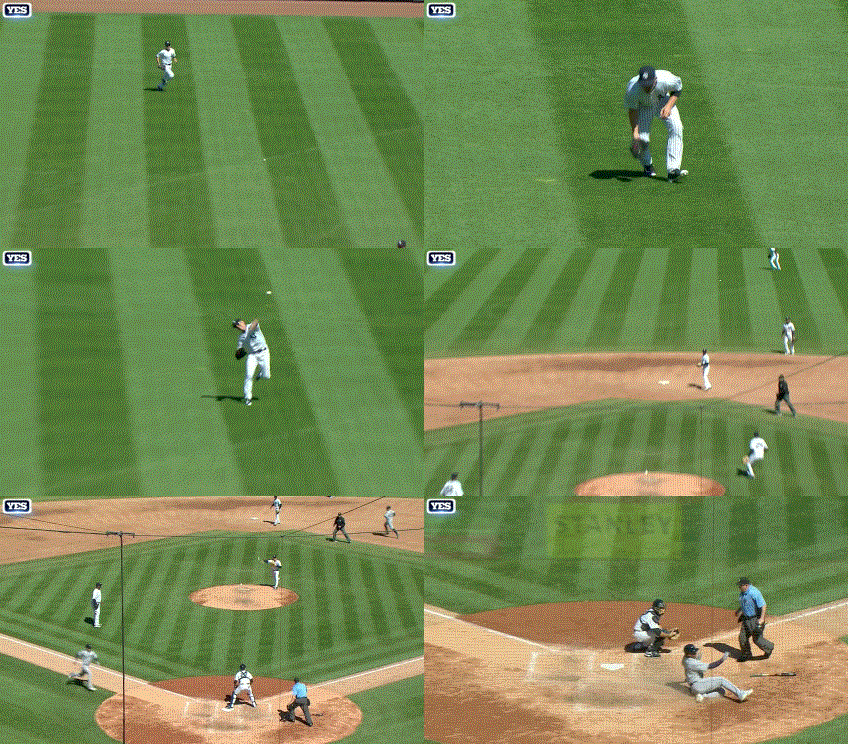
Posada has thrown out just 19% of attempted basestealers this year, Cervelli even less at 14%, and that’s just part of it. The passed balls have allowed countless runners move up, and there’s no better example of it than this game against the Mariners two weeks ago. Posada allowed two runners to move up on a passed ball in the 8th inning, and one pitch later a two run single tied the game. While not completely responsible for the blown lead, the defensive miscue was certainly a big factor.
Considering how much we’ve talked about catcher’s defense this year, I wanted to try and come up with an actual number for how many runs the Yanks’ backstops have cost them defensively this season. Because there are so many immeasurables when to comes to catcher’s defense, we’re going to have to stick with the basics: stolen bases, caught stealings, wild pitches, and passed balls. Of course this isn’t perfect, because it’s not just catchers that factor into those four stats, pitchers have a say as well. The broad assumption in this analysis is that the pitcher’s effect will even out when looking at the 30 teams across the first half of the season.
Stolen bases and caught stealings are nice and easy to understand, a guy either successfully stole a base or he didn’t. There’s a little more of a gray area with wild pitches and passed balls because official scorers and their sometimes questionable decisions come into play, and there are certainly wild pitches that a catcher doesn’t even have a chance to make a play on (say a pitch over everyone’s head to the backstop). I’m looking at it in a bottom line kinda way, did the catcher stop the ball or not? Good catchers will still stop a fair share of would-be wild pitches, and even then we’ll assume the number of plays a backstop had no chance on will even out given the sample.
I tallied up each teams total in the four stat categories for the 2010 season, then assigned run values to each event based on The Book. Defensively, a stolen base against costs a team 0.16 runs, but throwing a runner out trying to steal saves 0.45 runs. You don’t need to be a sabermetric whiz to understand that losing a baserunner hurts a team more than moving one up 90 feet helps. Wild pitches cost 0.26 runs, passed balls 0.28. It makes sense that those two are close in value, since they’re basically the same thing with two different names. I turned everything into a rate stat for comparison purposes, arbitrarily selecting 180 innings as my unit of time (20 games).
The big league average is exactly two runs lost defensively per 180 innings, which passes the sniff test because it’s tough for a catcher to prevent runs in this analysis. He’d have to throw out a ton of runners to actually save runs, which just isn’t realistic. It basically comes down to who gives up the fewest runs. The AL average is 2.2 runs lost, the NL 1.9. I ran the numbers just to see if the small ball NL approach had a big impact in the numbers, but it’s good to see that they’re close. I’m going to use ML average for the rest of the post.
You can see my entire table of results here. The table’s too big to embed, so just click the link if you want to see the full breakdown by team. My fancy acronym for this stat is cRSAA/180, which stands for catcher’s runs saved above average per 180 innings. Yes, I just wanted a nerdy name, so sue me. All I did was figure out how many total runs a team lost defensively per 180 innings, and compared it to that 2.0 ML average. The Cardinals have the game’s best defensive catching corps, saving 1.9 runs above the league average per 180 innings. This passes the sniff test because Yadier Molina has a reputation as a studly defensive backstop. The Diamondbacks are on the other end of the spectrum at 2.4 runs below average. Apparently they’re bad at everything.
The Yankees came in at 1.4 runs below average, tied for fourth worst in the game. The only teams below them are the D-Backs, Pirates (-1.6 cRCAA/180) and Angels (-1.5), and they were tied with both the Giants and Red Sox. Over a 162 game season, assuming nine inning games, the Yanks’ catchers will cost them 11.34 runs defensively, which is basically one win. For comparison’s sake, St. Louis would pick up a win and half because of their catcher’s defense, Arizona would lose another two games. The different between the best and worst teams is three and a half wins, hardly insignificant.
It probably didn’t surprise you that the Yanks came in towards the bottom of the pack, or at least it shouldn’t have. Let’s break it down individually for Posada and Cervelli…
First of all, apologies to Chad Moeller. Secondly, as you can see neither Posada or Cervelli are assets on defense. Posada has cost the team 1.8 runs below average with his glove for every 180 innings he’s caught this year, Cervelli a touch less at 1.1. If Posada were to catch 120 nine inning games, his defense would cost the team 10.8 runs, or one win. Of course his offense, even at 2010 levels, would provide just over 17 runs, so the next gain is six runs, for all intents and purposes.
Cervelli, on the other hand, would cost the team 6.6 runs below average if he played 120 nine inning games, and his bat would also be another 7.4 runs below average assuming 2010 levels of production. All told, the Yankees would be 14 runs in the red with Cervelli as their starting catcher compared to six runs in the black with Posada. It’s a 20 run difference, two wins in a tight AL East. This assumes a set designated hitter and that only one of the two catchers play per game.
Yes, this is an extremely oversimplified way of looking at things. There are parts of catcher’s defense that we can’t even begin to quantify, but the information we do have tells us that the Yanks’ catchers are hurting them with the glove. Posada mitigates all of that damage with his stick, Cervelli not so much. He’s supposed to be just a backup though, so in theory it shouldn’t hurt as much. You expect those guys to be below average. The real problem is that Cervelli has had to play so much this season that both his bat and glove have become detriments to the team in a very real way.
Catching issues are hard to hide just because of the nature of the game. The catcher is in on every play, every pitch. The demands of the position are so extraordinary that most of the time you’re just looking for the least harmful option. You don’t expect offense, you just hope for something more than complete incompetence. The Yankees’ catchers are holding them back a bit this year, but their pitching and offense is good enough to more than make up that lost win in the standings.
Numbers show a decline on Jeter’s range to his left
Posted by: | Comments
Photo credit: Kathy Willens/AP
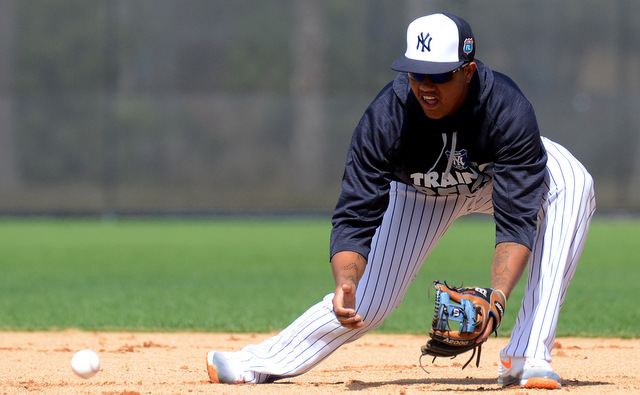
It’s unsurprising for anyone who has watched most of the season to date, but it appears that Derek Jeter has taken a step backwards defensively. Last year he made marked improvements, and the numbers confirmed what our eyes saw. This year we’ve seen him miss a number of plays, particularly those to his right. While the readily available defensive numbers don’t break down his defense that far, ESPN’s Mark Simon tracked down the specific left-right splits for Jeter.
In the winter of 2007-2008, Brian Cashman had a conversation with Jeter in which Cashman raised the issue of Jeter’s diminished defensive range. Jeter had not heard this from coaches or teammates, but made a commitment to improve. He started doing workouts that helped balance the typical workload of a baseball player. Because there are so many repetitive one-way movements — running the bases and swinging the bat — a player can become unbalanced. Jeter’s workouts strove to help him work both sides of his body.
It seemed to work. Not only did Jeter look better in the field starting in 2008, but the numbers reflected it. On Baseball Info Solutions’ +/- scale, Jeter rated just -1 to his left in 2008, and improved to +2 in 2009. This seemed to hamper his range to his right, usually his strong point, but even then he adjusted. After rating -18 in 2008, Jeter climbed to -3 in 2009. After another off-season of balanced workouts, we might have seen Jeter improve further, or at least negate the effects of age.
Instead we’ve seen him decline on balls to his left, on which he currently rates a -7. Again, this is no surprise to the faithful followers. Jeter has missed a number of balls, and has come close to missing a few more. I particularly remember a play in Detroit where it appeared he would smoothly scoop a grounder up the middle, but he hesitated at the last moment and had to make a spinning throw. On the good side, Jeter has been excellent on balls to his right, rating a +7.
At this point in his career, we can’t expect Jeter to become a top defensive shortstop. The balls up the middle are frustrating to watch, but it is reassuring to know that he’s at least making some plays that other shortstops have not. Still, it’s certainly going to affect his contract negotiations after this season. How much will Derek Jeter the shortstop cost compared to Derek Jeter the guy who will have to move off the position in a couple of years?