Archive for David Robertson

Feb
05

The New York Yankees Remix

Posted by: | Comments (28)

Flawless combining of sports and music. (Used under a creative common license from flickr user vtooky)

Sports have a lot in common with music.

First off, it’s easy to get over-invested. You love a band? Suddenly, you’re seeing three of their shows in a row, driving up and down the state and maybe into (shudder) Massachusetts. You might be listening to the same album over and over again. Likewise, I’m sure plenty of Yankees fans are going to Boston, DC, Queens, and Baltimore to check out your team. Also, there’s the fact we end up watching these guys play the same game 162+ times. That’s a lot to watch the same damn thing. I think we’re all crazy.

Additionally, there is nothing more pointless than arguing either music or sports with your friends. Your friend is Mets fan? Get new friends, but first, try to convince them to be a Yankees fan. Sadly, futile. Meanwhile, your friend likes that band you hate? There is no way they will ever tell you it’s not the best thing they’ve ever listened to. Meanwhile, you will make an equal fool of yourself singing in your cubicle or talking avidly about your fantasy team. (Hint: No one cares about your fantasy team.)

With this, I present Yankees as songs from my iPod.

Derek Jeter as “The Lightning Strike,” by Snow Patrol

There are lots of great things that Jeter presents: as a baseball player, he’s really good, really consistent, determined, disciplined, and talented. As a front presented to the media, he’s calm, with no surprises and no big crises; he doesn’t get into trouble, and as a result he doesn’t ever have to wiggle out of it. Jeter’s the golden boy, as everyone knows.

“The Lightning Strike” off A Hundred Million Suns, gives the listener all these things. Not only does it match Jeter’s lengthy career (the song has four parts and combines for a whopping 16:18 in play time), but the song starts with an intriguing intro before being played with a dramatic flare through all four parts. It even comes with a part around 9:35 where you thought it was over, but then you realize there’s a lot more to go. Despite the dramatic notes, there’s no surprises – gravitas is the norm, like Jeter, and there’s no random cymbal banging or screaming guitar solos where you didn’t expect them. The song ends leaving the listening feeling fulfilled, like this whole story was written and told perfectly, and couldn’t have been any other way, and when Jeter’s career is over… well, how could it have been any better? Ain’t no one out there like El Capitan.

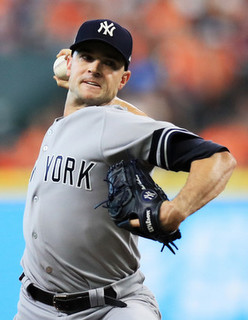
David Robertson as “Don’t Stop Me Now,” by Queen

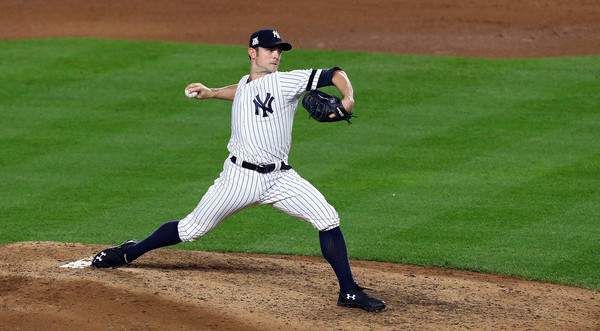
In the Non-Mariano Rivera division of things that happen in baseball games, is there anything that made you feel more secure in 2011 than David Robertson? The man was flat-out amazing on the mound in relief, and as such I think he’s worthy of such a great song.

Quite frankly, no one could have stopped Robertson, both last year and ’11, and even with a little regression he’d still be a downright amazing reliever. He had a real good time. He felt alive. He was floating around in ecstasy.

You get the point.

While there was usually a tenseness that came with Robertson’s appearance, they almost always ended in the impossible-to-frown-at cheeriness that also accompanies this song. Both the song and his at-bats tended to follow an easy routine: he throws fastballs, and curveballs, and strike guys out. Meanwhile, the song, like the baseball season, becomes bigger both in terms of leverage and Freddie Mercury’s voice, and Robertson still has it in the bag. With his strikeout rate’s rocket ship already reached Mars, he’s going to make a supersonic man out of you. By that, I mean he’s going to embarrass you with his pitches and make you ashamed as you walk back to your dugout.

Whether you think 200 degrees means the heat on his fastball or the break of his offspeed pitches, it was all enough to earn him a pretty awesome nickname (sadly, not Mr. Fahrenheit).

(Shameless Plug: I did a Yankees year in review video to this song.)

Phil Hughes as “Vida La Vida” by Coldplay

Phil Hughes used to be everything. He was the future. He was brilliance. He was the next 6-year-100M contact. He was the Yankees’ pride and joy. He was the kind of guy you ran off to get the jersey of, the one you knew was gonna mean everything.

But that was when he ruled the world.

These days, Hughes is but a shadow of the flawless prospect we imagined him as. Injuries and ineffectiveness have kicked him down from the position, and he’s gone from being The Future to fighting for a rotation spot. Given as how entertaining the “Phil Hughes is Fat” jokes can sometimes be, there’s a good chance that even if he returns to form, they’ll persist, and that possibility is even greater if he doesn’t. Both Hughes and Coldplay tell stories about rising and falling from power, and how easy it can be. After all, baseball’s almost as difficult as ruling a country, I bet.

While the song ends on a morbid, depressing note, I’m hoping Phil can break the trend here and get himself together in 2012. It wouldn’t be legitimately awful for him to end up as a reliever, but it does seem a little a let-down when he was so good in the first half in 2010. That seems far away now, doesn’t it?

Anyway, because this is music, I’m sure there will be many differing opinions on song choice. And because this is sports, I’m sure lots of people will disagree with me. That’s what the comments are for.

(I shamelessly modified this idea from where Friend of the Blog Rebecca Glass discusses the Yankees as mythical creatures. Derek Jeter is a unicorn.)

Categories : Whimsy
Comments (28)

The Yankees avoided arbitration with Joba Chamberlain and David Robertson by agreeing to one-year contracts, the team announced. Joba received approximately $1.675M (per Jon Heyman) his second time up for arbitration, a slight raise from the $1.4M he made last year. He would have cleared $2M if it wasn’t for the Tommy John surgery. Robertson signed for $1.6M with another $25k in incentives (per Heyman) his first time up for arbitration, a big raise from his near-league minimum salary.

Noon ET today was the deadline for teams and their eligible players to file arbitration salaries, and the trio of Russell Martin, Boone Logan, and Brett Gardner remain unsigned. Hearings start in February, but the two sides can still agree to a contract at any time. Here are MLBTR’s salary projections, if you’re curious. Phil Hughes agreed to a one-year deal and avoided arbitration yesterday.

Update: Heyman says Gardner filed for $3.2M while the Yankees filed $2.4M. They’ll probably split the difference and call it a deal, but Gardner’s arbitration case isn’t all that great because he’s a defense-first guy, and that doesn’t pay.

Update Part II: Heyman says Martin filed for $8.2M while the Yankees countered with $7M. Russ actually holds the salary record for first and second time eligible catchers. This is his fourth year of arbitration eligibility as a Super Two.

Update Part III: Jack Curry says Logan filed for $2.1M while the Yankees countered with $1.7M. Logan has a pretty decent arbitration case because of his low ERA (3.20 as a Yankee) and high strikeout rate (9.3 K/9 as a Yankee).

Categories : Asides, Transactions
Comments (37)

(AP Photo/Michael Dwyer)

The question comes up frequently, but we’ve yet to explore the possibility fully. The Yankees still seek a starter for their 2012 rotation, and there doesn’t appear to be much available on the market. While they have five starters in name, plus a few young backup plans, adding another mid- to upper-rotation arm will only help them in their quest to win the AL East and more. As many have asked, might David Robertson make sense in that role?

Why tackle this now? For starters, the Winter Meetings are going slowly for the Yankees, and things don’t figure to pick up. Maybe the Yankees have something on the horizon, but if they do it will come as a surprise to everyone. Meanwhile, we still enjoy exploring all reasonable avenues of improving the team. Also, Marc Normandin of Over the Monster recently wrote about Daniel Bard as a starter. That created the opportunity to piggyback some of the great work he did there.

While Marc’s work on Bard inspired this article, Bard might not provide the best comparable for Robertson. After all, Bard started game for UNC before turning pro, and then spent his first minor league season in the rotation. He’s been a reliever ever since, but at least he has a history of starting games. Robertson, on the other hand, has no such history. The last time he started a game was in 2005 when he was still hurling for Alabama. Since then he’s been used exclusively in relief. This makes him a bit more like Alexi Ogando, who had no starting experience prior to 2011. Then again, he had little pitching experience at all.

One big consideration in making a move is the translation between starter and reliever. That is, a pitcher will likely pitch better in relief for a number of reasons. Tom Tango applies what he calls the Rule of 17 for estimating these translations. Essentially, there are three factors that change by 17 percent when moving between the rotation and bullpen: strikeouts per PA, BABIP, and home runs per contact rate. What catches the eye, and what works to Robertson’s great benefit, is that walk rate doesn’t change much at all. He can’t really afford to walk more hitters than he already does — his almost 90 percent strand rate greatly aided his 2011 campaign — so any change in transition to the rotation would not be welcome. But if it remains flat, perhaps he can make it work.

If we use only Robertson’s 2011 season, clearly he’d look superb as a starter; his results were off the charts, both in terms of peripherals and results. There’s only a minuscule chance he can approach those numbers again in relief. Still, he did have two quality seasons in 2009 and 2010, following a rough rookie campaign in 2008. If we add up all his innings, though, he’s at 202 for his career. Since that’s a full season, it might be best to apply the Rule of 17 to his career stats and see what we get.

Robertson As A Starter

  RP SP
K/PA 31.1% 26.6%
BABIP .319 .373
HR/BIP 2.6% 3.0%

There are a few caveats to attend here. First, Tango’s study encompassed all pitchers. Some performed better than this baseline, some performed worse. It’s tough to know where Robertson will fall on that curve. It’s unlikely, for example, that he’d have a .373 BABIP as a starter. Even though pitchers do have a degree of control over the types of contact they induce, .373 seems out of line for anyone. This is all part of the great unknown of this whole experiment.

Also a factor: Robertson’s discernible improvement in 2011. It wasn’t just in the results. Robertson added about a mile per hour to his fastball. This played a large role in his heightened strikeout rate, as did the “sneaky fast” nature of his fastball; that is, it gets on top of hitters faster than they might expect, thanks to his extended stride. There is a chance, then, that some of his improvement could be real, and could make his expected numbers look even prettier.

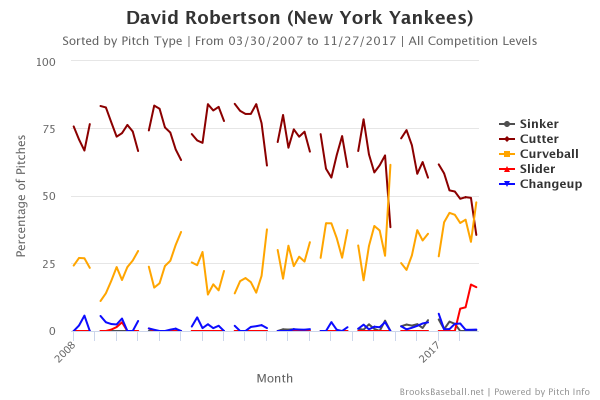
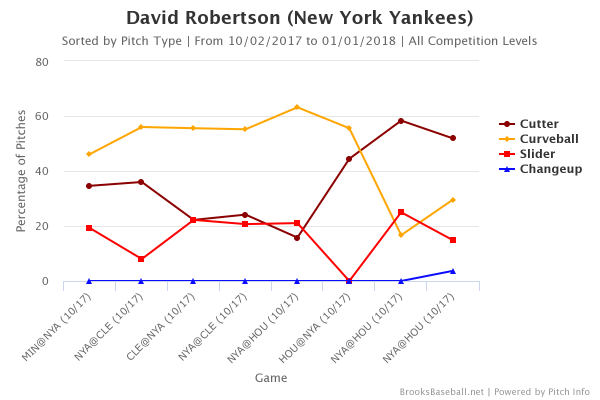
The one thing that could hold back Robertson is his repertoire. While he does have two quality pitches in his fastball and curveball, he doesn’t quite have that third pitch. He’s used a cutter, which has been effective at times. He also uses a changeup, but not at all frequently. He’d have to drastically increase its usage in the rotation. It’s not that using his changeup more frequently is out of the question; he really doesn’t have a chance to use a third pitch in the bullpen, after all. It’s that the third pitch adds another level of uncertainty to the conversion.

Finally, we have the issue of innings. Last year Robertson threw 66.2 innings, his highest total as a major leaguer. His previous high came all the way back in 2006, when he threw 82.2 innings combined between Alabama and the Cape Cod League. This is where a comparison with Ogando might work. In 2010 he threw about 75 innings between the minors and majors before making the jump to 169 innings in 2011. He did tire down the stretch, too. The Yankees couldn’t expect more than that from Robertson. It’s also unknown how Ogando will rebound from this increase in workload. He didn’t hurt himself in 2011, but there is still risk in the following year. Fatigue leads to poor mechanics, and poor mechanics can lead to injury, both in the present and in the future. The Yankees probably don’t want to take that risk with one of their best bullpen arms.

There certainly exists a case for converting Robertson to a starter. He took a significant step forward in 2011, and there’s a chance that his talents could play up well when throwing six, seven, or eight innings an outing. There are, unfortunately, a significant number of unknowns, uncertainties, and risks that go along with such a conversion. The Yankees are aware of these, I’m sure, and I don’t doubt that they’ve mulled the possibility, if only casually. It’s not a terrible idea in theory, but everything would have to break the Yankees way for it to work out. It’s understandable, then, if they wish to keep things as they currently stand. Robertson is plenty fine in his current role.

Categories : Pitching
Comments (50)

The AL Cy Young Award wasn’t enough. Justin Verlander was named the MVP of the American League today, receiving 13 of 28 first place votes. He’s the first pitcher to win the award since Dennis Eckersley in 1992, and the first starting pitcher to win the award since Roger Clemens in 1986. He’s also the first Tiger to be named MVP since Willie Hernandez in 1984.

Curtis Granderson was the Yankees’ best player all season, and was rewarded for his efforts with a fourth place finish in the voting. He received three first place votes and finished with 215 points, trailing only Verlander (280), Jacoby Ellsbury (242), and Jose Bautista (231). The top five finish triggers an escalator clause in his contract, raising the value of his 2013 option from $14M to $15M. Robinson Cano finished sixth in the voting with 112 points, though he did not receive any first or second place votes.

CC Sabathia (two sixth place votes), Mark Teixeira (one seventh and one tenth place vote), and David Robertson (one tenth place vote) also appeared on ballots. The full results are available on the BBWAA’s site. The NL MVP will be announced tomorrow at 2pm, the final award of the season.

Categories : Asides
Comments (106)

As expected, Justin Verlander won his first career AL Cy Young Award today, receiving all 28 first place votes. He’s the first Tigers pitcher to win the award since Willie Hernandez won both the Cy and MVP Awards in 1984. Congrats to him.

CC Sabathia finished fourth in the voting (63 points), behind Verlander (196), Jered Weaver (97) and Jamie Shields (66). He finished third in the voting last year, fourth in 2009, and fifth in 2008 after winning it with the Indians in 2007. Mariano Rivera finished eighth in the voting with four fifth place votes, and David Robertson received one lonely fifth place vote.

The full results can be found at BBWAA’s site. Both the AL and NL Manager of the Year Awards will be announced at 2pm ET tomorrow.

Categories : Asides
Comments (52)
Oct
12

What Went Right: David Robertson

Posted by: | Comments (41)

Over the next few weeks, we’re going to look back at what went right, what went wrong, and what went as expected during the 2011 campaign.

(AP Photo/Paul Sancya)

When the season started, David Robertson was third on the Yankees set-up reliever depth chart. He pitched very well in 2010, his first full season as a big leaguer, and he came into this year the proud owner of a 11.3 K/9 and 4.1 uIBB/9 in 135.1 career innings. On most teams, that guy is working the eighth inning or maybe even closing. On the Yankees, Robertson was just the sixth inning guy/fireman because of big money signee Rafael Soriano and incumbent setup man Joba Chamberlain.

The 26-year-old right-hander’s month of April was more notable for how often he didn’t pitch rather than how often he did. Robertson seemed to warm up every single game, but would be left with nothing to show for it when the starter got through the sixth inning and Joe Girardi went to his late-inning formula. He appeared in half of the team’s first 20 games, striking out ten in 8.1 IP. When Soriano went down with an elbow issue in mid-May, Robertson took over seventh inning duties. When Joba went down with an elbow issue of his own in early-June, he took over the eighth inning.

At the time of Joba’s injury, Robertson owned a shiny 1.16 ERA in 23.1 IP, but his underlying performance told a different story. He’d struck out 38 batters in those innings, but also walked 18. Those kinds of control problems can be scary late in the game, but it was like someone flipped a switch after the responsibility increase. After walking 18 in his first 23.1 IP (6.9 BB/9), Robertson walked just eight in his next 26.1 IP (2.7 BB/9). His strikeout rate remained sky high, and opposing batters were unable to top a .500 OPS off him. When Soriano returned from the disabled list in late-July, Robertson kept the eight inning job and forced the $35M man into the seventh inning.

All told, Robertson struck out 100 batters on the nose this season, becoming just the third full-time reliever in Yankees history with a triple-digit strikeout total. Mariano Rivera did it in 1996, and Goose Gossage did it three times. Robertson did it in at least 30 fewer innings than those guys, though. Only one batter managed to take him deep in 2011, J.J. Hardy of the Orioles on August 29th. That was also the only run he gave up on the road this season. Robertson’s 1.08 ERA was the second lowest among relievers with at least 60 IP, his 1.84 FIP third lowest this year and 11th lowest in a single season since 2000. We’re talking 2003 Eric Gagne, 2006 J.J. Putz territory.

In a season in which the Yankees got just 68 total innings out of their Opening Day eighth and ninth inning relievers, it was Robertson who emerged and did more than just fill in capably. He excelled and developed into one of the very best relievers in the game, a strikeout fiend with a knack for pitching out of jams. The “heir to Mo” talks are premature, but just the fact that the thought has crossed people’s minds is a positive sign. Robertson went from a nice complementary piece to a core Yankee in just six months, and he’ll be counted on for much more next season.

Categories : Players
Comments (41)

We’ve got four straight forward questions in this week’s mailbag, so no nonsense answers today. Remember to use the always handy Submit A Tip box in the sidebar if you want to send in any questions during the week.

(Jim McIsaac/Getty Images North America)

Will asks: What do you think of Jesus Montero‘s debut so far on the big league team? It seems like he’s been striking out way too much. Do you think Montero has a good chance at making the playoff roster? And how much can we expect him to actually contribute?

I think Montero’s been fine overall, neither great nor terrible. He obviously started out very well and has cooled off a bit (still at .313/.389/.542 overall), but that’s a function of having just 54 plate appearances more than anything else. Yeah, the strikeout rate is high (27.8%), especially of late (11 whiffs in his last 28 PA), but it’s not terribly surprising for a 21-year-old kid making his debut. Montero’s shown that Yankee Stadium-friendly opposite field stroke and we’ve seen the power on display, so we know the tools are there. Regardless of what happens this month, good or bad, we weren’t going to learn too much about the kid anyway.

As for the playoffs, yeah I think he makes the roster as the primary DH against lefties. We’ll talk more about Jorge Posada in just a second, but I hope the team decides to leave the traditional backup catcher at home and rely on those two as emergency fill-ins should anything happen to Russell Martin.

Cliff asks: Not sure when you do these but I was curious if you think Posada is going to make the postseason roster. If not, do you think they will announce it before Sunday so we can give him a proper send off in the last home game?

I was pretty sure that Posada was going to make the playoff roster all along, but I think that AL East-winning hit on Wednesday cemented it. He can still hit righties (.270/.346/.464), so he’s probably the best choice to platoon with Montero at DH. Plus Jorge can also be useful off the bench as a pinch-hitter and super emergency catcher. I don’t put much stock in intangibles but they definitely do exist, so if nothing else, we know that Posada won’t be overwhelmed by the moment in the postseason. He’s been through all that already, and it’s just one less thing the Yankees would have to worry about.

I would be very surprised if the Yankees announce that Jorge will not be on the playoff roster in time for the final home game,but like I said, I expect them to carry him on the roster. So that last point is basically moot.

(Dilip Vishwanat/Getty Images North America)

Scout asks: If the SF Giants decline his 2012 option, Jeremy Affeldt will become a free agent, and evidently without compensation. Does the lefthander make sense for the Yankees, assuming he will require a two-year deal?

Damaso Marte‘s contract expires after the season, so the Yankees have one of those $4M a year LOOGY spots to fill. We’ll go more in depth with potential free agent targets and what not during the offseason (so I don’t want to spoil it too much), but yeah, Affeldt would be a fine target. He held lefties to a .144/.206/.200 batting line with 24 strikeouts and just five walks in 97 PA this year, which is quite a bit better than the .245/.369/.365 batting line they posted against him from 2009-2010 (43 K, 29 BB in 195 PA). I think that has more to do with health than anything.

Affeldt, 32, still has pretty good stuff (low-to-mid-90′s two and four-seamers with a curveball) and he has been really dominant against same -side batters when it comes to getting ground balls over the last few seasons. The Giants have a $5M club option for his services next year, but apparently it will be tough for them to bring both Affeldt and Javy Lopez back next season. I’m very much against multi-year deals for less than elite relievers, but the Yankees obviously aren’t. Affeldt would definitely be an intriguing target after the season, assuming he hits the open market.

Daniel asks: With the success that Robertson has had this year and should he have a similar year next year, should he be made the closer after Rivera? If Rivera retires at the end of his current contract, the Yankees will still likely have Soriano for another year, and he has experience closing, but Robertson appears to be the better pitcher.

The one thing we have to remember is: how often do relievers have back-to-back elite years? The answer is not very often, so we shouldn’t plan out the rest of David Robertson‘s career just yet. That said, he’s obviously the best in-house replacement for Mariano Rivera, just like Phil Hughes was in 2009 and Joba Chamberlain was in 2007. I’d almost prefer that if Robertson does take over as closer, he does it as the guy that replaces Rivera’s replacement. It’s going to be impossible to fill Mo’s shoes, and I suspect the natives will be restless if the new guy struggles out of the gate. We saw it when Tino Martinez took over for Don Mattingly, fans booed him like he kicked their dog or something.

Assuming Rivera retires after next year, the last season on his current contract, I’m not sure the worst move in the world would be to let Rafael Soriano (a.k.a. the Proven Closer™) close at first, then have Robertson replace him if he fails. And if he doesn’t fail, then he’ll be a free agent after the year and Robertson could step after that. The closer’s job is overrated in general, and I think you can make a really strong argument that Robertson would be more valuable to the team pitching the seventh and/or eighth inning while a lesser reliever starts the ninth with a clean slate.

Categories : Mailbag
Comments (89)
Sep
21

David Robertson’s Dead-ish Arm

Posted by: | Comments (31)

Over the course of the season, I think we’ve come to take David Robertson for granted. Well, maybe that’s not the right way to put it. I guess it would be more accurate to say that he’s one part of the Yankees that we’re not concerned about, like at all. At least that’s how I feel. Aside from Mariano Rivera, there’s no pitcher out in that bullpen that I have more confidence in that D-Rob.

Because of this lack of concern about Robertson and his performance, there’s a chance that you may not have noticed his velocity in recent appearances, which happens to be trending downward ever so slightly. Here, have a look…

It’s nothing major, but there’s a definite arc there. Robertson started the year at his usual 91-92, peaked at 93-95 with a few 96′s (and I remember at least one 97) in the middle of the summer, and now is gradually declining back to the 92-93 range. That’s right in line with what we learned about velocity and the temperature earlier in the year, and again, it’s not a huge spike or decline in velocity either. It’s there, it’s real, but it’s not drastic.

Robertson’s workload this month has been an issue, only because the team has played an inordinate number of close games lately. Monday’s appearance was his first in three days, but before that he pitched in nine of the first 16 days of September. At one point he made six appearances in the span of nine days. Aside from this recent stretch, Joe Girardi‘s always been very good at keeping his top relievers fresh and spreading his workload around.

Overall, Robertson has already eclipsed last year’s total of 61.1 IP by 2.2 IP, however he’s faced ten fewer batters and thrown four more pitches. Furthermore, not all appearances are made equal. Although Robertson has faced 138 batters with men on base this year (146 last year), he’s faced way more with men in scoring position (109 vs. 88) and with the bases loaded (18 vs. 9). I think we call agree that pitches thrown in tight spots are more taxing that pitches with no one on base, which is why that nominal increase in innings pitched can be a little deceiving.

I don’t think this is anything to be worried about, it’s not like he’s suddenly throwing 87-88 or something like that. Robertson has worked quite a bit this month because of all the close games the Yankees have played lately, but the team is in the position to rest him over the final eight days of the season. They don’t need to push him three, or hell, even just two days in a row from here on out. Robertson’s performance hasn’t suffered at all, and right now there’s no reason to expect it too. The kid has proven that he can pitch at 91 in the past, and the velocity hasn’t even dropped off that much yetanyway. This is just something that caught my eye over the last week.

Categories : Death by Bullpen
Comments (31)

Four questions this week, but three of the four answers are kinda long. The Submit A Tip box is your friend, assuming you need a friend that can help you send in questions for future mailbags.

(AP Photo/Michael Dwyer)

Chris asks: Do you think the Yankees would consider trying David Robertson out for the rotation? He seems to have good mechanics with his delivery and no obvious physical detriments that would inhibit his ability to start. Stuff-wise, I think few would doubt Robertson’s qualifications — especially now that he’s added a serviceable change-up to go along with his plus curveball and fastball. What do you think David Robertson’s ceiling as a starter would be? Is it high enough to justify a “Robertson-as-a-starter” experiment?

You know, I could have sworn Joe wrote a post about Robertson as a potential starter, but apparently he didn’t because I can’t find it in the archives anywhere. Oh well.

Stuff-wise, Robertson would be fine. He’d definitely lose some heat off the fastball, figure more 91-92 than the 94-95 he’s working with these days, but he’s got that great curveball and will show a changeup from time to time. He’s thrown that changeup just 1.7% of the time this year, so he’d have to be comfortable with using the pitch a lot more than he does now for it to work.

There’s two big hurdles here. First, Robertson hasn’t started a game since 2005, when he made three spot starts as a sophomore at Alabama. He also hasn’t thrown more than 61.1 IP in a season since 2008, when he topped out at a career high 84 IP (he threw 84.1 IP in 2007, so close enough). It’s not like they could just stick him in the rotation and expect 30 starts right out of the chute, it’ll take a year or two to get him safely stretched out. The second thing is his efficiency, or lack thereof. Because Robertson’s such a high-strikeout, high-walk guy, he ends up throwing a ton of pitches. In fact, his rate of 4.51 pitches per batter faced is the highest in baseball among relievers with at last 40 IP, and his 18.5 pitches per inning are the eleventh highest when you use that same criteria. He’d have to learn how to become more economical, which means pitching to contact a little more. If he can’t do that, he’d be a five and fly starter.

There’s also the element of the unknown here. We have no idea if Robertson can be successful the second and third time through the order. At least with Joba Chamberlain, you had his dominant college and (brief) minor league track record to fall back on. That’s not to say it can’t work (C.J. Wilson was very similar to Robertson when he was in the bullpen, and his transition was a smashing success), but that it won’t be easy. I can’t imagine the Yankees will entertain the thought of trying Robertson in the rotation, but it’s not a completely insane idea. Would take a lot of work on David’s part though, that’s for sure.

Brent asks: I was reading your article about Pedro Feliciano and got to wondering: How is the luxury tax, insurance payments, salaries effected by an injured player like this?  What $$ are the Yankees exactly on the hook for in this situation?

I can’t answer the insurance, we really don’t have any idea what kind of insurance teams have on their players. I imagine the extent of the coverage is a case-by-case thing, like every other insurance arrangement, and it’s basically impossible to find that info freely available somewhere. For all we know, the Yankees could have been reimbursed for every dime they paid Feliciano this year.

The luxury tax is a different story though. You can download the pdf of the current Collective Bargaining Agreement right here, then scroll down to Article XXIII for everything you need to know about the Competitive Balance Tax, the luxury tax’s fancy name. I’ll spare you the gory details, but in a nutshell, teams are taxed on their “Actual Club Payroll,” which is the average annual value of all the contracts on their 40-man roster. There’s almost some specifics about signing bonuses, benefits, etc., but a team is taxed for every player on the 40-man, and Feliciano has been on the 40-man all year. The Yankees will have to pay luxury tax on his contract even though he never pitched for them. Since they’re taxed the maximum 40%, that’s another $1.6M on top of his $4M average annual salary.

J.R. asks: If a player goes on the DL in the playoffs he is ineligible for the next round (ie Clemens in the ALDS). If the Yankees lost a player in the ALDS could they be off the roster for the ALCS but then put back on for the WS?

Yep, that’s exactly how it would work. The Braves lost Billy Wagner to injury in the NLDS last year, and replaced him on the roster with a new pitcher. Wagner was ineligible for the NLCS, but if Atlanta had made it to the World Series, he could have been re-added to the roster. If a player is replaced on the roster in the LCS, they’re off limits in the World Series, which kinda stinks.

Mike asks: Who are the minor leaguers who need to be added to the 40 man roster after the season to protect from the Rule 5 draft and who are the candidates to be cut from the 40 man to make room for them? I think you touched on this a couple of months ago but things have changed in Sept a little.

I trimmed Mike’s question down just for the sake of saving bandwidth, but you get the idea. I answered a question about who’s eligible for the Rule 5 Draft a few weeks ago, but you’re right, things have changed. Both George Kontos and Austin Romine were added to the 40-man roster and called up while Steve Garrison and Pants Lendleton lost their spots. Here’s a quick recap of the 40-man situation heading into the offseason…

On 60-day DL (7): Feliciano, Chamberlain, Damaso Marte, Sergio Mitre, Reegie Corona, Colin Curtis, Justin Maxwell

Scheduled to become free agents (8): Marte, Mitre, Luis Ayala, Bartolo Colon, Freddy Garcia, Eric Chavez, Andruw Jones, Jorge Posada

Non-tender/release candidates (4): Corona, Aaron Laffey, Scott Proctor, Raul Valdes

That’s eight spots definitely being opened up by departing free agents, but five of those spots will immediately be filled by 60-day DL guys (Marte and Mitre overlap). There’s no DL in the offseason, those guys have to be activated. Proctor’s as good as gone, so that’s another open spot. Pretty safe bet that Corona and at least one of Laffey/Valdes will go as well, so that’s two more spots. Right now, we’re at six open spots.

The outfield trio of Maxwell, Greg Golson, and Chris Dickerson will all be out of options next year, so something has to give. They could be released, traded for a marginal prospect (like what they did with Juan Miranda), or run through waivers just to see if they clear. All three could be gone next year, or all three could be back and off the 40-man roster. I have to imagine that at least one of those guys will be cut loose at some point, perhaps two. Either way, those are some flexible spots that can be dealt with as needed. The out-of-options thing really doesn’t become a problem until you actually want to send them to the minors, usually at the end of Spring Training.

With Romine and Kontos added to the 40-man, David Phelps is the only remaining lock to be added to the roster to prevent Rule 5 Draft exposure. David Adams and Pat Venditte are up in the air, as are a few others. Remember though, those open 40-man spots aren’t just for prospects. The Yankees have to replace Garcia and Colon in the rotation, add some bench players to replace Chavez and Andruw, and rebuild some bullpen depth. The 40-man roster can be a difficult thing to manage in the offseason, especially for a team like the Yankees, a team with so many players locked into long-term contracts.

Categories : Mailbag
Comments (32)

Via the man himself, David Robertson has been named a finalist for the Marvin Miller Man of the Year Award, which is given annually “for outstanding on-field performance and off-field contributions to [the player's] community and is one of the awards given during the Players Choice Awards banquet annually.” Robertson was elected as one of six finalists (one per division) for his work with High Socks For Hope, helping those effected by tornadoes in his hometown of Tuscaloosa.

The winner will be announced after the season. Curtis Granderson won the award in 2009, when he was with the Tigers.

Categories : Asides
Comments (14)