Jun
09

2011 Draft Review: Part Two

By

Earlier today we looked at Day Two of the draft, which featured a lot of power hitters and (physically) big pitchers. Now let’s focus on Day Three, which followed a completely different theme entirely.
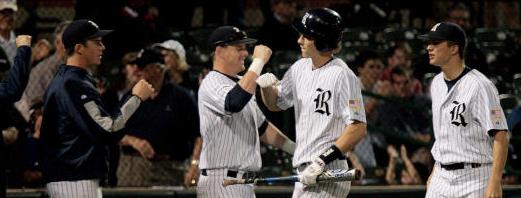
Rathjen's the big dude with the bat. (Photo Credit: The Houston Chronicle)

Day Three: Signability

Signability is a great little catch-all term that definitely has some connotations to it. It typically refers to a player that falls in the draft because of a strong college commitment and the likelihood that it’ll take an above-slot bonus to get them to turn pro, so guys like Dellin Betances and Austin Jackson and Bryan Mitchell are perfect examples. The primary connotation stuck to it is that the player also has high upside, which is not always the case. The Yankees loaded up on signability types on the final day of the draft, some of whom legitimately own big time potential.

The best of the bunch is high school hurler Adam Ravenelle (44th round), a 6-foot-3, 185 lb. right-hander touted as one of the best prep arms in New England. His fastball consistently sits in the low-90′s despite the need for sharper mechanics, and he’s shown the ability to spin a tight breaking ball and also fire off a quality changeup. It’s the kind of package you can dream on. Ravenelle is very raw and also very committed to Vanderbilt, so much so that Conor Glassey said (rather matter-of-factly) he will attend college in the fall in Baseball America’s review of Day Three.

The Yankees also landed a non-traditional signability guy in Jeremy Rathjen (41). The Rice center fielder took a medical redshirt this spring after tearing his ACL, and he has the added negotiating leverage of being able to go back to school as a fourth-year junior and re-enter the draft in each of the next two years, when he’d be coming off a (presumably) healthy year. Rathjen is a physical specimen at 6-foot-6 and 190 lbs., offering bat speed and plenty of power potential to go along with above-average foot speed and defense in center. A monster performer in wood bat summer leagues, he was expected to be a fourth or fifth rounder before the injury, though I’m guessing it’ll take more than a fifth round bonus ($200,000 or so) to get him to sign on the dotted line.

Another New England high schooler, right-hander Joey Maher (38), sports a heavy upper-80′s sinker that figures to add a tick or two as he fills out his 6-foot-5, 200 lb. frame. The secondary pitchers are still a work in progress, but you can’t teach that kind of natural movement on the fastball. Illinois righty Tyler Farrell (43) owns a 6-foot-2, 190 lb. frame that delivers fastballs up to 93 with a power curveball from a refined, old school drop-and-drive delivery. It was arguably the best two-pitch combo available out of the state this year. Chris McCue (35) has already figured out a changeup, a huge step in any pitcher’s development, and the right-hander also throws low-90′s gas and a downer curveball while standing just 6-foot-0 and 170 lbs. Commitments to Northeastern, Western Illinois, and North Carolina stand in the way of these three, respectively.

Outfielder Spencer O’Neil (33) apparently wants $1M to sign, which probably means the Yankees will wish him luck during his career at Oregon. He fills out a uniform well (6-foot-4, 185 lbs.) but still needs plenty of development on both sides of the ball. Righty Skylar Janisse (34) works in the 80′s with his fastball and is mostly a projection pick (6-foot-4, 200 lbs.). He’s committed to Oakland and isn’t a priority sign. Lefty Wes Benjamin (48), outfielder Ethan Springston (47), and shortstop Kevin Cornelius (42) are more lottery ticket types; the Yankees will follow their progress in the various summer showcase events before deciding on their true worth.
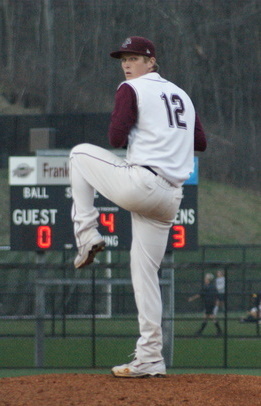
36th rounder Ryan Thompson. (Photo Credit: The Nashua Telegraph)

The Yankees also did a fine job grabbed some small/junior college players. Franklin Pierce righty Ryan Thompson (36) was born in Canada, grew up in the Bahamas, and spent two years at UConn before transferring this spring, a good move since his goal was to gain more exposure rather than be buried on a deep pitching staff. The 6-foot-3, 190 pounder throws a two-seamer fastball anywhere from 88-92 and also offers a slider and changeup. Thompson still has room to fill out and already has a reputation as being a guy that hold his velocity deep into games. He was expected to be more of a early-double digit rounds pick, so the Yankees got good value with the pick and will get better value if they sign him. Navarro Junior College righty Tyler Maples (49) has run his fastball up as high as 93. And as usual, the Yankees did select some college players to fill out rosters in the lower levels of the minors, namely LSU shortstop Tyler Hanover (40) and Missouri third baseman Connor Mach (46).

Following what seemed like a concerted effort to address the organization’s lack of power in Day Two, the Yankees followed a more traditional path and went for more upside in the final 20 rounds on Day Three. Aside from Ravenelle and Rathjen, the two real standouts of Day Three, Farrell and McCue are the two big upside picks. Farrell has a knockout two-pitch combo already in his back pocket and McCue has already shown three legitimate pitches with potential (rare for high schoolers) even if his size isn’t ideal. UNC doesn’t screw around either, that’s a powerhouse baseball program that only goes after the best, so that’s another feature in McCue’s cap.

The draft is like the regular season in that it’s a marathon and not a sprint. There are fifty rounds, fifty names, and fifty door number threes. One player or bad pick can’t sink a draft class, but one player sure can make it. The Yankees did a fine job of targeting upside yesterday while other clubs were filling out minor league rosters, but they lost out on the consensus best of the best by waiting until Day Three to go for that upside. Some of their early picks were reaches, so they’re going to need to sign some of these late guys to have a chance at some real impact players.

Categories : Draft

41 Comments»

  1. pat says:

    Day three was Boars Head. No filler.

  2. zs190 says:

    Sleeper on day 3 for me is Taylor Guilbeau, 6’3, 175 prep LHP from Louisiana. Fastball isn’t there yet as he’s more mid to high 80′s right now but he has a very good 78 mph slider that some rank as the best breaking ball in the state (and LA is a pretty good baseball state) and a solid changeup. If he gains a couple ticks on the fastball velocity as he fills out the frame, could be a really good prospect.

  3. zs190 says:

    Not that NY Post is a good source on this, but here’s the full list of picks 31-50 with brief description on them

    http://www.nypost.com/p/blogs/.....xOgTDNN58H

  4. Ted Nelson says:

    “One player or bad pick can’t sink a draft class, but one player sure can make it.”

    Very true.

    “Some of their early picks were reaches, so they’re going to need to sign some of these late guys to have a chance at some real impact players.”

    If you look back at the draft coverage of people who–unlike you no offense–actually scout these players you are going to find a lot of guys they panned who worked out very well. Goldstein has a good article on the subject on ESPN.com.

    That “the industry” didn’t love Bichette doesn’t mean he can’t or won’t be a “real impact player.”

    • zs190 says:

      This gets written every single year, I know for sure there were a lot of these same comments about Culver last year. Would be curious to see the success rate of seemingly unconventional picks.

      • jsbrendog says:

        like some guy named pujols…or piazza haha

        • zs190 says:

          Eh, that’s actually not what I meant but I guess I wasn’t clear. I meant unconventional first round picks that hardly anyone projects to be first round pick. It’s kind of hard to do and I doubt anyone would do it but maybe someone did/will do one.

          • Cecala says:

            The thing was Dante projected to be a first rounder if the year was any other year. Its not like he was total garbage.

            • JobaWockeeZ says:

              Was he truly? Information about Dante was rare and the only things I’ve seen him connected to the first round was speculation by Rockies beat writers.

              • Ted Nelson says:

                He was the #108 prospect in BA’s top 200. Picks made before him and right after him were ranked lower on BA’s list.

            • Ted Nelson says:

              Yeah, I think a lot of it is just because the Yankees only had one semi-high pick. Other guys ranked behind Bichette in BA’s top 200 were taken before him.

      • Ted Nelson says:

        Not at all to the success rate, merely the best somewhat recent obvious cases, but Goldstein’s article is interesting. It’s about guys who all went well before #51, too, and ranges from sort of controversial picks to more shocking ones.

        http://insider.espn.go.com/mlb.....id=6639645
        If no insider: Adrian Gonzalez, Joe Mauer, Prince Fielder, Markakis, Butler, Lincecum, Revere, Chisenhall, Storen, and Gary Brown.

        My guess is that the time you get to #51 “unconventional” picks are probably about as successful in general as “conventional” ones…. because most of them just aren’t successful. Just look around the league at guys like Youkilis, Pujols, Posada, etc., etc. (including less successful examples of late draft picks making it). Whether they were “conventional” or “unconventional” a whole lot of teams passed on those guys a whole lot of times.

        • zs190 says:

          That’s a good point, it’s hard enough to project first rounders, sandwich picks are really hard to project especially considering how many how many of them are signed for easy-to-sign due to excess picks.

        • Ted Nelson says:

          Another good take away from the Goldstein piece is basically that if you get anything at all you’ve generally made a good pick outside the first 15 or whatever… Revere might not be a stud, but he’s an MLB player. Same with Storen.

          Also, upside means nothing if a player doesn’t reach it… have to consider probability too.

  5. Skip says:

    Hey did anyone have more insight on that whole Yankees have a small scouting department brouhaha from yesterday? I know that Glassey said the Yankees only had 21 vs. the Sox/Jays 70+ scouts. Is there any actual validity in that? I think those numbers are just a bit fishy, that’s all.

    • I haven’t seen anything further. I asked Frankie Pilliere to weigh-in but btw me being just some random twitter person and him I’m sure being pretty busy the last couple of days, he hasn’t responded. Perhaps if a million people start bombarding him with the question he’ll respond.

      (Kidding, let’s not bother the guy. I’ll re-tweet the question to him and see if he responds.)

    • Sam says:

      Apparently the Jays have a much larger scouting department than most but the Yankees and Sox have very similarly sized scouting departments.

    • Ted Nelson says:

      I have no idea… but more isn’t always better. There’s definitely something to increasing returns from seeing more prospects more times, but at the same time decreasing returns could results from a diminished quality of scouting and just too much info.

      • JobaWockeeZ says:

        But those two have been shown to be elite at drafting and developing players.

        Youkilis, Pedroia, Lester, Papelbon, Bard and Ellsbury beats your soon to be argument in Gardner, Joba, Hughes, AJax (which is funny because people say he sucks but then since the Yanks developed him he’s a good player), and DRob.

          • I think they’re talking about players drafted, not IFAs.

          • Wang and Cano? IPK and Melancon and Dunn and McCutchen and McAllister?

            • JobaWockeeZ says:

              Yeah I half assed it. I still think Boston has an edge (sorry Jeter). But to say that the number of scouts can hurt more than help, if I’m getting the argument correctly, isn’t exactly solid IMO.

              • I think Boston and Tampa have had an edge in drafting and developing players over the last decade, but it’s smaller than people think and a lot of it has to do with three things:

                1.) good health (i.e., the Yankee record would look MUCH better if Hughes, Joba, and IPK hadn’t all missed so much time and development to injury, while Boston and Tampa Bay’s kids have been by and large healthy big leaguers)
                2.) having more picks and higher picks. Tampa was shitty for a long time and used numerous high picks to add more elite depth to their farm, thus raising the number of lottery tickets purchased. Boston, meanwhile, has punted on the occasional offseason and let FA’s walk and collected arb compensation picks (and gamed the system effectively, like the Billy Wagner gambit, for example).
                3.) trading win-now veterans for future prospects. This is more Tampa than Boston, but it can’t be ignored that some of Tampa’s prospect haul comes from the guys like Matt Garza and Edwin Jackson and Dioner Navarro, guys they didn’t draft and develop but rather traded surplus pieces for during down-years where they weren’t competing for a title.

                One of those is just dumb luck; the other two are luxuries that a team that has an organizational mandate to compete for a title every single year without fail can’t really attempt on a regular basis.

                • Ted Nelson says:

                  Agreed with all of this.

                  In terms of luck, I would also say that there’s a pretty high degree of luck involved in the draft in general… For example, Boston waited until the 7th round to nab Youkilis. Part of this is skill, certainly: identifying him as a desirable prospect, letting him slide a little even maybe beyond where you thought his talent warranted knowing he’d still be there (ala the Yankees with Betances), and being the first to take him. If Billy Beane, Moneyball said he wanted Youkilis, steps up and takes Youk in the 6th, though… the Sox get unlucky. If someone else took the guy the Red Sox were about to take in the 7th and they took Youk as a plan b… they got lucky. A few breaks like that can be the difference between Lester, Youk, and Pedroia and… nothing.

              • Ted Nelson says:

                The argument is that at some point you may experience diminishing returns. At some point having more scouts might mean that more of the scouts are simply incompetent, but they’re hidden in amongst the competent guys to the point it’s hard to

                I also specifically said that there is something to be gained from having more eyes up to a point, if you manage them correctly. You chose to ignore that part of my comment. I would look up “increasing returns” and “diminishing returns” if you want to understand my argument.

                More so the argument is that the sheer number of scouts is probably less important than who is actually managing those scouts. If you allow him to hire 20 scouts or 300 scouts a good manager/drafter may get better results than a bad one you allow to hire 70, 200, 1000000 scouts.

                Simply saying that the Red Sox made a few very good picks from 2002-2005 does not disprove any of this.

        • Ted Nelson says:

          Because Oppenheimer drafted all those guys, right? It makes a lot of sense to criticize Oppenheimer for what the Yankees did before he actually made the draft picks. Good point.

          We don’t even know how many scouts each team has, just speculation from unreliable sources on Twitter. It’s not at all worth getting worked up over that the Red Sox turned out more talent from 2002-2005 than the Yankees. Relax. I am saying that theoretically it can be better not to have too many scouts, just like it can be better to have more scouts.

          • JobaWockeeZ says:

            Because Oppenheimer drafted all those guys, right? It makes a lot of sense to criticize Oppenheimer for what the Yankees did before he actually made the draft picks. Good point.

            The fuck? I could be mistaken but I don’t recall ever bashing Oppenheimer at all. If you can quote where I said Oppenheimer sucks then by all means. I mean you don’t even have to use WAR to show the Red Sox draft pick successes.

            All I’m saying is that the Red Sox have more resources to evaluate prospects and it’s working for them. The Yankees if the rumor is true is on the opposite end of the stick.

            • JobaWockeeZ says:

              And because I’m going to end up saying this, no I’m not criticizing anyone on the Yankees. No I don’t think they suck and I don’t think Oppenheimer is an idiot I’m saying the Red Sox have done better in their drafting skills.

              • Ted Nelson says:

                From 2002-2005. Every example you gave besides Bard was drafted in that period, and Bard is not better than Joba and Robertson and Melancon and Betances (as a prospect still) who were drafted that same year. Your entire point basically rests on two examples: Youkilis and Pedroia.

                • Ted Nelson says:

                  *And Lester.

                  Making three really, really, really good draft picks from 2002-2005, though, does not mean the last 5 drafts have gone any better for the Sox than the Yankees. That’s my point. You are dealing with old results and projecting it onto recent history. It’s irrelevant.

            • Ted Nelson says:

              “All I’m saying is that the Red Sox have more resources to evaluate prospects and it’s working for them.”

              No.

              A. You are jumping to a conclusion about the resources they have… Piliere disagrees with you and says they all have the same number of scouts.

              B. It worked for them from 2002-2005 when all those guys you mentioned were drafted. They are now in their primes. Opp was not running the scouting department in those years. The guys picked then who are in or would be in their primes? Not his picks. Whoever scouted them did not ultimately report to him. The picks he has made have been working out at a good rate so far, but are largely still too young for any meaningful judgement of his ability to run a scouting department and draft.

              That’s what the fuck.

              The point is that the management of the scouting department can be as important as the sheer number of scouts.

              “The fuck? I could be mistaken but I don’t recall ever bashing Oppenheimer at all.”
              “But those two have been shown to be elite at drafting and developing players.”

              You implied that he is not “elite” at drafting… who the hell have the Jays drafted?

    • JohnnyC says:

      Piliere answered the question in the Pinstripes Plus site and, essentially, Glassey’s numbers are way off for both the Jays and the Red Sox. The 3 teams have a comparable number of amateur scouts (21 for the Yankee, 23 for the Red Sox and 24 for the
      Jays). Even if he counted all associate scouts, they’d be in the same ballpark. Odd misrepresentation of facts there.

  6. Rick in Boston says:

    As an NE-10 alum, it’s great to see Thompson drafted by the Yanks.

  7. I assume that Rathjen photo is post-homerun, and he carried the bat all the way around the bases with him.

    He sleeps with it. He eats with it. It never leaves his side. It’s name is Charlene.

    ——-

    This is my bat. There are many others like it, but this one is mine. My bat is my best friend. It is my life. I must master it as I must master my life. Without me, my bat is useless. Without my bat, I am useless. I must swing my bat true. I must hit harder than my enemy, who is trying to retire me. I must hit him before he retires me. I will. Before God I swear this creed: my bat and myself are defenders of my team, we are the masters of our enemy, we are the saviors of my life. So be it, until there is no enemy, but peace. Amen.

  8. nycsportzfan says:

    Even if they reached some in early rounds, those guys were still players going in earlish rounds, so aren’t they still pretty solid players? I personally can’t way to see Stafford pitch, that kids good… Staffor, Bichette, and Cave really excite me…

Leave a Reply

You may use <a href="" title=""> <abbr title=""> <acronym title=""> <b> <blockquote cite=""> <cite> <code> <del datetime=""> <em> <i> <q cite=""> <strike> <strong> in your comment.

If this is your first time commenting on River Ave. Blues, please review the RAB Commenter Guidelines. Login for commenting features. Register for RAB.