Archive for Playoffs
Selig talks about a shortened playoff schedule
Posted by: | CommentsAfter 162 games over 180 days during the regular season, baseball slows down for the playoffs. Any given team can play a maximum 19 games in the postseason, which usually last 30 days (plus the days off following the regular season conclusion). That’s quite a change for players and fans, who are used to the every day nature of baseball. Couldn’t baseball do something to shorten the postseason schedule so that they’d get days off at least somewhat comparable to the regular season?
There are a few obstacles in the way of such a playoff layout. Travel days is an obvious one. It’s unfair to make a team, or both teams, travel from the West Coast after a game and play the next day. In fact, during the regular season a team cannot travel from the West Coast to the East Coast without a day off. So preserving some level of off-days when changing venues makes sense, because you never know where the travel will take you.
Another obstacle is the uncertainty of how long a series lasts. Three of four teams swept their opponents in the first round this year, and the other series went only four games. This meant many extra days off for these teams. First because of the unplayed games, but also because of the travel days between them — and in a 2-2-1 system, that’s two game days and a travel day for the sweeping teams, and one game day and a travel day for the four-game team.
Yet the biggest obstacle of all could be the television networks. They pay a lot of money to acquire broadcast rights for the playoffs, and they therefore want to maximize their advertising revenues. This necessarily means more days off. TBS and FOX benefit when they’re the only station with a game. This is why one LCS starts a day before the other, and also why there’s a random day off between Games 4 and 5. It puts each station in an exclusive position, meaning they’ll be able to grab a greater portion of the total audience attention.
On top of the want for extra days off, the networks also request to start the playoffs on a Wednesday. It helps them to get more games in during peak viewership hours. If the playoffs started on a Saturday, the lowest-rated night of the week, they would probably have fewer people watching, and therefore lower advertising revenue.
Commissioner Bud Selig recently addressed this issue, saying that he favors a shorter playoff schedule. In fact, citing an argument from Angels manager Mike Scioscia, Selig pretty firmly says that we can expect a tightened playoff layout.
“We’re going to change it,” Selig said. “I don’t disagree with Mike Scioscia. I think he was right, so we’re going to try and tighten that up.”
He goes on to cite some of the complications listed above, but concedes that some of the off-days — I’m assuming those requested by the networks — are unnecessary. That sounds like a definitive statement from Selig, though I’m not quite as optimistic that much will change next postseason.
I’d like to see some more flexibility in the scheduling, if possible. As we saw with the one-game playoff this season, sometimes there are issues of venue availability. The Twins and Tigers were supposed to face off the Monday after the season ended, but weren’t able to because the Vikings had a Monday night game scheduled for then. Baseball had to wait another day. There won’t be a football-baseball overlap for them this season, but there are still a few teams that play in dual-purpose arenas. And in those cases, flexible scheduling can be an issue.
Will Bud stand by his word on this one? I hope so. The long playoff layout afforded the Yankees an advantage this postseason, but I’d make the trade-off. Players go through a long, grueling regular season with just 18 off-days in six months. I’d like to see a more accurate emulation of that for the playoffs.
Addendum by Ben: Just to hit on a point, the lengthened playoff schedule, as Shysterball so aptly reminds us, was Selig’s doing in the first place. He’s simply trying to undo another bad decision he made when he kowtowed the interests of TV over the flow of the playoffs. Other than for the sake of TV, there’s no reason the ALCS can’t start two days after the last ALDS wraps up, and there’s no reason why the World Series can’t just start two days after the last LCS game is played. If Selig had the best interests of baseball in mind, he would fix this problem.
World Series hangover: Joba, Pedro and feelin’ good
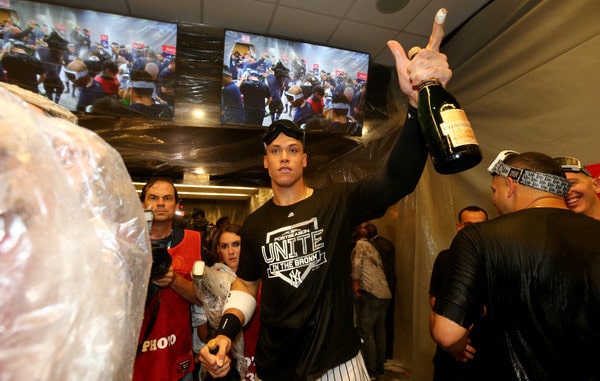
Posted by: | CommentsThe Hot Stove League will soon heat up, but as a bright November weekend dawns in the City of New York, Yankee fans are still recovering from their collective World Series hangover. To that end, we have a few stories for your Saturday reading pleasure.
A World Series moment with the Chamberlains
It’s sometimes easy to forget that Major League Baseball players are young kids who are struggling to adjust to a world very unfamiliar to them. Subject to more debates over the last 2.5 seasons than any 24-year-old should, Joba Chamberlain has been growing up in the New York spotlight. Starter, reliever, overhyped or not, Joba has heard it all. When the Yankees won the World Series on Wednesday, Joba and his dad shared a moment captured by photographers and Yahoo! Sports’ Big League Stew author Kevin Kaduk.
The story is a great reminder about how baseball is about families. It’s about how baseball is about the people and how the players we analyze, the players we admire and the players some people criticize are, at heart, just people similar to you and me. At ‘Duk writes, baseball is always about a father having a catch with his son, and Joba and Harlan had the joy of sharing a baseball moment this week that doesn’t come around too often.
While Joba and Harlan had their hug, Pedro Martinez was feeling less than happy about the game. After his Game 6 defeat at the hands of the Yankees, Pedro tried to duck out on reporters. The media throng cornered him in the hallway, but he would speak only in Spanish to them. One fan taunted him with a chant of “Who’s your daddy?” but Pedro was clearly upset about losing the game. Beating Pedro made this World Series victory even sweeter.
For Tyler Kepner, 2009 marked his eighth season covering the Yanks and their first World Series under his watch. From World Series losses to 0-3 ALCS comebacks, it has been a tumultuous few years in Yankeeland, but as Kepner wrote on Wednesday night, this World Series restored a “peaceful, easy feeling” to the Bronx. No team has won more games in the 21st Century than the Yankees have and now they have their title to go with it. It has indeed been a peaceful time for Yankee fans.
Yanks-Phils Classic sees 42% ratings jump over ‘08
Posted by: | CommentsA year ago, those in charge of baseball were panicking a bit. The 2008 World Series ended amidst some weather-inspired controversies, and no one had watched. Ratings were down 20 percent from 2007, and average of just over 13 million fans, the lowest total since FOX started broadcasting the Fall Classic, tuned in per game. Baseball was on the verge of losing its wider national audience.
However, with the onset of the MLB Network’s wall-to-wall coverage of the sport and, more importantly, the return of the Yankees, the villain of October, to the World Series, ratings for the Series were up a record 42 percent over last year. Although this year’s wasn’t the most watched World Series of recent times, it was the fourth-highest viewed of the last decade and has restored baseball’s October dominance and popularity. Over 19 million fans tuned in each night to watch the Yankees battle the Phillies, and the numbers suggest that the Yankees, as I’ve said before, are good for baseball.
Maury Brown at the Biz of Baseball has more on the ratings:
Fueled by outstanding individual and team performances, dramatic come-from-behind wins and the most one-run games in a single postseason, each round of the 2009 MLB Postseason generated double-digit percentage year-to-year increases in average viewership as compared to 2008, capped by the 2009 World Series averaging 19.4 million viewers, a +42% increase over last year and the largest-ever year-to-year gain in viewership (previous high was 36% from 2000-2001, which followed a low viewership showing for the Subway Series).
Complete 2009 MLB Postseason coverage on FOX and TBS averaged 9.0 million viewers, up +30% over last year and the most-watched since 2005. In addition to the +42% viewership gain for the World Series on FOX, viewership for the Division Series on TBS was up +11% over last year and viewership for the League Championship Series on FOX and TBS increased +14% over 2008.
The 2009 MLB Postseason delivered extraordinary results for FOX and TBS, including leading TBS to the most-watched week in its 33-year history, and catapulting FOX to a commanding +22% lead in the key Adult 18-49 demographic against its network competition. The huge Adult 18-49 season-to-date advantage for FOX is the largest in the network’s history in the fourth quarter and the largest fourth-quarter lead for any network since 2003.
In addition to these hearty aggregate numbers, the World Series was the highest-rated network primetime show during the six nights of games, reports Brown. All over the country, people wanted to watch the Yankees.
And so fans may hate the Yanks. They may root against the team and its payroll. They may say the Steinbrenners bought another title. But the reality of it is simple: Baseball fans tune into watch Goliath because they hope David can win. When David happens to be another team with a payroll in excess of $100 million from a major media market, baseball executives can go home happy. This year, the World Series was very, very good for baseball.
On the eve of free agency, Godzilla makes his mark
Posted by: | CommentsFor seven seasons, Hideki Matsui has just always been there. He arrived in New York in 2003 at the age of 29 and was set to be a solution to the Yanks’ inability to find a steady left fielder, and now with a World Series MVP unders his belt, Matsui has been every bit as good a hitter as advertised.
In ten seasons in Japan, Matsui was a beast. He made his NPB debut at age 19 and amassed a career line of .304/.413/.582 with 245 home runs in 1268 games. In the states, he has played in 916 games and has hit .292/.370/.482 with 140 home runs. As age sapped him of the strength in his knees, his power has declined a bit, but by the end of a healthy 2009, Matsui had reemerged as one of the go-to clutch hitters in the Yankees’ lineup.
This week, Matsui has been the man about town. He appeared on David Letterman last night, carrying in the World Series trophy, and Japanese restaurant import Go! Go! Curry on West 38th St. has been celebrating their fellow countryman this week as well.
My two favorite stories about Matsui this week came from The Times. Jack Curry talked about Hideki’s World Series legacy. Matsui came to the Bronx to win a World Series, reached the Classic in his first year in pinstripes and did not make it back until potentially his last season with the Yanks. Curry notes the symmetry:
For Matsui, the game bookended his performance against Martinez in his first season in the 2003 American League Championship Series. Matsui belted a run-scoring double off Martinez as the Yankees rallied to beat the Red Sox, 6-5, on Aaron Boone’s homer.
After Martinez walked Alex Rodriguez on four pitches to begin the second, his pace slowed against Matsui. After Matsui fouled off a 3-2 changeup, Martinez tossed a fastball. It was an 89-mile-per-hour pitch, which is about as robust a fastball as Martinez can muster these days, and Matsui drilled into the second deck in right field for a two-run homer.
Matsui said he loved New York and hoped that he gets to stay. In Matsui’s first season, he proved that he was comfortable on baseball’s biggest stage. In what might have been Matsui’s final game with the Yankees, he showed that he can still perform professionally and exceptionally.
And then there is Hiroko Tabuchi’s report from Japan where the country has been celebrating Godzilla all week. Newspapers throughout the island nation proclaimed it the year of Matsui, and Japanese baseball fans understand the impact of Hideki’s heroics.
“For this baseball-loving nation,” wrote Tabuchi, “Matsui’s performance at the World Series on Wednesday — hitting a home run, tying a World Series record with six runs batted in and being named the most valuable player — sent a clear message. It put a Japanese player and the Japanese game on the American baseball map more firmly than any compatriot’s performance did.”
Today, Patrick Newman reported that Matsui will not be returning to Japan as had been previously rumored. Instead, the left-handed slugger will look to stay in the states, and if the Yankees want him for another year, I will welcome Number 55 back with open arms.
(image via tsjc)
Poll: What was your favorite moment of the playoffs?
Posted by: | CommentsOkay, I guess everyone’s favorite moment of the playoffs was the weak grounder to second that clinched the Yanks’ 27th World Championship. What about your favorite moment after that?
We already took a poll for the first half and second half, so surely you know how this works. Here’s some notable postseason moments:
ALDS Game Two: A-Rod’s game tying two run homer off Joe Nathan (video)
Twins starter Nick Blackburn kept the Yankees off balance all night, long enough for his teammates to push two runs across against Phil Hughes in the 8th. With a two run lead in the 9th, Rod Gardenhire turned to All Star closer Joe Nathan, who promptly gave up a single to lead off the inning. Alex Rodriguez, still dogged by his playoff choker reputation, took three straight pitches out of the zone before Nathan came in for strike one. A-Rod teed off on his next fastball, sending it deep into the Yankees’ bullpen to tie the game. The Yanks rallied to win the game in extras, but none of that would have been possible if not for A-Rod’s heroics against Nathan.
ALCS Game Two: A-Rod’s game tying homer off Brian Fuentes (video)
Nine innings wasn’t enough, as the the Yanks and Angels went into extras tied at two. The Halos pushed a run across off Al Aceves in the 11th, and turned to Brian Fuentes, another All Star closer. Alex Rodriguez, the first batter in the bottom of the 11th, took two straight fastballs over the plate for a quick 0-2 count, but turned Fuentes’ third heater around and parked it in the right field seats to tie the game. Much like Game Two of the ALDS, the Yanks went on to win, but it wouldn’t have been possible without A-Rod’s shot off Fuentes.
World Series Game Two: AJ Burnett dominates Phillies to tie series at one (video)
In their most important game of the year, enigmatic AJ Burnett went out and shut the Phillies down to tie the World Series at one game apiece. He pounded the zone and was dropping curves in at the knees for strikes when he wasn’t blowing his heat by batters. The uncertainty of middle relief was never a factor in the game, as Burnett handed the ball right off to Mariano Rivera. The Yanks carried the momentum into Philadelphia, where they won the next two games.
World Series Game Five: Johnny Damon singles and steals two bases on one pitch to ignite game winning rally (video)
After pulling ahead in the 5th inning before losing the lead thanks to a Pedro Feliz homer in the bottom of the 8th, Hideki Matsui and Derek Jeter went down with ease against Phillies’ closer Brad Lidge in the 9th. Damon fouled off five pitches as part of a nine pitch at-bat, eventually dunking a single into shallow left. On the very next pitch, Damon took off for second, and not only did he make it safely, he headed down to third because no one bothered to cover the bag. The go-ahead run was on third, and before you knew it the Yanks pushed some runs across to win the game.
Those are just some of the highlights in the playoffs. Vote on your favorite below, but if you think another moment was the best of the playoffs – maybe Mariano Rivera getting out of a bases loaded, none out jam in Anaheim, or Hideki Matsui’s homer in Game Six of the World Series, or CC Sabathia’s start on short rest against the Angels – use the “Add an Answer” button to write in your own favorite moment. Don’t add any bad words like the jerk who did during our first favorite moment poll, we’ll just delete it and ban you from ever even accessing the site, let alone commenting. Yes, we can do that.
Everyone knows that everyone’s favorite moment this postseason was winning the World Series, so keep it out of the poll so we can have a little diversity. Consider this a “what’s your second favorite moment” poll. Thanks.
The most important game of the year
Posted by: | Comments
Fans are quick to throw around the “must win” or “huge game” or (ahem) “playoff preview” moniker these days. If a team loses two games in a row with a division rival set to come into town over the weekend, then it’s called a big game. No matter what fans call it, you can always tell which games are the most important by how the team treats them. When Ian Kennedy is brought into the eighth inning with a one-run lead in Anaheim for his first action of the season, then yeah, it’s not all that important.
Most of the time for a playoff club, the most important game of the season is a Game Seven, or an elimination game where the season was on the line. Those are the true “must-wins,” not those dumb games in June that seem important just because the offense is in a little bit of a funk.
For the 2009 Yankees, the most important game of the year seems pretty clear to me: Game Two of the World Series.
Think about the circumstances coming into the game. Cliff Lee had just manhandled the Yankees the night before. He crushed them, grabbing liners behind his back and shagging pop-ups nonchalantly when he wasn’t striking guys out. For a team that had dominated the competition during the regular season and made good clubs like the Twins and Angels look like Little League teams with all the mistakes they forced, Game One of the World Series was a humbling experience.
Not only did the Yankees come into Game Two already down one-love in the series, they were going on the road to Philadelphia for the next three games. Heading down the turnpike down two games to none was something the Bombers wanted to avoid at all costs. So they gave the ball to AJ Burnett, the most unpredictable starter in their playoff rotation.
And AJ delivered.
He pounded the zone early all night, throwing first pitch strikes to 22 of the 26 batters he faced. He threw his fastball and curve at almost a 1:1 ratio (53 fastballs, 45 curves), and allowed the first four batters in Philly’s’ lineup to reach base just twice, and one of those instances was an intentional walk to Chase Utley. Burnett sat down the last eight batters he faced, and the only run he gave up came on a ball that ricocheted off Alex Rodriguez’s glove.
It was a masterful performance, and the game was more important to the outcome of the Yankees’ season than either of his Game Five starts (ALCS or World Series). Opposing starter Pedro Martinez held the Yankees’ offense down, meaning there was little margin for error. Anytime a start can hand the ball off to Mariano Rivera in a playoff, then you know he’s done his job and then some.
Let’s give AJ some props. He’s frustrating as hell, but the dude was money in the team’s most important game of their championship season.
Photo Credit: David J. Phillip, AP
Closing it out while fighting an injury
Posted by: | CommentsAs the Stadium emptied out and the Yanks continued to celebrate into the wee hours of the morning, Mariano Rivera stopped by the ESPN stage to chat with Peter Gammons, Steve Berman and Dave Winfield about winning the World Series. Rivera is just three and a half weeks shy of his 40th birthday, and his face expressed elation at capturing a fifth ring.
He started out the interview by talking about the long wait, putting the ghosts of 2001 to bed and Andy Pettitte. Laughing at how Pettitte performed on three days’ rest, Rivera simply said with a smile, “That old goat is wonderful.”
I know Rivera won’t complain about his workload, but he had a very long season this year. Although his regular season innings total of 66.1 was a seven-year low, his 16 postseason innings are the most he has thrown since 2003. He was clearly feeling the effects of making 78 appearances this year. “I’m beat up, man,” he said to the ESPN crew.
And then he let slip a secret. “My side was killing me. I don’t know how I finished,” Rivera said. Yankee fans had a feeling something was wrong with Rivera during Game 4 when FOX caught him holding a heating pack to his right side, and last night, he confirmed what he called a “rib injury.”
Rivera labored last night. He needed 41 pitches to get five outs after using just 13 to get the previous five outs. His velocity seemed to be a tick lower than usual, and his control wasn’t as sharp as it generally is. When the game, the season, the World Series ended, though, Rivera was on the mound, and he could rest his rib. “We did not want to say about it,” he said. “Thank God we finished that today because I don’t think I could go another day with that.”
After the game, though, Rivera said he could keep going. He wants to pitch for another five years and might just be serious about it. “I’m serious,” he said to Chad Jennings. “I hope the organization does whatever it takes to bring me back.”
In today’s Times, Jack Curry writes glowingly of Rivera, and it’s no secret that Mariano is my favorite player. In fact, for every single playoff game this season, I wore my Rivera 42 2008 All Star Game jersey. Now, we hear he is injured, and he closed out the World Series while hurt. Yet, it doesn’t show. He takes the ball; he throws that cutter; he gets his outs. The legend and the greatness of Mo just continues to grow, and five years after he retires, I’ll be in Cooperstown with him, watching a great player earn a spot in the Hall of Fame.