How good has Nick Swisher been compared to previous Yankee right-fielders?
ByWhile I’m sure Nick Swisher doesn’t need defending among RAB’s audience, his name has continued to arise this offseason due to a variety of factors: (a) As the Yankees’ only position-player free agent among the starting nine next offseason, he would seem to be the most tradeable; (b) Some folks are still irrationally mad at Swish for underperforming in three separate and completely unrelated small sample sizes; and (c) the Yankees need pitching, which is basically an extension of (a).
Here’s the problem with any trade speculation involving Swish: Nick Swisher is (as I mentioned in the above-linked piece) the living and breathing embodiment of the ideal New York Yankee on offense, a sabermetrician’s dream of patience and power who led the team in OBP in 2011 with a .374 mark despite starting the season in a horrid slump, notched the best BB% on the team, at 15% — a massive jump from 2010′s 9.1% not to mention the third-best mark in the American League — and finished 11th in the AL in pitches per plate appearance (20th in 2010 and 2nd in the league in 2009).
He’s really quite good at what he does, random postseason struggles aside. This becomes even clearer when taking a quick scan of the 2013 outfield free agent class:
Left fielders
Josh Hamilton (32)
Eric Hinske (35)
Mark Kotsay (37)
Carlos Lee (37)
Juan Rivera (34) – $4MM club option for 2013 with a $500K buyout
Luke Scott (35)
Delmon Young (27)
Center fielders
Michael Bourn (30)
Marlon Byrd (35)
Melky Cabrera (28)
Curtis Granderson (32) – $13MM club option with a $2MM buyout
Angel Pagan (31)
B.J. Upton (28)
Shane Victorino (32)
Right fielders
Matt Diaz (35)
Andre Ethier (31)
Torii Hunter (37)
Mark Kotsay (37)
Carlos Quentin (30)
Juan Rivera (34) – $4MM club option for 2013 with a $500K buyout
Ryan Spilborghs (33)
Ichiro Suzuki (39)
Nick Swisher (32)
Before the Dodgers extended Matt Kemp, fine, I’d have been alright with letting Swish walk in favor of Kemp patrolling whichever section of Yankee Stadium’s outfield he wanted. However, as it currently stands, none of next year’s pending free agent outfielders are better than Swish. The only names on that list that I would maybe think twice about are Carlos Quentin and Shane Victorino, and Swish has been a better offensive player (.370 wOBA) than both outfielders over the last three seasons (both Victorino and Quentin have matching .354 wOBAs during that same timeframe). Yes, we all know Josh Hamilton’s been a beast (.388 wOBA over the last three seasons), but he also can’t stay healthy and will presumably be looking for a huge deal. With all of these players essentially the same age, I’d go with the devil you know who has also played in 150 games in each of his three seasons in pinstripes.
But wait, there’s more. Here’s a rundown of Yankee right-fielders over the last 20 individual seasons, sorted by OPS+:
| Rk | Player | PA | Year | Age | G | AB | 2B | HR | BB | IBB | SO | HBP | |||||
|---|---|---|---|---|---|---|---|---|---|---|---|---|---|---|---|---|---|
| 1 | Paul O’Neill | 176 | 443 | 1994 | 31 | 103 | 368 | 25 | 21 | 72 | 13 | 56 | 0 | .359 | .460 | .603 | 1.064 |
| 2 | Danny Tartabull | 152 | 526 | 1992 | 29 | 123 | 421 | 19 | 25 | 103 | 14 | 115 | 0 | .266 | .409 | .489 | .898 |
| 3 | Gary Sheffield | 141 | 684 | 2004 | 35 | 154 | 573 | 30 | 36 | 92 | 7 | 83 | 11 | .290 | .393 | .534 | .927 |
| 4 | Bobby Abreu | 138 | 248 | 2006 | 32 | 58 | 209 | 16 | 7 | 33 | 1 | 52 | 1 | .330 | .419 | .507 | .926 |
| 5 | Gary Sheffield | 137 | 675 | 2005 | 36 | 154 | 584 | 27 | 34 | 78 | 7 | 76 | 8 | .291 | .379 | .512 | .891 |
| 6 | Paul O’Neill | 137 | 637 | 1997 | 34 | 149 | 553 | 42 | 21 | 75 | 8 | 92 | 0 | .324 | .399 | .514 | .912 |
| 7 | Paul O’Neill | 137 | 543 | 1995 | 32 | 127 | 460 | 30 | 22 | 71 | 8 | 76 | 1 | .300 | .387 | .526 | .913 |
| 8 | Paul O’Neill | 136 | 547 | 1993 | 30 | 141 | 498 | 34 | 20 | 44 | 5 | 69 | 2 | .311 | .367 | .504 | .871 |
| 9 | Paul O’Neill | 130 | 672 | 1998 | 35 | 152 | 602 | 40 | 24 | 57 | 2 | 103 | 2 | .317 | .372 | .510 | .882 |
| 10 | Nick Swisher | 129 | 635 | 2010 | 29 | 150 | 566 | 33 | 29 | 58 | 0 | 139 | 6 | .288 | .359 | .511 | .870 |
| 11 | Paul O’Neill | 123 | 660 | 1996 | 33 | 150 | 546 | 35 | 19 | 102 | 8 | 76 | 4 | .302 | .411 | .474 | .885 |
| 12 | Nick Swisher | 122 | 607 | 2009 | 28 | 150 | 498 | 35 | 29 | 97 | 2 | 126 | 3 | .249 | .371 | .498 | .869 |
| 13 | Bobby Abreu | 120 | 684 | 2008 | 34 | 156 | 609 | 39 | 20 | 73 | 2 | 109 | 1 | .296 | .371 | .471 | .843 |
| 14 | Nick Swisher | 117 | 635 | 2011 | 30 | 150 | 526 | 30 | 23 | 95 | 6 | 125 | 5 | .260 | .374 | .449 | .822 |
| 15 | Bobby Abreu | 113 | 699 | 2007 | 33 | 158 | 605 | 40 | 16 | 84 | 0 | 115 | 3 | .283 | .369 | .445 | .814 |
| 16 | Raul Mondesi | 110 | 403 | 2003 | 32 | 98 | 361 | 23 | 16 | 38 | 6 | 66 | 2 | .258 | .330 | .471 | .801 |
| 17 | Paul O’Neill | 107 | 675 | 1999 | 36 | 153 | 597 | 39 | 19 | 66 | 1 | 89 | 2 | .285 | .353 | .459 | .812 |
| 18 | Paul O’Neill | 104 | 563 | 2001 | 38 | 137 | 510 | 33 | 21 | 48 | 4 | 59 | 2 | .267 | .330 | .459 | .789 |
| 19 | Raul Mondesi | 96 | 302 | 2002 | 31 | 71 | 270 | 18 | 11 | 28 | 2 | 46 | 2 | .241 | .315 | .430 | .744 |
| 20 | Paul O’Neill | 92 | 628 | 2000 | 37 | 142 | 566 | 26 | 18 | 51 | 2 | 90 | 0 | .283 | .336 | .424 | .760 |
| 21 | Shane Spencer | 86 | 329 | 2002 | 30 | 94 | 288 | 15 | 6 | 31 | 4 | 62 | 4 | .247 | .324 | .375 | .699 |
Swish’s three seasons didn’t end up ranking quite as high as I’d have expected, although that’s really more a tribute to how beastly Paul O’Neill was in pinstripes than any shortcomings on Nick’s part.
However, the case for Nick Swisher as one of the best Yankee right-fielders of the past two decades really comes into focus when we look at the cumulative numbers (minimum 300 PAs, sorted by fWAR), courtesy of FanGraphs:
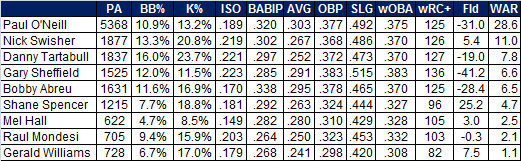
Who knew Danny Tartabull was a regular OBP machine? The Yankees have gotten some pretty robust offensive production out of their right-fielders for a large chunk of the past 20 years. As you can see, Swish is tied for third-best wOBA with Bobby Abreu and Tartabull, but more importantly, has been considerably more valuable than both men in a similar amount of PAs due to his superior glovework.
While the Yankees may not see another Paul O’Neill for a good while — believe it or not, O’Neill actually has a decent case for one of the top Yankee rightfielders of the last 50 years (2nd-highest fWAR, 3rd-highest OBP, 6th-highest wOBA) — they’ve arguably got the second-best thing in Nick Swisher.


If they could sign Beltran for two years, I think trading Swish now could be an example of trading high.
Is that really worth it though? Beltran is an injury waiting to happen for more money. I don’t see the appeal over Swisher.
See the appeal? In his first year back from injury his WAR that year was higher than Swisher has ever done. That’s why the Yankees were interested. They didn’t like his emdicals otherwise he’d be a Yankee.
if healthy he’s completely better than Swisher.
He hasn’t been healthy in three years now.
Which is why Swish was here. But there was interest and appeal from the Yankees that Swish has a day of rumors but they didn’t like the medical reports.
is* here
That’s a pretty big if. And if you already have a solid option, what’s the point?
It would be Swisher on his own for one year, or Beltran for two years, plus whatever we get in the Swisher trade.
I like the two year deal for Beltran and trade Swisher move, theoretically. Obviously, you don’t know if anybody is looking to give up anything much for Swisher or if Beltran wants to sign with the Yanks for two years.
Why would a team trade prospects for Swisher knowing they can sign Beltran for only money?
Because they don’t like Beltran’s knees and prefer a one year commitment as opposed to 2 or 3, not to mention the fact there are multiple teams that want Beltran so they might not get him at all.
1 and 2 are obviously good reasons but I don’t think they’d be enough for a GM to decide to sacrifice prospects.
As for #3, sure if they don’t get Beltran they would want to trade for Swisher. But then the Yankees wouldn’t be able to sign Beltran (unless of course they signed Beltran before trading Swisher which is highly unlikely).
I doubt Beltran signs for 2 years only since he is a Boras client. Swish is cheap and will probably bounce back on the production this year. He’s younger than Beltran, solid defensively in right field (no knee issues) and is great in the clubhouse.
Yeah, it’s a big if that he would take a two year deal, but Swish may not be cheap after this season because it’s probably his last chance for a very big contract.
Beltran did offer the Yankees a discount in 2004, so that’s why would gauge his interest in possibly doing it again.
He really isn’t cheap this season either. He is getting paid about market value, maybe only very slightly under at best.
Considering his health who would give Beltran more than 2 years? I haven’t followed the market on him, but I think he is a high risk investment.
Beltran switched agents this year to Dan Lozano, FWIW.
What do you think Swisher could net in a trade?
I would hope a near ML ready position prospect(s) (OF, 3B, SS) since that’s their current weakness other than at catcher.
Mike HC, I think Cuddyear’s contract does make Swisher’s contract cost-effective. A team doesn’t have to make a longer term commitment now, and they could get a relatively high pick if he leaves.
I luv Swish. But the game changes in the playoffs and he has a hard time handling it.
Huge take. Next caller.
Bring back O’Neill #21. YES salary plus performance incentives.
Babe Ruth was better
And a lot cheaper.
I’ve got nothing against Swisher. The Yankees could do much worse in RF and considering what they gave up to get him, he’s been a steal. Add in his personality and clubhouse presence, he’s good.
Aside from Paulie, Sheff was my other favorite RF. With him, Giambi and A-Rod hitting on all cylinders, that was a scary 3-4-5.
And with Jeter, Posada and Matsui, it was a terrifying lineup.
yeah, 1-9 they were scary. Damon, Jeter, Abreu, A-Rod, Sheff, Matsui, Giambi, Posada and Cano? That was impressive, even if that lineup was only for a half season or so.
“Who knew Danny Tartabull was a regular OBP machine?”
Certainly not me. In retrospect, The Bull had a nice career, better than I had recalled.
Also:
Tartabull’s slash line
.273 .368 .496
Swisher’s (his season with the Sox drags it down a bit)
.254 .360 .466
I was floored when I found out Kevin Seitzer had an career OBP of .375.
Its better to burn out than fade away.
Wanna make it even weirder? His last three seasons as a pro his slash line in 1465 PA’s is….311/.394/.433.
All higher than his career avg’s. His last year was kind of a stinker though but was only 220 PA’s.
He got beaned in the face at the end, right? I don’t remember if he just retired after it or if it led to his retirement, but I don’t think his was just a lack of interest.
I was just surprised by his OBP effectiveness.
Yup. I love looking back on guys I grew up watching and figuring out who I would have been really into and who I thought was a lot better than they were.
(Like Dwight Evans. I would have reluctantly argued about the awesomeness of Evans.)
“The Yankees have gotten some pretty robust offensive production out of their right-fielders for a large chunk of the past 20 years. As you can see, Swish is tied for third-best wOBA with Bobby Abreu and Tartabull, but more importantly, has been considerably more valuable than both men in a similar amount of PAs due to his superior glovework.”
I find it curious that so many recognize that these fielding stats are terrible yet they are not only sighted but accepted as proof that Swisher is the best right fielder since ‘ahem’ Shane Spencer.
Fielding stats are recognized as being imperfect, not terrible (if given a large enough sample size). Besides you don’t need stats to see Swish is a superior defender to Bobby “never met a wall I was afraid to get near” Abreau.
But is he really 36 runs better than Paulie? Fielding stats are recognized as being imperfect, but I may go so far as to say they are crap. People recognize these failures and then say stuff like “Well UZR has not figured out how to grade first basemen” or some other dismissive comment while still using stats like WAR that rely heavily on them. I just do not feel these metrics are ready to be used yet and to incorporate them into WAR can only result in some pretty poor decisions
I don’t think the issue there is so much that UZR can’t give a reasonably accurate portrayal of OF defense over a large enough sample size. The issue with Paulie is that he retired in 2001, and I don’t believe UZR came into play until 2002, so O’Neill was being rated some other way (not sure how?) I would agree that comparison of the two based on defensive measures when they were rated under different systems should be taken with a huge grain of salt, but I don’t think its so much because of any flaw in UZR as it is the fact UZR wasn’t around to rate O’Neill.
I don’t think anyone who makes roster decisions looks up WAR on b-r or fangraphs. For the purposes of internet discussions of baseball players, I think using those sites is sufficient.
I’m no fan of UZR, I wasn’t when MGL invented it back in the day, and my opinion hasn’t changed, but as a blunt instrument at positions other than 1B and C, it’s good enough. If one player has a WAR of 6 and another has a WAR of 4, I’d trust one is better than the other.
The problem is when people say “Player A has 5.3 WAR and player B has 5.8 WAR so player B is better.” It was never designed to be that specific.
Shoot, don’t get me started on UZR.
You take UZR, I’ll take FIP and we’ll start to tear down those stupid nerds with their nerd stats. Then rebuild with better nerd stats.
Plank,
I think that’s a very well-put way of dealing with WAR’s inherent limitations. At this point anyone who’s into reading about baseball on the web is probably aware of WAR’s flaws, but until something better (or more freely accessible) comes along, it can generally be a helpful barometer when making player comps in certain instances.
As long as it’s not being treated as the be-all end-all, there’s still some value in utilizing it as a benchmark, even if the currently available fielding metrics seem to come up short.
I like WAR so much better when you back out defense, recalc it then look at defense in a +/- sort of way. Otherwise you end up with stuff like Gutierrez and Gardner as top 25 most valuable players and that just doesn’t work.
(That was terribly phrased given that there’s a defensive stat named +/-. I meant accepting the quantifications of offense and position and replacement level then using defensive metrics as a non-numerical bonus or demerit.)
just out of curiosity, what would you think a fair + number for Gardner’s defense would be? Wouldn’t you need to put some kind of number on it to determine to what extent great defense offsets mediocre offense, or poor defense offsets good offense. For example, if Gardner really does save 25ish runs/year over average defense LF, then Gardner is really that valuable. A run saved counts just as much as a run created.
Exactly. You need to put some amount in order to compare it. If Mr. Delaware is claiming that he feels his gut instinct about how many runs to award a player for his defense is better than even a flawed stat like UZR…put me in the skeptical category. I think it’s best to use a mishmash of the available ways to rate defense. In Gardner’s case that leads to a slightly more measured praise — FRAA doesn’t love his defense as much as the batted ball systems, but still that he’s worth about 4-5 wins a year.
“You need to put some amount in order to compare it. If Mr. Delaware is claiming that he feels his gut instinct about how many runs to award a player for his defense is better than even a flawed stat like UZR…put me in the skeptical category.”
I’m saying the opposite, really. I’m saying its better to not quantify when the other choice is a quantification that can’t be relied on. With offensive WAR, we know the inputs are correct or atleast consistently applied across all players. With defensive WAR, we don’t, because we all (I think) have our issues with the means of measuring and the measuring itself. The massive restatement of Fenway Park a few years ago is a really good case in point; Jason Bay’s defensive WAR numbers did a complete 180. I don’t see why that can’t happen again, for example, in terms of measuring the polar positions like LF (where some players outright suck and some are huge plusses) relative to the premium positions like CF (where even bad defensive CFs are pretty decent defenders overall).
I would assume most teams use their own metrics based on FieldFX intead of BIS zones like UZR is.
My biggest gripe with UZR is that it is essentially a black box. MGL has never released his formula. He has explained some of the logic of UZR, but he just gives numbers and people are supposed to trust them. Fangraphs picked it up, and voila, it became the go to standard for freely available defensive metrics. He admits that it’s not that sensitive, but fWAR uses it to the tenths place anyway. It could be just as effective as he says it is (which is not as effective as how people use it) but how would anyone know?
Plank, exactly on the Field F/X thing. If you had measurements of each BIP’s starting point, ending point and time from bat to ground, you could get a much, much more accurate view of which guys use their range most effectively. Aside from flukes like IFs breaking the wrong way because of a SB attempt or sunlight plays, it would clean up a ton of the noise and miscategorized plays.
So, summarized, it comes down to me preferring a metric that would measure effective range, in feet-per-second or something, rather than catches and non-catches, because the latter can get skewed by both teammates and opportunity differences. On offense, all players are walking to the plate with the same general starting point. In the field, making 8 out of 8 plays doesn’t necessarily mean a guy is better defensively than the guy who made 4 of 6. Could mean just the opposite based on where those balls were hit and how hard.
I believe Field FX measures the location of every player during a play, too. I would think it can measure the route players take and their reaction time of reading a ball after it leaves the bat. It seems like that information would be informative.
I’m not 100% sure on that. I think it’s true, though.
I think you’re right. And I think Shane Victorino’s flight paths (or whatever they’d call it) on balls over his head would be hilarious.
“I’m saying it’s better to not quantify when the other choice is a quantification that can’t be counted on”
So what you meant above is that you literally just deal with defense as either a plus or a minus? It seems hard to me to imagine that a system with that few buckets (i.e. a player is either positive or negative, two buckets) is really more informative than a system with essentially infinite buckets, even if it’s harder to sort the players into the buckets. UZR gives a lot of information. Is that information perfect? Certainly not. But I think UZR telling me that Brett Gardner was woth 18 runs on defense and Nick Swisher was worth 6.9 runs tells me a lot more than you saying Brett Gardner is a +, and Nick Swisher is also a +.
It seems to me like that is sacrificing a lot of accuracy to get a little precision.
Luckily there can be both non-quantitative and non-binary, although I guess I just do a more nuanced version of what you said. Plus-plus, plus, average, minus or super minus would probably be my mental buckets, informed by the stats, mostly DRS.
And given the variances between metrics and inaccuracies inside each, I don’t think 5 categories is much less meaningful. Like you can say “it might not be +20 but its definitely within 2 runs either way”. Large margin of error and non-absolute system and all that.
Sorry, should have gone in order here, not ignoring your question …
“just out of curiosity, what would you think a fair + number for Gardner’s defense would be?”
I don’t know. I think eventually we will know but don’t right now. The problem is trying to quantify what we accurately can’t.
“Wouldn’t you need to put some kind of number on it to determine to what extent great defense offsets mediocre offense, or poor defense offsets good offense. For example, if Gardner really does save 25ish runs/year over average defense LF, then Gardner is really that valuable. A run saved counts just as much as a run created.”
Absolutely to all of this. I think its very possible Gardner saves 25 runs per year with his glove, or more, or half that. I just don’t think the publicly available metrics measure that yet. Just for an example, a ball in the gap between Gardner and Granderson, either can get. One does, so only one gets credit. That same ball between Rasmus and Snider, Rasmus is taking every time. Is Rasmus better than Granderson? Maybe. Will the numbers say he is, based on those plays? Yup. That’s my issue, in a nutshell.
Swish has done everything that he could have reasonably expected of him, and more. It is impossible to predict who is going to be the Scott Brosius or David Freese of the playoffs. Any player better than Swish has to be considered a star, even then it doesn’t guarantee October success.
Assuming similar enough years and dollars requests, I’d put Swisher 4th behind Victorino (low baseball IQ and all), Upton (some day, he’s going to explode) and overrated-but-good Ethier.
Hamilton is clearly a different player. Swisher is better than Quentin, at best a push. Upton, Victorino, even Pagan offer a speed and athleticism approach, though not necessarily better
Paul O’Neill’s best year in his 20′s, .256/.346/.481.
Paul O’Neill’s 3rd worse year in his 30′s .285/.353/.459
He was better at 38, .267/.330/.459, than he was at 25, .252/.306/.414
Maybe the Yankees would be selling low if they got rid of Swisher now.
I was upset when I heard they ot rid of Roberto Kelly. I thought we got robbed. Funny how that works out.
Yup.
I loved the trade because Paul O’Neill was awesome on Sportstalk Baseball for Sega Genesis. He was a big time homerun hitter in that game.
I’m surprised no one has replied to this comment with “steroids” yet.
Must mean no local, ESPN or CNNSI writers have checked this thread yet.
It wouldn’t bother me, but it’s not impossible. He was angry a lot.
Seems like he should bat 1 or 2, not 6-7 like he usually does. “Too much power” to lead off?
Not enough salary or “Captain-ism” to lead off?
On the other hand, while is OB skills might make him look like a good lead off hitter, I’m not sure his speed or base path skills make him a good choice.
I really think you’re missing Upton as a potential upgrade next off-season. He has good numbers and he’s much younger.
Who do you think will have a better next 3/4 years Upton or Swisher?
price might become a factor there
Given Upton’s age and likely higher potential, Upton would likely command more in years and dollars (which the Yankees might not want to commit to him with the need to extend Cano and Granderson the year after)
If the price was comparable though, I’d certainly prefer taking a shot with Upton
I hope they don’t extend Granderson.
any particular reason??
I’m not sure they will, and I’m expecting him to regress negatively at least somewhat this season, but his power plays very well in YS. If the price is right, I would think they would try to lock him up.
I wish I knew. 1st/2nd year Upton is a ton better than Swisher, 3rd/4th/5th year Upton is maddening. Upton is the better bet for stardom, Swisher is the better bet to not be below average.
I’d love to see what K Long can do with Upton
Same. The hands part of Upton’s swing is about as pretty as you’ll see. That grinding of his front toe is not.
Let’s break Swish down on a tool basis.
Baserunning? Slow as molasses, bad instincts.
Arm? Erratic, lots of loopy throws.
Fielding range? Limited. He’s slow and he gets pulled in the late innings and not because he’s old and needs the rest. Has there ever been a first baseman slash outfielder who was a good outfielder?
Hits for average? No. Particularly from left side.
Hits for power? Moderate. 23 HRs in the new YS is moderate at best and that’s his latest report.
As for his walks, notice he had a big dropoff in 2010 when he was batting second. He takes the pitcher’s strategic walk and now that the Yankee lineup is no longer circular, he gets a lot of those batting sixth. He had zero intentional walks in 2010, six in 2011.
He is not a good breaking ball hitter. His swing from the left side has holes as reflected in his 2011 numbers. Tex gets all sorts of crap for his performance as a LHB but Swisher’s numbers were just about as mediocre (except Tex hit a lot more home runs).
Swish’s OPS has been respectable. So was Abreu’s. Cashman kicked Abreu to the curb while he acts as Swishers’s champion. Funny, that.
Abreau was older, entering his decline years, and was horrible defensively
Swish is younger and league average defensively
That’s a pretty big difference. And when has Cash acted as Swisher’s “champion”? Because he picked up Swish’s very reasonable option when there were no really better options available?
And made half the money.
I believe the Yanks could have negotiated with Abreu as a free agent after they non-tendered him, and he wound up going for cheap. After Tex was signed, Cashman could have re-dealt either Swish or Nady if he wanted to make room for Abreu. Swish didn’t have a position at that point.
Abreu earned himself a good follow-up contract with the Angels.
At that point, I think the Yankees viewed Abreau as strictly a DH (appropriately IMO) and wanted no part of him in RF on a regular basis
Abreu’s 2008 dWAR was 0.0. Not admirable but
Nady didn’t have a rep (or the stats) as a good fielder either. Nor did Swish (neg dWAR in 2008).
You’re right that was the Yankees’ justification and there was something to it. My point is that Swish has a lot of flaws that could also be seized upon as justification to try someone else.
And I would not agree that there was no reasonable alternative to picking up Swish’s option. We’ll see what Beltran winds up signing for.
depends on the metric for Abreau, UZR had him -21.4 for 2008
As far as Beltran, I think the injury concerns and likelihood of a multi-year contract make him less practical for the Yankees. If they make a change, I would think they would look to get younger and more durable, considering the age and durability concerns already present with Jeter and ARod
Cespedes then.
Yes, risky. Everything has a risk, including staying with the same lineup until 2015, which is the way things are going.
Fielding range? Limited. He’s slow and he gets pulled in the late innings and not because he’s old and needs the rest. Has there ever been a first baseman slash outfielder who was a good outfielder?
Swisher is actually a very respectable outfielder. He looks pretty ugly going after balls, but he gets to a lot more balls than the typical right fielder.
Hits for power? Moderate. 23 HRs in the new YS is moderate at best and that’s his latest report.
He was 27th in MLB among outfielders for ISOP. That’s not elite, but it’s solidly above average.
As for his walks, notice he had a big dropoff in 2010 when he was batting second. He takes the pitcher’s strategic walk and now that the Yankee lineup is no longer circular, he gets a lot of those batting sixth. He had zero intentional walks in 2010, six in 2011.
He did see the 17th most pitches per plate appearance in MLB last year, which is a good thing regardless of whether he draws walks or not.
As for walks, they’re probably more related to the fact that he swung at the third fewest pitches out of the strike zone this year among all MLBers. And he’s not just a guy that sits there an never swings – he swung at slightly more than the league average number of pitches in the strike zone (66.1% vs 65%)
So, once you consider the facts, most of your arguments don’t make sense.
I’d be more impressed by your conclusion if you addressed my points more directly.
Swish does get pulled for defense when an extra outfielder (Dickerson) is available, which isn’t something that usually happens to a relatively young OF who is actually regarded as an above average fielder. “Moderate” is a matter of word choice if we’re agreeing his power is not elite. And his pattern of swinging at pitches doesn’t explain why his walks dropped so sharply when he was placed second in the batting order (in 2010) rather than towards the bottom of the order.
a RF being replaced by a CF on defense doesn’t mean the RF is bad, just that the CF is better and the manager is trying to make full use of his bench
As for the walks, in 2010 Swish walked 38 times in 378 PA batting second, 20 times in 257 PA elsewhere. His walk rate was 9.1% overall, 10.0% batting 2nd, and 7.8% batting elsewhere. It would seem his BB% decline had more to do with an overall decline in BB% that year, since he walked more, not less batting second that year
His career BB% is 13.5%, while his career BB% batting second is 13.4%
So you’re questioning his drop in walks in 2010, ignoring he had his best season as a Yankee that year?
Regarding your Abreu love (and he was a fine player), the Angels wouldn’t hesitate to do an even swap of Abreu for Swisher. The Yankees wouldn’t do it.
The issue is somewhat complicated by the fact that Cashman actually chose Nady as Abreu’s replacement-in-waiting. Even though the justification for getting rid of Abreu was his fielding and Nady was himself a hack in that regard.
The Angels would not have exchanged Abrea for Swisher in 2009. And I don’t think other teams are eager to pay Swisher $10M a year now. We’ll see what happens if he goes to the open market after this year.
Cuddyer got 3 years for 10.5/year
Swisher > Cuddyer and only required a one year commitment with the option
I thought I was actually very direct in addressing your points. Without spending way too long replying, this was the closest I could come to a point-by-point rebuttal.
And his pattern of swinging at pitches doesn’t explain why his walks dropped so sharply when he was placed second in the batting order (in 2010) rather than towards the bottom of the order.
Here’s his Out of Zone and In Zone Swing% and BB% by year:
O% Swing% BB%
2006: 17.3 % 41.0 %
2007: 16.6 % 37.8 %
2008: 18.9 % 38.5 %
2009: 17.3 % 35.7 %
2010: 25.7 % 44.5 %
2011: 21.1 % 39.9 %
While Swisher certainly earns his paycheck each year, his production is not irreplaceable. It’s relatively easy to find offensively productive right-fielders.
Let’s not act as if we’re married to our favorite players…
Is it? Josh Willingham just got a 3 year commitment.
So did Cuddyer. And no one would take Cuddyer or Willingham over Swisher.
I’d take Willingham over Swisher. He’s close to the same player in the regular season, and he can’t be any worse in October.
I like Swish, but fuck him. He needs to go. I don’t care how good he is in the regular season. When the playoffs come, he disappears. He has no business being on this team.
How you went from “I like Swish” to “fuck him” and “he has no business being on this team” is quite a transition. I mean even if he REALLY can’t ever hit in the playoffs, the regular season counts (supposedly) and Swisher performs quite well in the regular season.
I would call that transition abrupt, but flawless.
Haha. I do like him, don’t get me wrong. But I’d rather have someone I don’t like for whatever reason help the team in the playoffs.
I’d take Andre Eithier over Swisher
If Ethier could stay healthy, I would. But he can’t.
With the new austerity plan, I don’t know if they are willing to extend Swisher. He is obviously our best option as of now. I knew that O’Neill was good but the sabermetrics stats he appears even better. If they are not going to sign Swish, whom I like very much, despite his struggles in the postseason, then the cheaper next best player over the long run would be Cespedes.
i.e. with the sabermetric stats…
Man this article should have been called Paul was a Yankee Beast.
Not to mention he was so entertaining to watch in the dugout.
that was my takeaway. his goofy announcing style makes it easy to forget how good he was
i remember mattingly saying his arrival in 1993 was the moment the clubhouse culture started the change
and looking at his 1994 numbers reminds me of how crushed i was by the strike that year
at the time, i believed 94 was their one and only shot
and then i thought 95 was their one and only shot
different world back then
O’Neill definitely was a beast.
Without a suitable replacement, I’d offer Swisher 2 years for $25 million. Someone will probably offer him 3 years but I think he loves playing in NY.
Plus taking into account the RAB tenet that all players reach their regular season numbers in the postseason if given a large enough sample size, Swisher is due to just explode any October now.
“Plus taking into account the RAB tenet that all players reach their regular season numbers in the postseason if given a large enough sample size”
That’s a bit of a reach. I would reasonably expect all players over a large enough sample size to have slightly worse numbers in the postseason due to facing higher quality pitching on average in the postseason than in the regular season.
That said, Swish still should be due for some positive regression.
That statement was an attempt (a poor one I guess) at being facetious.
I agree with you about expecting worse numbers and I also think it’s a lot more than just luck why some players seem to excel in the postseason.
jeter career regular season ops: 832
jeter career post-season ops: 839
“clutch” means maintaining your ability under pressure, not magically turning into a better player (impossible)
I wholeheartedly agree. Anyone who’s played sports at any level knows how much more difficult it is to perform in a tense situation.
I think there are plenty of players in all sports who can’t execute when the pressure is on and others who are able to focus even more and raise their performance a bit.
That assumes there is no overbearing pressure until the playoffs. HS in front of major league scouts? College world series? Minor league auditions? Making it and trying to stay in the majors? Why do people think guys don’t choke until the playoffs? The guys who get there, 99% of the time, aren’t choking. (The other 1% of the time its Nick Swisher!!!)
If one guy is “choking”, doesn’t someone else have to be “turning into a better player”? Every negative has a positive.
If I remember correctly, overall offense decreases by approximately 15% in the postseason compared to the regular season. If that stat is correct, then it appears that Jeter is performing at a higher level in the postseason.
I’m not advocating the Jeter is a better player in the postseason, but the straight line comparision of regular-season stats to postseason stats requires some context. It always seems to get left out of the discussion.
Pitchers are just stepping up while hitters choke.
timing could possible account for some of Jeter’s postseason/regular season comparison. Jeter has played in 152 postseason games, but just 14 of those came in Jeter’s 3 worst OPS seasons (2008, 2010, 2011) In contrast, he played 32 postseason games in his 3 best OPS seasons (1999, 2006, 2000)
That his OPS is slighly better in the postseason may have at least something to do with playing more of his postseason games in his best seasons overall
Larry,
Great article on Swisher. It’s great to see someone stand up for a very good every-day player. From reading some of the responses, however, it’s obvious that some fans refuse to give Swisher the credit he deserves. To whit:
* The importance of his ability to work pitchers deep into counts is vastly underrated by many Yankee fans. Typically, the more pitches a pitcher throws, the less effective he is. So, even when Nick isn’t hot, he’s helping the rest of the lineup by making the pitcher throwing a lot of pitches.
* His attitude and dedication to winning is as good as any player in the game. Some fans seem to be vastly underrating the importance of this aspect of his game. I was dumbfounded to read that several fans actually think B.J. Upton, one of the biggest under-performing players in the game, would be a better option than Swisher. Upton’s attitude is awful; he has all the tools to be a great player, save one: a good attitude. And makeup, as the Yankees have come to realize, is extremely important in player development and team chemistry.
* Yes, Swisher hasn’t had a breakout year in the playoffs yet, but, as Larry pointed out, that’s still a relatively small sampling size. That could change in one off season and, hopefully, will change.
Everyone’s entitled to their opinion, of course, but I sincerely hope they extend or resign Swisher for 2 years (plus an option) after this season.
If Upton was more polite and well-spoken he would be a better ball player. If he eked out every ounce of potential he has like Gardner, Swisher, and Teixeira he could be so much better. Instead he’s out there loafing around not making use of the God-given potential he was born with just like Cano, CC, and Granderson.
what???
you think cano is lazy???
it’s that kind racist thinking that…
oh. sarcasm.
how many babips do you think swisher needs to get before he becomes good??
personally i want to see him get several more, especially in the postseason
can he get that many? or will he need to wait for regression??
if he has to get regression then i think we should get a different right fielder. maybe montero, maybe we bring paulie back. i cant have a right fielder with not enough babips.
Great tweet
I would call the Atlanta Braves GM and offer him Swisher,and Nuez for Jason Heyward. I love Jayson Heyward.
I hope you also like the sound of dial tone.
why not? the Braves did not play him at all last year even after he came back from injury. i think they have lost faith in him as a person and player because he did not want to play until he was 100% when they really needed him. also we are giving them a replacement and Nunez which they love.
What if, before Lowrie was dealt to Houston, the Red Sox offered Reddick and Lowrie?
Swisher is more costly but better proven in the Mjors then Reddick and lowrie is good but i think Nunez has a highers ceiling.
It would take at least Montero and probably more to get Heyward.
Montero is better than Heyward so i say no!
Because Heyward has tremendous upside and is only 22 and very cheap (497K). His best years are in front of him. Swisher is going to cost 10.5 million and they can only retain him for one year. Nunez is a replacement part.
I’d love to have Heyward. He’s going to cost a lot more than Swisher and Nunez.
Considering that Jason Kubel, a poor-fielding OFer best suited for DH, and coming off of triple-slash seasons of .249/.323/.427 and .273/.332/.434, just signed a two-year agreement for $15 million to play in the NL, then I’d say the absolute floor for Swisher would be a 3/39 if he puts up his regular numbers in 2012. He’ll probably get more.
Replacing him will not be easy.
Yup. The tendency to put everyone into “awesome” and “suck” buckets rears its head again. If you aren’t “awesome”, you are “easy to replace”.
It was getting crowded up there.
Here is a summary of FIELDf/x. Seems like it would take care of a lot of the complaints about current public or semi-public fielding metrics.
http://www.sportvision.com/base-fieldfx.html
Also, with the data provided through FIELDf/x, teams could use it any way they want.
[ejaculates]
FIELDf/x and HITf/x are the holy grail; unfortunately it doesn’t sound like they’re going to be made publicly available anytime soon. For whatever reason MLB teams don’t sound terribly eager to share these particular toys.
As someone who thinks, researches and writes about baseball as frequently as I do, I often wonder if we’ll ever get a chance to look back and laugh at the analysis being conducted in this timeframe given how relatively little information we actually have at our disposal.
As enjoyable as it is for the analytical junkies among us to develop our own statistical theories about why Player X or Y is or isn’t doing one thing or another (it certainly helps pass the time during a slow offseason) our work unfortunately pales in comparison to what I can only presume is insanely rigorous and detailed analysis that team quants are getting paid to do on a daily basis.
It’s a shame it isn’t publicly available. MLB and this company decided to make pitchFX available (probably because it’s more money for them somehow?), but I don’t really see as much value in that. Pitching is more of an art. Saying a pitcher has x break and y speed doesn’t tell as much as the fieldFX info would tell. Every player wants the same things in terms of fielding. Speed, reaction time, and good routes are universally good. Pitching is more of an art form. Even with the pitchFX info, most of what makes great pitchers great and mediocre pitchers mediocre doesn’t come out clearly in the numbers.
I like Swish, but there isn’t anything “random” about his post season struggles. He has been pretty consistently bad, no?
Just like a lot of guys who then had a good series and leveled out. And other guys who were clever enough to have a good series or two at first before a lot of bad ones.
Swisher had a really big hit against the Twins in 2009 ALDS. I believe offense was sleeping until he and Melky woke them up. he might have done very little since then, but still, that was a big hit that was easily lost in the shuffle.
Speaking of right fielders, where’s the love for Barfield’s arm? That should have its own mini-monument.
Nicky is a huge bonus in this lineup. At times, he seems to be the one middle of the lineup guy that has a quality AB just about every time at the dish. Doesn’t try to yank everything, will take the walk, very rarely gets cheated and because of that, always has a +.350 OBP. My concerns are his postseason numbers. He’s been in 9 playoff series in his career and posts a sub .200 BA, sub .300 OBP and a slugging% less than .330. IMO, that’s not a couple of bad series; that is a trend.
That being said, Nicky is the starting right fielder for this Yankee team. Yankee fans must live with his postseason whoas and just hope to get a little production from Nicky the next time the Yanks are in a playoff series. A few games like Game 3 of 09 series will be nice!
“Some folks are still irrationally mad at Swish for underperforming in three separate and completely unrelated small sample sizes”
As I assume all three sample sizes are Swisher Yankee post season performances to say they are completely unrelated is fallacious.
Please explain how a set of 56 PAs accumulated in the fall of 2009 have anything to do with an even smaller sample size of 38 PAs one year later, and how either of those have anything to do with an even tinier sample size of 20 PAs separated by yet another calendar year.
Is Prince Fielder still unsigned because he’s a career .192 hitter in the playoffs???????