River Avenue Blues

  • About
    • Privacy Policy
  • Features
    • Yankees Top 30 Prospects
    • Prospect Profiles
    • Fan Confidence
  • Resources
    • 2019 Draft Order
    • Depth Chart
    • Bullpen Workload
    • Guide to Stats
  • Shop and Tickets
    • RAB Tickets
    • MLB Shop
    • Fanatics
    • Amazon
    • Steiner Sports Memorabilia

The Yankees avoided the luxury tax in 2018, and now we’ll find out exactly how much they’re willing to spend

October 16, 2018 by Mike

(Presswire)

Winning the Wild Card Game and getting bounced in four games in the ALDS hardly qualifies as a successful season, but, as far as ownership is concerned, the Yankees accomplished a very important goal this season. The Yankees stayed under the $197M luxury tax threshold and reset their tax rate, and saved tens of millions in the process. It’s not quite a clean slate financially, but it’s about as close as the Yankees can get.

Over the last year or so the general assumption seems to have been that once the Yankees reset their luxury tax rate — they’ll be taxed 20% rather than the maximum 50% should they go over the $206M threshold next year — they would go back over the threshold and spend lavishly. They’re the Yankees and they should rank near the top of the league in payroll, right? Right. It’s been assumed they’ll do it again. Will it be reality? No one really knows.

“I don’t want to speak for (Hal Steinbrenner), but my general feeling from him and for us has been not wanting to line the pockets of others to let them utilize that excess against us,” said Brian Cashman at his end-of-season press conference next week. “It was mission accomplished in terms of the payroll this year, and taking away advantages that teams have been getting from us because we were exceeding those thresholds.”

Luxury tax money does wind up in the pockets of other teams — a chunk is taken off the top to help fund player benefits and half the remainder is distributed evenly to teams that didn’t play luxury tax — and, based on Cashman’s comments, the Yankees don’t like giving money to other teams. They already pay tens of millions (probably hundreds of millions at this point) into revenue sharing. They don’t want to give them more through luxury tax.

“I’ve been saying you can have a world championship caliber team and not have a $200M+ payroll, and I think we’re finally getting to a point where that’s coming true for us,” said Hal Steinbrenner to Billy Witz at last November’s owners’ meetings. Hal’s been saying that for years. Whether it’s sincere or simply posturing, the “we don’t need to spend $200M to win a championship” line has been repeated ad nauseum for a few years now.

Cashman’s and Hal’s comments all point to payroll not increasing significantly next season. Again, they could be posturing. The Yankees have to make players and agents and teams think they are working on a fixed budget to maintain negotiating leverage, otherwise everyone’s going to try to take them for a ride. The fact they adhered to a budget this year increases their leverage. Sticking to a budget is not just talk anymore. They did it.

My quick math has $55M in free agent contracts coming off the books this offseason and, during a radio interview last week, Steinbrenner said “my family has always been willing to take money that comes off the payroll and put it back in,” which didn’t happen this year. Last year’s payroll was $226.4M for luxury tax purposes. This year it’s around $193M. That is roughly $33M that came off the payroll last year and was not put back into the roster.

The Yankees can put that $55M back into the roster this winter — some of that $55M will go to arbitration raises — and still come in well under next season’s $206M luxury tax threshold. The team has money to spend and I expect them to spend it. Manny Machado? Patrick Corbin? Bryce Harper? I don’t know. But that money is going somewhere. The question is whether just that money is spent, or money is spent on top of it to bring the Yankees over next year’s threshold.

“We’re going to leave no stone unturned. Every single option that comes across my desk I’m going to be considering. I don’t know who that is or who that isn’t. We haven’t begun that process yet,” said Hal last week. Cashman indicated payroll addition decisions are made on a case-by-case basis, which makes sense. It seems that, if the Yankees are going to go back up over the threshold next year, Cashman will have to make a convincing case, which he’s done in the past, most notably with Mark Teixeira.

The Steinbrenners own the Yankees and are free to run the team however they want. They can set payroll limits, introduce new uniforms, change the team colors, whatever. They can do whatever they want. At the same time, the Yankees staying under the luxury tax threshold does not benefit fans at all. Ticket prices aren’t coming down or anything like that. The fan experience will be enriched exactly 0% by avoiding the luxury tax. Could it lead to the Yankees spending more in the future? Sure. But they could’ve done that anyway given their revenues.

The window of contention will never get more open than it is right now. The Yankees have an excellent young core and most of those players are in their cheap pre-arbitration years, leaving money to spend elsewhere. This past season the Yankees cut payroll and won 100 games anyway. Will they continue to toe the line between contention and austerity? Or will they put their newfound payroll flexibility to use? The luxury tax plan has been in the works for years and this offseason we’ll finally see what things look like on the other side.
Filed Under: Hot Stove League Tagged With: Payroll

The Redemption of Dellin Betances [2018 Season Review]

October 16, 2018 by Mike

The 2018 season ended far earlier than we all would’ve liked. Now that the season is over, it’s time for our annual season review series, which continues today with Dellin Betances. Aside from post a day Monday through Friday, there is no set schedule for these posts. We’ll write about players when we feel like writing about them, so each day’s review post will be a surprise (even to us!).

(Omar Rawlings/Getty)

Had many folks gotten their way last offseason, Dellin Betances would not have been a Yankee in 2018. He collapsed so spectacularly down the stretch in 2017 that he seemed almost unsalvageable. We’ve seen Betances go through ups and downs for years now, often extreme ups and downs. What he went through last season was the lowest point of his big league career.

Things went so poorly for Betances down the stretch late last season — at one point Dellin walked ten batters in 9.2 innings, and he would’ve walked more had Joe Girardi not had a quick hook — that he was basically unusable in the postseason, which meant a larger workload for David Robertson and Chad Green in October. Would the Yankees trade Betances? Non-tender him? Many were ready to cut ties with Dellin.

Fortunately, the Yankees aren’t the kind to give up on high-end talent, so they stuck with Betances and were rewarded with a spectacular 2018 season, one in which he was their best reliever and again a dominant bullpen force. Dellin went from persona non grata in the 2017 postseason to Aaron Boone’s top weapon in the 2018 postseason. Quite a difference a year makes, eh?

In 66.2 innings this past season Betances posted a 2.70 ERA (2.47 FIP) with an excellent strikeout rate (42.3%) and an acceptable walk rate (9.6%). That is the highest strikeout rate of Dellin’s career — only Josh Hader (46.7%) and Edwin Diaz (44.3%) had a higher strikeout among the 89 relievers to throw at least 60 innings this year — and a walk rate that is far below his 2017 number (16.9%) and career average (11.0%). He was awesome.

This season Betances became the first reliever in history with five straight 100-strikeout seasons — Betances and Hall of Famers Goose Gossage and Rollie Fingers are the only relievers with five 100-strikeout seasons in their career — and he jumped into 15th place on the franchise’s all-time appearance list (357). He could move into the top ten next season. Let’s review Dellin’s season.

A Summer of Dominance

From May 19th through September 22nd, a span of 44 appearances, Betances pitched to a 1.74 ERA (2.00 FIP) with 81 strikeouts in 46.2 innings. The numbers are comical: 46.2 IP, 23 H, 9 R, 8 ER, 17 BB, 76 K. Opponents hit .158/.266/.253 against him. Only nine times in those 44 appearances did Betances allow multiple baserunners and only five times did he allow an earned run.

Those dates are not necessarily cherry-picked. May 19th is the day Betances started his American League record 44-appearance streak with a strikeout and September 22nd is the final appearance in that stretch. Here are the longest reliever strikeout streaks in baseball history:

  1. Aroldis Chapman, 2013-14 Reds: 49 games
  2. Corey Knebel, 2016-17 Brewers: 46 games
  3. Dellin Betances, 2018 Yankees: 44 games
  4. Bruce Sutter, 1979 Cubs: 39 games
  5. Josh Hader, 2017-18 Brewers and Eric Gagne, 2003-04 Dodgers: 35 games

Betances set both the American League record and the MLB single-season record this year. His record streak came to an unceremonious end on September 24th, in his second-to-last appearance of the season. He didn’t get hit around or anything. Betances faced three batters and got three quick ground ball outs on eight pitches. The strikeout streak is over. Long live the strikeout streak.

“Honestly, I’m not a guy that puts much attention into stretches or stats, but this is probably the best I’ve felt in a long time,” Betances said in August. “I’ve been feeling good all year. Even when I was going through some stuff early on, I felt like it was just a matter of results changing and maybe paying attention a little bit more to detail and what I need to do to make sure I wasn’t giving up as many runs as I was earlier. I just feel like I’ve been good with my delivery, repeating my delivery and using both my pitches equally, so I think that’s helped me.”

Dellin was not selected for the All-Star Game this season, ending his run of four straight All-Star selections. Betances, Chris Sale, Clayton Kershaw, and Max Scherzer were the only pitchers selected to every All-Star Game from 2014-17. Betances could’ve been an All-Star this year though. Even after his early season hiccup, he had great numbers, but pitching spots were hard to come by because the Twins (Jose Berrios), Blue Jays (J.A. Happ), and Tigers (Joe Jimenez) all needed a token All-Star. Oh well. Dellin did not get selected but was still worthy.

The Highest Leverage Situations

Regular season Leverage Index tells us Betances was not among the league leaders in high-leverage appearances. He didn’t even lead the Yankees in such appearances. One-hundred-and-forty-seven relievers threw at least 50 innings this past season. Here are Dellin’s Leverage Index numbers:

  • Average LI:  1.43 (46th in MLB)
  • Average LI when entering game: 1.34 (65th in MLB)
  • Appearances with 1.5 LI or higher: 24 (60th in MLB)

For the Yankees, Betances was second to Chapman (1.90) in average Leverage Index and third behind Chapman (1.56) and David Robertson (1.41) in average Leverage Index when entering the game. His 24 appearances with a 1.5 Leverage Index — anything at 1.5 or above qualifies as high leverage — were third on the Yankees behind Robertson (27) and Chapman (25).

Betances settled in as the Eighth Inning Guy™ early in the season and that meant he didn’t always pitch in the highest leverage situation. Sometimes he’d pitch with a two or three run lead after Robertson or Chad Green entered with a one-run lead an inning earlier. Betances did, however, get some of the biggest outs in the postseason. He was Boone’s middle of the order specialist and that mean crucial outs in the middle innings.

Championship Probability Added is essentially Win Probability Added on steroids. It tells you how much closer an individual play brings you to a World Series title rather than how much closer it brings you a single win. Here are the five biggest outs of the 2018 Yankees season by CPA:

  1. Wild Card Game: Luis Severino strikes out Marcus Semien to end fourth (+0.011 CPA)
  2. Wild Card Game: Betances gets Matt Chapman to fly out for the first out of the fifth (+0.009 CPA)
  3. ALDS Game Four: CC Sabathia gets Ian Kinsler to fly out to end the first (+0.008 CPA)
  4. Wild Card Game: Betances gets Jed Lowrie to fly out for the second out of the fifth (+0.007 CPA)
  5. Wild Card Game: Betances strikes out Khris Davis to end the fifth (+0.007 CPA)

Severino striking out Semien with the bases loaded to preserve the two-run lead is, pretty clearly, the biggest out of the season. That passes the eye test and the CPA test, I think. Three of the next four biggest outs of the season came in the next inning, with Betances on the mound. He inherited runners on first and second with no outs from Severino, and the A’s had their 2-3-4 hitters up. Dellin sat them down in order. He then tossed a 1-2-3 sixth inning as well.

“I’ve been waiting for that moment since last year,” said Betances following the Wild Card Game. “Obviously, last year I didn’t finish the season the way I wanted to. So for me to be able to go out there and do that, it’s a dream come true.”

Several pitchers still playing in the postseason have since passed Betances on the 2018 leaderboard, but, after ALDS Game Four, he was top five among all pitchers in CPA. He’s still top ten. Betances led Yankees pitchers in CPA this season and rather easily as well. Here’s the leaderboard:

  1. Aaron Judge: +0.056 CPA
  2. Dellin Betances: +0.050 CPA
  3. Masahiro Tanaka: +0.024 CPA
  4. Aroldis Chapman: +0.022 CPA
  5. Neil Walker: +0.018 CPA

Neil Walker? Neil Walker! Anyway, this is all a very long way of saying Betances got some incredibly important outs this season. He was the team’s best reliever this summer and, in the postseason, Boone used him in what he considered the game’s biggest moments. Dellin was my platonic ideal of a high-leverage guy in October. He faced the other team’s best hitters with the score close. It was awesome.

“Dellin is a stud. I told him before the (Wild Card Game), you may be who I go to in the fourth or the fifth inning potentially, if it’s a part of the lineup that I want you facing in that spot,” Boone said. “I just felt he was the guy and so we got him ready for it and he was lights out.”

A Small Adjustment Pays Big Dividends

Betances did not have command problems last season. He had basic strike-throwing problems. Severino had command problems this year. He threw plenty of strikes but they weren’t great strikes. He left pitches out over the plate rather than dotting the corners. Betances couldn’t get the ball over the plate late last season. It was ugly. Relievers who don’t throw strikes tend to find themselves outside the Circle of Trust™ rather quickly.

Never will Betances be a pristine control guy. He’s not someone who will run a 4% walk rate or something like that. He overpowers hitters with upper-90s fastballs and a wicked breaking ball — it’s actually two breaking balls — and he just needs to be around the zone to be effective. He doesn’t have to paint the corners or hit the knees. Just be around the plate enough and in the zone enough, and things’ll work out. Dellin couldn’t do that last year.

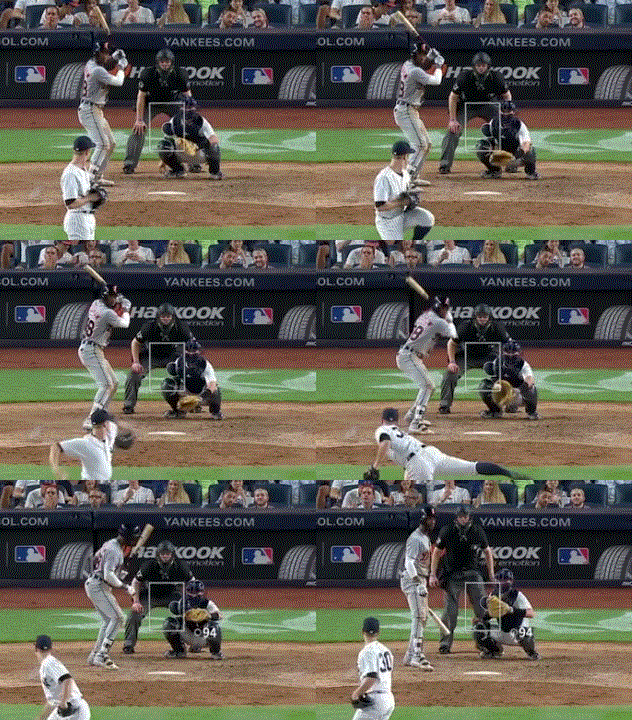
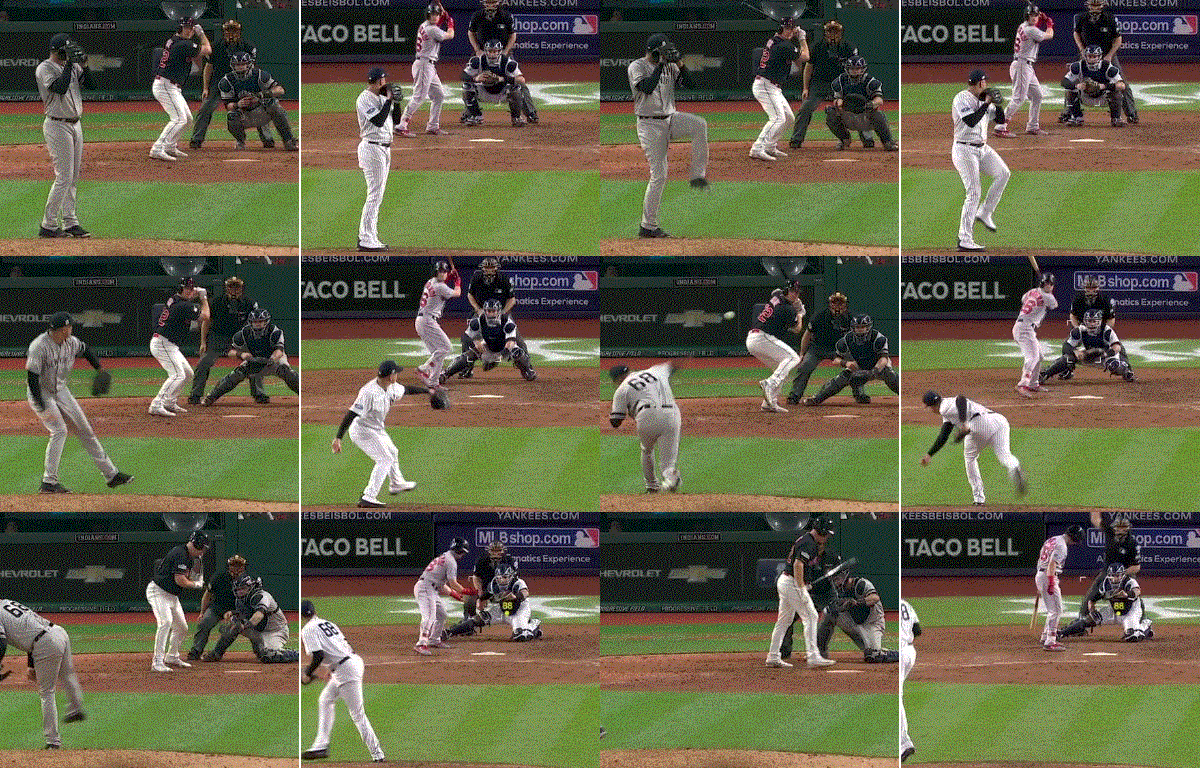
To correct that problem, the Yankees and Betances worked to simplify his delivery a bit, specifically shortening up his leg kick and eliminating some extraneous movement. Here is the obligatory before-and-after GIF. That is 2017 Betances on the left and 2018 Betances on the right.

Last season Betances brought his left knee up high during his delivery. Right to his chest, basically. This year the leg kick was much more abbreviated. Up and down, quickly. Last year it was this clunky leg kick that seemed to slow everything down. Now the leg is up, the leg is down, and the ball is heading toward the plate. The simplified delivery helped Betances throw more strikes and get back to being one of the game’s best relievers.

“You’d rather not go through those (struggles), but with relievers that have pitched a lot, it happens quite a bit,” said pitching coach Larry Rothschild in August. “He’s come out on the right side of that more times than not. His track record is impressive. Four All-Star Games is not something you ignore. It was just a matter of him getting back into a real solid delivery and repeating it. He’s been able to do that.”

Betances was not perfect this season. No relievers are. He struggled out of the gate this season and looked #stillbroken, then, late in the season, he had that back-to-back homers blown save against the Tigers. By and large though, Betances was excellent, and a dominant force at the end of the games. And it’s not like we’d never seen that guy before. This season didn’t come out of nowhere. Dellin has been outstanding the last five years. The dominance outweighs the hiccups and that was especially true in 2018. He was great.

What’s Next?

The 2019 season will be Betances’ final season of team control. He is arbitration-eligible for the third and final time this winter — MLBTR projects a $6.4M salary next year — and I suppose the Yankees could approach him about a long-term contract. Betances is obviously very good and very valuable. He also turns 31 in March and can be unpredictable. I wouldn’t be surprised if the Yankees give him a one-year arbitration contract for next season, and then worry about 2020 after the season.

Either way, there shouldn’t be any (or many, I guess) calls to trade or non-tender Betances this offseason. At least not like last offseason. He was great throughout the regular season and postseason, and other than the general “this guy can be unpredictable” worries, there’s no real reason to believe Betances is about to see his performance slip. He’ll be back in a high-leverage role again in 2019.

Filed Under: Players Tagged With: 2018 Season Review, Dellin Betances

The Yankees have their priciest arbitration class in years this offseason and some big decisions are required

October 16, 2018 by Mike

(Elsa/Getty)

Given the roster situation and contention window, the Yankees figure to be very active this winter. The team is ready to win now but they need help, particularly in the rotation, but also elsewhere on the roster. The injured Didi Gregorius has to be replaced, as do impending free agents David Robertson and Zach Britton, among others. These next few months should be busy.

The Yankees already have their core in place — they need to supplement this offseason more than overhaul — and they’re going to spend at least part of the offseason keeping that core in place. Guys like Aaron Judge and Gleyber Torres and Gary Sanchez are still in their pre-arbitration years and will make something close to the league minimum next year. Others like Gregorius and Luis Severino are arbitration-eligible and will cost a bit more.

Last week Matt Swartz released his 2019 salary arbitration projections at MLB Trade Rumors. There are always exceptions, but Matt’s system is very accurate overall. These aren’t “in the ballpark” numbers. These tend to be close to dead on. Here is the Yanks’ arbitration class and their projected 2019 salaries:

  • Didi Gregorius: $12.4M (fourth time eligible as a Super Two)
  • Sonny Gray: $9.1M (third time)
  • Dellin Betances: $6.4M (third time)
  • Aaron Hicks: $6.2M (third time)
  • Luis Severino: $5.1M (first time as a Super Two)
  • Austin Romine: $2.0M (third time)
  • Tommy Kahnle: $1.5M (second time as a Super Two)
  • Greg Bird: $1.5M (first time)
  • Ronald Torreyes: $900K (first time as a Super Two)

The nine-person arbitration class projects to cost the Yankees a whopping $45.1M in 2019. Goodness. Last year’s arbitration class ran $29.2525M even when including Adam Warren’s full salary. The Yankees have about $55M in free agents coming off the books this winter. Going from a $29.2525M arbitration class last year to a $45.1M arbitration class this year eats up about $15M of that $55M. Hmmm. Anyway, let’s talk about the arbitration class a bit.

1. What happens with Gregorius? Sir Didi needs Tommy John surgery and I have to think that means the Yankees will not pursue a long-term contract extension, if they were even planning to pursue one in the first place. Don’t you have to wait and see what Gregorius looks like post-surgery before committing? I mean, he’ll probably be fine, but you never really know. It’s a major surgery.

As I mentioned yesterday, I don’t think the Yankees will non-tender Gregorius, but I don’t think it would be as egregious as it may seem. He might not be back until August or September. Is it really smart to commit $12.4M to a guy who may not help you much, if at all, when he’ll become a free agent next winter? That’s a lot of money to give to a guy who is going to spend most of the year rehabbing. The potential reward isn’t all that great.

Perhaps there’s a compromise to be made here? Rather than a one-year contract at the projected arbitration salary, the Yankees and Gregorius could work out a two-year agreement? Something like, say, two years and $25M? Or maybe even $30M? That ensures two things:

  1. The Yankees won’t pay Gregorius a hefty sum during his injury shortened 2019 season only to possibly lose him to free agency next winter.
  2. Gregorius gets a nice little guaranteed payday and will still be able to become a free agent prior to his age 30 season, when he’ll still have good earning potential.

The Gregorius injury is really unfortunate. He’s a great player who proved difficult to replace during his short time on the disabled list this past season. The injury also complicates his contract situation for next year. Maybe the Yankees will fork over that projected $12.4M contract for the season then worry about Didi’s free agency next winter. I guess we’ll find out soon enough.

2. Gray’s salary is higher than I expected. I didn’t expect Gray’s salary projection to come in north of $9M. He made $6.5M this season and was terrible. His past accomplishments (2015 All-Star, third in the 2015 AL Cy Young voting, etc.) are doing the heavy lifting here. No player has ever had his salary cut during arbitration and Sonny sure as heck won’t be the first. I thought maybe he’d get $8M to $8.5M. I underestimated.

Brian Cashman was very open about trading Gray during last week’s end-of-season press conference. I can’t remember him ever being that candid about trading a player. Here’s what Cashman said, via Brendan Kuty:

“I think it’s probably best to try this somewhere else,” Cashman said. “It hasn’t worked out this far. I think he’s extremely talented. I think that we’ll enter the winter unfortunately open minded to a relocation. Probably to maximize his abilities would be more likely best somewhere else. But then it comes down to the final decision of the price in terms of trade acquisition and matching up with somebody, if we match up.”

I don’t think Cashman would’ve said that unless he was confident he could find a trade match for Gray and get something decent in return. The Yankees very clearly want to get rid of him. It doesn’t mean they’ll give him away. Pitching is in demand and hey, if you were another team, wouldn’t you have interest in buying low on Gray? I think there will be enough of a market that the Yankees get something good in return. Not great, but good.

Now, that said, if the Yankees have trouble finding a trade partner for Gray, would they consider non-tendering him? I don’t think so, but it’s not impossible. Worst case scenario is you take Sonny into Spring Training and essentially audition him for teams. Some team is going to suffer an injury and need a starter. That team might be the Yankees! But yeah, Gray’s a goner. His projected salary is higher than expected but I don’t think it’ll be an obstacle during trade talks.

3. Time to talk extension with Betances? Next season is Dellin’s final season of team control. He’ll be a free agent next winter. Historically, players who sign extensions the year before free agency get free agent contracts. There’s no discount. I don’t think Betances would get Wade Davis money (three years, $52M), but Bryan Shaw money (three years, $27M) ain’t cutting it. I could see Dellin’s camp pushing for four years and $44M or so next year.

Betances is an all-time personal fave and he had a tremendous bounceback season this year. He went from completely unusable in the postseason last year to being the team’s No. 1 bullpen weapon this postseason. There were a lot of folks (a lot of folks) who wanted Betances traded last offseason. Fortunately the Yankees kept him. That said, there are some reasons the Yankees should pass on an extension this offseason.

  1. Betances turns 31 in March and his free agent contract begins during his age 32 season. Dellin’s not that young anymore! He’s almost certainly had his best years already.
  2. As we know, Betances is extremely volatile. When he’s good, he’s unhittable. It’s so fun. When he’s bad, he’s unusable. What if it goes bad again in 2019? I hope it doesn’t happen, but it might.
  3. Dellin does have an injury history. He’s been very durable as the big leaguer, so he deserves credit for that, but he has Tommy John surgery in his past and also shoulder issues while in the minors.

As much as I love Betances and hope he gets to record the final out of the World Series for the Yankees one day, I wouldn’t blame the Yankees one bit for not signing him long-term this offseason. Relievers are inherently volatile and Betances is more volatile than most. They have him for another season and that means another year of gathering information. If he’s willing to take a sweetheart deal, then by all means, sign him. Otherwise I think waiting is the right move.

4. Time to talk extension with Hicks? Yes, I think so. Switch-hitting center fielders who provide big value on both sides of the ball are worth keeping. Hicks turned 29 only two weeks ago, so he has several peak years remaining, and I want him to spend those peak years in pinstripes. Both versions of WAR had Hicksie as a top seven outfielder in baseball this season. Dude’s legit.

Hicks will be a free agent next offseason and, as noted earlier, players who sign extensions at this service time level usually get free agent contracts. There’s no more discount. The contract comparables for Hicks are pretty straightforward. He figures to seek Dexter Fowler (five years, $82.5M) and Lorenzo Cain (five years, $80M) money. And you know what? I’d give it to him. That’s the going rate for a comfortably above-average center fielder.

It’s important to note here that a five-year contract would cover Hicks’ age 29-33 seasons. He’s younger now than Fowler (age 31-35) and Cain (age 32-36) were when they signed their deals. Hicks is younger but he also doesn’t have as long a track record, which kinda balances things out. If the Yankees give Hicks a five-year deal this winter, they avoid all those nasty decline years in his mid-to-late 30s, at least in theory. This should be a thing they pursue this winter.

(Getty)

5. Severino’s cheapest years are over. The Baby Bombers are growing up. Severino is arbitration-eligible for the first of four times as a Super Two this season. He has two years and 170 days* of service time, which is well over whatever the Super Two cutoff will be this winter. (It varies year to year and is usually somewhere around two years and 120 days.) Severino’s first big payday has arrived.

* The MLB season runs 186 days but it only takes 172 days to qualify for a full season’s worth of service time. That means, come the 2022-23 offseason, Severino will be *two days* short of qualifying for free agency. Ouch. He spent juuust enough time in Triple-A in 2016 to push his free agency back and I doubt that was a coincidence.

The salary record for a first time arbitration-eligible pitcher belongs to Dallas Keuchel, who received $7.25M for the 2016 season, the year after he won his Cy Young award. Severino doesn’t have a Cy Young but he didn’t finish third in the voting last year, which will boost his earning potential. Within the last three offseasons five starting pitchers went through arbitration for the first time as a Super Two. Their salaries:

  • Kevin Gausman, 2016-17: $3.45M
  • Marcus Stroman, 2016-17: $3.4M
  • Chase Anderson, 2016-17: $2.45M
  • Taijuan Walker, 2016-17: $2.25M
  • Mike Foltynewicz, 2017-18: $2.2M

Severino’s been better than all those dudes and, frankly, it’s not all that close either. His first year salary is considerably higher than theirs, as it should be. Using the $5.1M projection as a starting point, Severino’s salaries during his arbitration years could go something like $5.1M, $10M, $15M, $20M. More high finishes in the Cy Young voting will equal more money.

Should the Yankees sign Severino to an extension this winter? Eh, I don’t see the need to rush into it. The Yankees can of course afford big arbitration salaries and pitchers are known to break down. It sucks, but it happens. We spent a few years here saying the Yankees should sign Chien-Ming Wang long-term, they didn’t, then he broke down. Baseball can be cruel like that. I am totally cool waiting at least one more year before discussing a Severino extension. Free agency is still a ways away.

* * *

Even subtracting out the likely to be traded Gray, the Yankees have a very expensive arbitration class this offseason. Their most expensive in years. That tends to happen when you have a lot of good young players. The Yankees will have to make some big decisions with this year’s arbitration class too. Do they approach Gregorius, Hicks, or Betances about extensions the year before free agency? Or just let the year play out? There’s a case to be made for both approaches.

Filed Under: Hot Stove League Tagged With: Aaron Hicks, Austin Romine, Dellin Betances, Didi Gregorius, Greg Bird, Luis Severino, Ronald Torreyes, Sonny Gray, Tommy Kahnle

David Robertson wants to return and the Yankees should find a way to make it happen

October 15, 2018 by Mike

(Getty)

We are still a few weeks away from the hot stove firing up, but already some free agent chatter is starting to trickle in. According to George King, impending free agent David Robertson wants to return to the Yankees next season, but he’s not going to take a discount to make it happen. (Nor should he.)

“I would like (a reunion) to happen, but I have to do what is best for me and my family,” said Robertson. In an unusual move, Robertson has parted ways with his agent and will represent himself this winter, reports Mark Feinsand. Huh. That doesn’t happen often. I wouldn’t advise it, but what do I know.

This past season was the final season on the four-year, $46M contract Robertson signed with the White Sox back in the day. It was the third largest reliever contract in history at the time it was signed and it is still one of the seven richest reliever contracts ever. Robertson is well-positioned to get another multi-year deal at eight figures annually.

The 33-year-old Robertson threw 69.2 innings with a 3.23 ERA (2.97 FIP) and strong strikeout (32.2%) and walk (9.2%) rates this past season. That is as David Robertson as it gets. The ERA was a shade high, otherwise everything was right in line with his career norms. It was the ninth straight season he’s made at least 60 appearances and thrown at least 60 innings.

As I wrote last week, re-signing Robertson is a no-brainer to me. He’s excellent, he’s willing and able to pitch whenever, he’s postseason and New York battle-tested, he’s been durable, and there has been zero decline in his stuff. If anything, Robertson’s stuff is improving, because he’s tinkering with different arm angles and a two-seamer. He’s a crafty veteran now.

Given the state of baseball, quality relievers have never been more in demand, and I can’t imagine the fact guys like Craig Kimbrel, Zach Britton, Adam Ottavino, Kelvin Herrera, Jeurys Familia, and Andrew Miller will also be free agents will hurt the market. The market’s not flooded. Plenty of contenders need bullpen help. All those dudes are getting paid.

Last offseason Bryan Shaw, Jake McGee, and Brandon Morrow set the market for non-elite relievers at $9M+ annually and Robertson is a heck of a lot closer to elite right now than those guys last year. His opening ask this offseason could be three years at $15M per season and I don’t think it would be crazy. Start there and, if no team pays up, come down a bit.

Given his age (34 in April), it’s fair to worry that Robertson could soon decline, especially since he’s been a workhorse throughout his career. All those high-leverage innings take their toll. That said, every reliever is a risk, even the great ones. Robertson is steady, reliable, and unflappable. Not sure what more you could want in a bullpener. Re-sign him as soon as possible, Yankees.

Filed Under: Hot Stove League Tagged With: David Robertson

Another Lost Season for Greg Bird [2018 Season Review]

October 15, 2018 by Mike

The 2018 season ended far earlier than we all would’ve liked. Now that the season is over, it’s time to begin our annual season review series, which kicks off today with Greg Bird. Aside from post a day Monday through Friday, there is no set schedule for these posts. We’ll write about players when we feel like writing about them, so each day’s review post will be a surprise (even to us!).

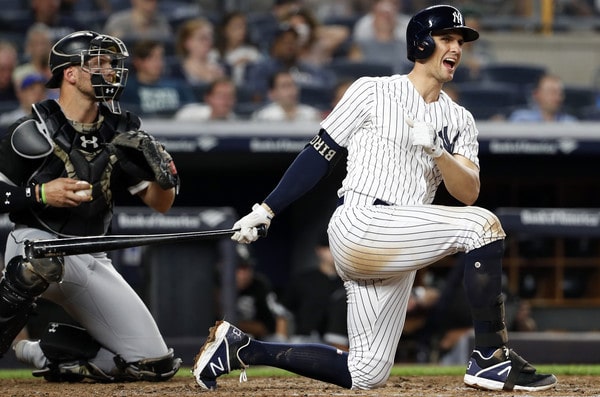
(Adam Hunger/Getty)

This was supposed to be the year. The year Greg Bird finally stayed healthy and took over as the Yankees’ first baseman of the present and future. Injuries sabotaged him in 2016 (shoulder surgery) and 2017 (ankle surgery), though we did get a reminder of what Bird is capable of last October, when he hit .244/.426/.512 (151 wRC+) with three home runs and 12 walks in 13 postseason games.

Who can forget Bird’s home run against Andrew Miller in ALDS Game Three last year? Aside from Didi Gregorius’ three-run home run in the Wild Card Game, the Yankees didn’t have a bigger hit all season.

Bird’s postseason performance combined with the perpetual hope that This Is The Year Greg Bird Stays Healthy had everyone excited coming into this season. I’m not the biggest Greg Bird fan out there but he has Yankee Stadium friendly pull power plus military style plate discipline. The Yankees didn’t need him to be their best (or second best, or third best, or even fourth best) hitter. He was expected to be a strong complementary piece.

Instead, for the third straight season, we were left disappointed. First it was another injury, then it was poor performance. Bird hit .199/.286/.386 (81 wRC+) with eleven home runs in (a career high!) 311 big league plate appearances in 2018. Not only did Luke Voit steal away the first base job in August, Bird didn’t even get a spot on the postseason roster. The Yankees carried six bench players on the Wild Card Game roster. Bird was not one of them. He wasn’t on the ALDS roster either. His potential to poke a ball into the short porch was deemed not necessary. Ouch.

Unfortunately, this year’s Greg Bird season review is like the last two. He was hurt, he didn’t live up to expectations, and we’re left wondering what the future holds. And, moreso than at any point before, it seems Bird may no longer be in the Yankees’ long-term plans. They love the guy, they’ve made it clear these last few years, but things don’t always play out as hoped. Let’s look back at Bird’s season.

Another Year, Another Injury

Bird did not even make it out of Spring Training healthy. He finished last season and the postseason healthy, had his first normal offseason in several years, and then his ankle started acting up again. Bird was held out of a Grapefruit League game on March 24th with inflammation in his right foot and sent to see a specialist. Two days later, the Yankees announced he needed surgery to remove a bone spur. The recovery time: 6-8 weeks.

“He was really emotional the other day when he came out, when he was dealing with the pain. Because he knows, obviously, he hasn’t gotten to put it together yet,” said Aaron Boone after the surgery was announced. “And he understands in his mind what kind of player he is and what he thinks he can be. So there were a couple days of some real frustration: ‘What’s going on? What’s the problem?’ … (He) got some closure and feels like this could be the answer to the problem, even though it’s going to cost him some weeks on the front end of the season.”

The initial injury was fairly concerning because Bird had surgery on the ankle last year and there was no play that caused the new injury. He played a full nine-inning game at first base and had discomfort the next day. Those non-contact injuries are always the worst. The Yankees sent him for tests, which revealed the bone spur. A quick recap of Bird’s surgeries:

  • 2016: Missed entire season with right shoulder injury.
  • 2017: Missed three and a half months with right ankle surgery.
  • 2018: Missed roughly two months with right ankle surgery.

Bird had his surgery and was shut down six weeks before beginning a minor league rehab assignment. I remember being pretty stoked that he returned to game action on the low end of that 6-8 week rehab time frame. Bird hit .205/.367/.436 (132 wRC+) with three home runs in his 12 rehab games and rejoined the Yankees on May 26th, two months to the day after it was announced he needed surgery.

All things considered, Bird’s injury and rehab went about as well as everyone could’ve hoped. The injury was unfortunate and the fact he needed surgery stunk, but Bird completed his rehab in six weeks and showed power and patience during his rehab assignment, and that was encouraging. I naively thought the ankle surgery would only be a bump in the road and not a season-derailer. Bottom line though, two surgeries on the same ankle within 12 months is bad news.

A Troubling Decline in Contact Quality

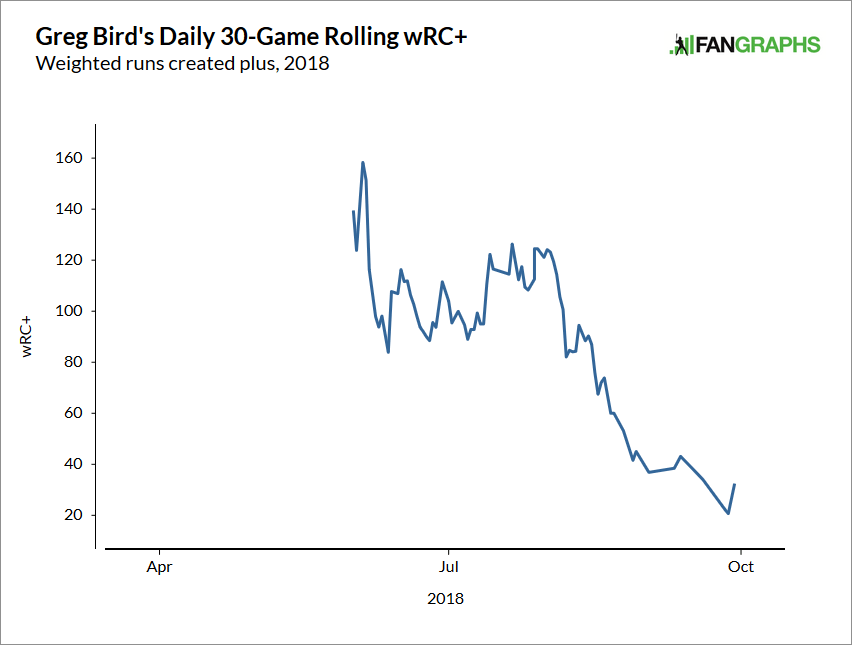
To Bird’s credit, he initially played well after returning from the disabled list. He went 7-for-28 (.280) with two doubles and two homers in his first six games back, and he also had a two-homer game against the Red Sox on June 29th. During his best stretch of the season, from June 29th to July 29th, Bird hit .286/.357/.548 (138 wRC+) with six home runs in 23 games. Who knew? It happened though.

Once the calendar flipped to August, Bird’s production cratered. He hit .135/.210/.260 (26 wRC+) the rest of the season and lost his first base job to Voit. The nosedive in graph form:

Bird started only three games in September — one of those three was the meaningless Game 161 after the Yankees clinched homefield advantage in the Wild Card Game — and appeared in only seven of the team’s final 27 regular season games. He was healthy. He just stunk and didn’t deserve a lineup spot. “It’s frustrating. It sucks to suck,” he said in August.

“Performance matters. The matchups matter,” said Boone late in the season when asked about Bird being mostly glued to the bench. “(I’m) trying to keep both guys relevant and put both guys in positions to succeed as best we can. But I would say it’s a fluid situation … If we can get (Bird) going in the right direction, I’m positive he can not only help us down the stretch, but, hopefully, if we get into the playoffs.”

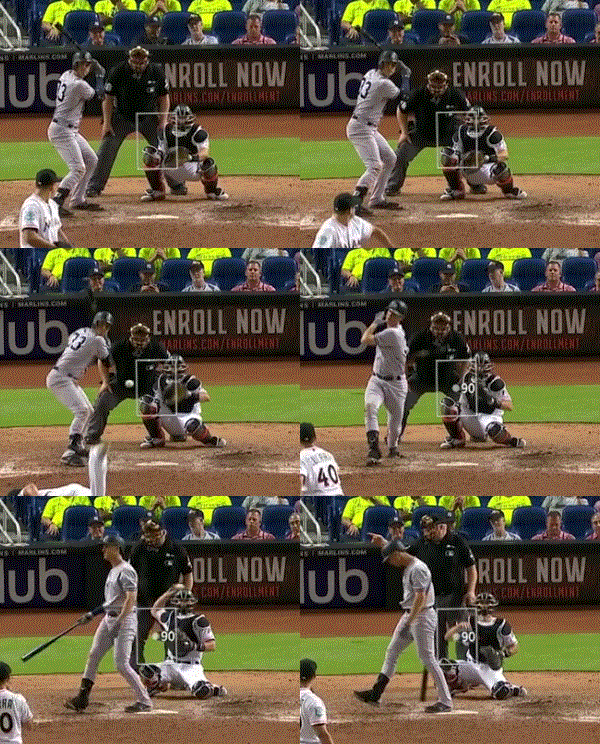
Watch enough baseball and you’re bound to see a talented player struggle for a long stretch of time. Everyone falls into a rut now and then, you know? Bird’s slump was beyond a normal baseball slump, however. He was struggling and he looked terrible while doing it. This wasn’t one of those “eventually one of these hard-hit balls will fall in” slumps, you know? I keep going back to this GIF:

That is a middle-middle 90 mph fastball and Bird swung through it like it was 99 mph. He could not catch up to fastballs all season. Bird hit .175 with a .174 ISO against fastballs this season (.278 wOBA and .319 xwOBA). That is horrible. The league averages are .269 and .175 (.344 and .344), respectively. Bird couldn’t handle even bad fastballs, opponents noticed, so they kept throwing him fastballs. MLB is unforgiving. Show a weakness and it will be attacked.

When he first broke into the big leagues, Bird was touted for his ability to hit the ball hard and get the ball in the air. He was a launch angle guy before launch angle was cool. The sample sizes are not big because of the injuries, but Bird’s ability to drive the ball in the air is trending in the wrong direction:

Average Exit Velocity
2015: 93.0 mph
2016: Injured
2017: 89.7 mph
2018: 86.9 mph

Average Launch Angle
2015: 21.3°
2016: Injured
2017: 20.2°
2018: 18.9°


I should note that an 18.9° average exit velocity is pretty good. You want to average somewhere in the 10° to 25° range, the closer to 25° the better. Below 10° means too many grounders and above 25° means more fly balls and pop-ups than line drives. Bird is still in that ideal range, but his launch angle is trickling down, and his exit velocity is way down. He simply did not hit the ball hard this past season.

Remember Allen Craig? Craig put up a .312/.364/.500 (139 wRC+) batting line in nearly 1,300 plate appearances from 2011-13, then he suffered an ankle injury in 2014 and was just done. Like done done. Hasn’t played in the big league since 2015 and didn’t even hit in Triple-A pitching from 2015-17. Craig lost that explosiveness in his lower half after the injury and just couldn’t hit any more. He didn’t have a good base underneath him. His swing was all arms. I worry about that with Bird.

“I think he’s over it and past it, but I think there’s a level of building up that stamina and explosion and the fact that you’re still recovering from a surgery,” said Boone about Bird a few weeks ago. “I don’t think there’s any question that if he can stay healthy, a month from now, six months from now, it’s better, it’s more explosive. That’s something that we kind of monitor, talk about and hopefully he can get through this while building up that stamina that makes him special when he’s really on time and impacting the ball.”

Bird has now had three surgeries in the last three years on two important body parts. His right shoulder had to be rebuild and his right ankle had to be repaired twice. That’s his front shoulder and front ankle when hitting. That’s the power shoulder and the weight transfer ankle. Pretty important! It’s not like he tore a finger ligament or pulled a hamstring. These have been some very serious injuries.

We’ve seen Bird be an impact hitter. For very short stretches of time, but we’ve seen it. The natural talent is there and it’s not like he’s an older player. He turns 26 in November. He should be in his prime or just about to enter it. Can Bird still be an impact hitter, physically? Or have the shoulder and ankle trouble compromised him too much? I hope that’s not the case, but it might be.

What’s Next?

The Yankees went into the 2017 and 2018 seasons counting on Bird to be the man at first base. It was his job and he never even had to compete for it. That is not the case now. During his end-of-season press conference last week Boone was quick to note Voit had won the first base job and that, at best, Bird would get a chance to compete for it in Spring Training next year.

“(Voit) certainly came over here and was given that opportunity and took it and kicked the door in,” said Boone. “I’m sure there will continue to be competition on all kinds of levels. The one thing with Greg that I never lost is we’ve seen him be an impact player at times in his career … This year, in a lot of ways, was a little bit of a lost season for him.”

Believe it or not, Bird is arbitration-eligible this winter. He accrued service time while on the disabled list these last few years. Those injuries and the lack of production mean Bird’s salary won’t be exorbitant — for what it’s worth, MLBTR projects Bird for $1.5M — so the Yankees won’t non-tender him or anything like that. Bird has all three minor league options remaining. Technically, he was called up in 2015 and hasn’t been sent down to the minors since. It’s been rehab assignments only.

Point is, Bird is going to be (relatively) cheap and the Yankees will be able to send him to Triple-A next season. At this point, that’s probably the best course of action. No more handing him a job, no more overvaluing a big Spring Training, nothing. Give Bird a look in Spring Training, send him to Triple-A and make him show he’s healthy and productive, then call him back up. That’d be my plan.

When it comes to Greg Bird, nothing would surprise me at this point. I wouldn’t be surprised if he showed up to camp next season, seized the first base job, and raked all summer. I wouldn’t be surprised if he got hurt again and was a non-factor (again). I wouldn’t be surprised if he did something in-between, which is kinda what happened in 2017. I wouldn’t be surprised if the Yankees traded him either. This past season was another lost year for Bird, and time is starting to run out for him to carve out a role in the Bronx.

Filed Under: Players Tagged With: 2018 Season Review, Greg Bird

Thoughts following Didi Gregorius’ Tommy John surgery

October 15, 2018 by Mike

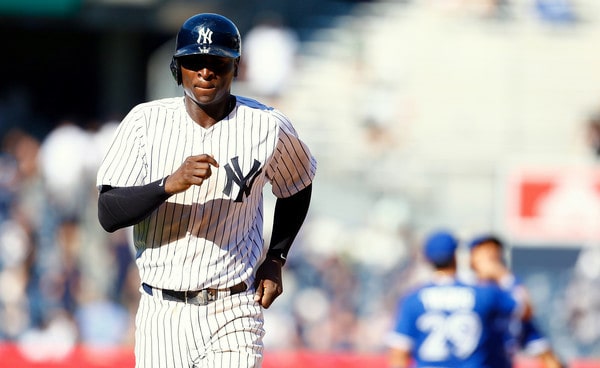
(Mike Stobe/Getty)

The 2018 season just ended and already the 2019 Yankees have suffered a major loss. Didi Gregorius needs Tommy John surgery. He hasn’t had the surgery yet, but he does need it, and he’ll have it soon. The rehab is expected to keep him out until sometime next summer. That is not a great way to start the offseason, folks. Here are some thoughts.

1. The typical Tommy John surgery rehab timetable is 6-9 months for position players but that does vary by player and position. Catchers need more rehab time than outfielders, for example. Gleyber Torres had his Tommy John surgery in June and was more or less ready to go by January, though he had surgery on his non-throwing elbow, which is a different animal. Gregorius needs surgery on his throwing elbow. Jay Jaffe did some digging and found that middle infielders who had Tommy John surgery on their throwing elbow missed ten months, on average. That puts Gregorius on track to return next August. Tony Womack returned in six months. Rafael Furcal was out 15 months. Mets utility man T.J. Rivera had Tommy John surgery last September and missed the entire 2018 season with setbacks and whatnot. There’s a wide range of possible outcomes here. Point is, no one really know when Gregorius will be back. There is a chance — a pretty good chance, really — he will play next season. Possibly even as early as May or June. That seems to be the best case scenario. More than likely, the Yankees and Gregorius are looking at a return around the All-Star break, maybe even later than that. That’s a major bummer.

2. Given the nature of the injury and the uncertain rehab timetable, the Yankees have to proceed this winter as if they won’t have Gregorius at all next season. Plan on not having him and, if he returns at some point, great. But the Yankees have to plan around the worst case scenario. Betting on internal options like Tyler Wade or Ronald Torreyes until Gregorius returns would be a mistake, and I like Wade and Torreyes. Torreyes is a nice utility guy and Wade has more to offer than what he’s shown to date. But yeah, the Yankees have to do something here. They can’t bank on Gregorius returning early in the season and not missing a beat. Gleyber’s versatility allows the Yankees to look for a shortstop or a second baseman this winter, which gives them more options. My preference would be to find another shortstop and keep Torres at second, though that is much easier said than done. Quality shortstops are hard to find. The good news (“good” news) is the timing of the injury. Sir Didi’s elbow didn’t give out in Spring Training or during a late offseason workout. He’s having surgery in October, before the postseason even ends, so the Yankees have the entire offseason to go out and find a middle infield solution. This isn’t something that will pop up and surprise them in January or February or March.

3. So I guess this is where we talk about Manny Machado, huh? Machado is either the best or second best free agent on the market this winter — he and Bryce Harper are essentially 1 and 1A — and it is entirely possible the Yankees were planning to pursue him aggressively even before the Gregorius injury. (Remember, they did try to get him at the trade deadline.) Sign Machado, put him at third base, move Miguel Andujar elsewhere (first base? left field? trade for pitching?), then profit. Now the Yankees need a shortstop. Machado is a shortstop, or at least he considers himself a shortstop. He did not look good at the position while with the Orioles. It seemed like every time a ball was hit his way, he was on the ground. Machado has been better defensively with the Dodgers — Ken Rosenthal (subs. req’d) recently wrote the Orioles are miffed players perform better after leaving the team — to the point where keeping him at shortstop in the short-term seems viable. Earlier this year it looked like a return to third base was in everyone’s best interests. I don’t know what the years and total dollars will be, but I do know Machado is going to be a $35M+ per year player. That’s the market right now. He could very well wind up a $40M per year player. I think $35M annually is his floor though, and I don’t think the Yankees are going to make a $35M per year decision based on another player getting hurt. This is one of those things that happens more in video games than reality. “A player got hurt? Better go sign that free agent to a massive contract to replace him.” That sorta thing. If the Yankees were already planning to pursue Machado, then nothing’s really changed. If the Yankees weren’t planning to pursue Machado, or at least not go all out to sign him, I don’t think the Gregorius injury changes their plan much. Giving Machado a couple hundred million bucks was never going to hinge on Didi’s health. That was always going to be a money decision rather more than a roster needs decision.

4. One non-Machado name to keep in mind: Josh Harrison. The Yankees were connected to him a bunch last offseason (the last few offseasons, really) and the Pirates are expected to decline his $10.5M option, making him a free agent. In fact, the Pirates pulled Harrison mid-inning in their home finale a few weeks ago so the crowd could give him an ovation, so yeah, they’re declining the option. Harrison did not have a good 2018 season (.250/.293/.363 and 78 wRC+) but he is one year removed from a .272/.339/.432 (104 wRC+) batting line and is regarded as a good defender who can play pretty much anywhere. (Harrison went from 23 hit-by-pitches in 2017 to five in 2018, dragging down his OBP. Last winter I mentioned his reliance on hit-by-pitches to prop up his OBP worried me.) I don’t think Harrison would be Plan A or even Plan B. He seems like someone the Yankees could pick up with an eye on filling in at second base (with Torres at short) until Gregorius returns before sliding into a true utility role the rest of the season. I don’t love it and I would prefer to see the Yankees aim higher when searching for a Gregorius replacement. Harrison just seems like someone to watch this offseason. The Yankees reportedly liked him enough to pursue him in trades the last few years, but not enough to give in to Pittsburgh’s demands. Now that he’s available for nothing but cash, they could pounce.

5. Something I could see happening quickly: Adeiny Hechavarria re-signing with the Yankees on a minor league contract. Hechavarria is a great defensive player but he can’t hit (.246/.283/.347 and 68 wRC+ the last three years) and similar all-glove/no-bat middle infielders like Darwin Barney, Danny Espinosa, Ryan Goins, Cliff Pennington, and Ruben Tejada inked minor league contracts last offseason. It’s possible some team will step forward with a guaranteed Major League contract — the Royals gave Alcides Escobar a one-year deal worth $2.5M last winter for some reason — and one team is all it takes, so maybe Hechavarria and his camp will wait things out in the offseason. I could see the Yankees pushing to get this done soon. A minor league deal with a base salary around $2M at the MLB level (plus incentives for games played?) with an opt-out at the end of Spring Training seems possible here. Before the Gregorius injury, I didn’t think there was much of a chance the Yankees would retain Hechavarria. He was a useful late season pickup who didn’t seem to have a spot on the normal 25-man roster from April through August. The Didi injury changes the equation though. Hechavarria is no great shakes by any means, but, if the Yankees can bring him back on a no risk minor league contract, they’ll at least be able to move forward knowing they have a defensive whiz at shortstop in their back pocket should they strike out on the free agent/trade market.

Return of the Hech? (Getty)

6. Some rapid fire thoughts on other potential middle infield targets: Daniel Murphy can hit righties but can’t really play second base anymore, and I don’t think the Yankees want another disaster defensive infielder after living through the Andujar experience this year. Brian Dozier is a very good defender whose offensive game has really slipped the last year or two. The name value is greater than the on-field value at this point. Jed Lowrie, Asdrubal Cabrera, and Logan Forsythe are boring yet perfectly cromulent second base possibilities. I hope the Yankees aim higher. I suspect Eduardo Escobar and Marwin Gonzalez will get larger than expected multi-year contracts as super utility guys and I’m not sure the Yankees want to spend big on a Gregorius replacement not named Machado. DJ LeMahieu is a sleeper option. He’s great defensively at second base and he’s a high contact hitter. It is fair to question how much he’ll hit outside Coors Field though. The last three seasons LeMahieu has hit .345/.411/.479 (110 wRC+) at home and .277/.330/.405 (96 wRC+) on the road. Eh. Would the Brewers trade Jonathan Schoop so soon after acquiring him at the deadline? They gave up some pretty good prospects to get him. (Sonny Gray for Schoop?) The Orioles are presumably open for business and Jonathan Villar could be a target. He played well for them last season and is a major stolen base threat. The Yankees have been connected to Derek Dietrich a bunch over the years and he could be an option, though he hasn’t played much second base the last few seasons. The Phillies are said to be planning “significant changes” this winter and I’d be very open to a Cesar Hernandez trade. Hard pass on Addison Russell, who seems destined to be traded this winter.

7. I don’t think it’ll happen but I don’t think non-tendering Gregorius is as outlandish as it may seem on the surface. Matt Swartz and MLBTR posted their annual salary arbitration projections last week and their (very) accurate system pegs Gregorius for a $12.4M salary in 2019. If, once surgery is complete, the prognosis has Gregorius returning sometime in August or September, the Yankees could non-tender him and use that money elsewhere. It would be somewhat similar to the Nathan Eovaldi decision two years ago. Eovaldi blew out his elbow with one year of control remaining, and rather than pay him a pretty good salary to rehab in 2017 only to have him become a free agent after the season didn’t really make sense. It was money for nothing. Gregorius is expected back next season, possibly not until late in the season though, and the Yankees may decide getting less than two months of Sir Didi is not worth that projected $12.4M salary, especially since he’ll be a free agent after the season. Plus he’s probably going to need some time to get back up to speed once he returns. He may play 50 games next year, but the Yankees might only get 30 games of fully healthy and productive Gregorius after the injury. Know what I mean? Like I said, I don’t think a non-tender will happen. Gregorius is expected back at some point next year and he is a 28-year-old middle infielder who has established himself as a +4 WAR player. Those dudes are hard to find and you don’t just give them away. I just think the chances of a non-tender went from 0% to something like 5% after the injury. Probably not going to happen, but never say never after a major injury and surgery like this.

8. The Yankees have not been particularly aggressive locking up their young players to long-term extensions — they haven’t signed a player to a multi-year extension during his arbitration years since giving Brett Gardner his about to expire four-year deal in February 2014 — but, if they were ever going to do it again, doing it with Gregorius this winter would’ve made sense. He’s a comfortably above-average two-way player at an up-the-middle position who is right smack in the prime of his career and is an important figure in the clubhouse. Didi is exactly the kind of guy you lock up and build around, right? Right. The injury changes things though. If the Yankees were planning to explore a long-term extension with Gregorius this offseason, it might be off the table to completely now, only because we have no idea what he’ll look like post-surgery. Chances are he’ll be fine. Tommy John surgery has a fairly high success rate, even moreso with position players. But what if he’s not fine? What if he has complications and misses more time than expected, or his throwing arm is diminished to the point where he can’t remain at shortstop? No one wants that to happen but sometimes it does. Gregorius is one year away from free agency and, historically, players who sign multi-year extensions at this service time level get free agent dollars. There is no discount. Perhaps Gregorius would be open to signing a discounted multi-year deal now — a major injury like this can be scary and could push him to take the guaranteed money now rather than bet on himself post-surgery — though he has made some good money already (his career earnings are north of $17M) and he might not be desperate for that big payday. I love Didi and hope he’ll be a Yankee forever and ever. That said, I wouldn’t blame the Yankees for holding off on a long-term contract until seeing what he looks like after elbow reconstruction. This isn’t like getting a tooth pulled. It could change his career outlook going forward.

9. As for Gregorius personally, wow does the injury suck. The injury and the timing. He’s gotten better offensively literally every season with the Yankees …

  • 2015: 9 HR and 89 wRC+
  • 2016: 20 HR and 97 wRC+
  • 2017: 25 HR and 107 wRC+
  • 2018: 27 HR and 121 wRC+

… and he’s a standout defensive shortstop who has had some huge postseason moments. He replaced Derek Jeter better than I think anyone expected and he’s been a controversy-free fan favorite with the Yankees. Unless he signed a long-term extension this offseason, Gregorius was poised for a massive 2019 contract season that sent him into free agency in position to cash in big. Now he won’t have a fully healthy contract year and, fairly or unfairly, there will be questions about his elbow next winter. Even if he comes back strong next year and rakes. How will the elbow hold up long-term? How much longer does he have at shortstop? Those sorta things. You know teams will use the injury against Gregorius during contract talks. Sucks. Sir Didi has been a great Yankee these last few years and I was happy he would finally be able to cash in on his success. The Tommy John surgery throws a big wrench into that. Poor guy.

Filed Under: Injuries, Musings Tagged With: Didi Gregorius

Fan Confidence Poll: October 15th, 2018

October 15, 2018 by Mike

2018 Regular Season Record: 100-62 (851 RS, 669 RA, 98-64 expected record), second in ALE
2018 Postseason Record: 2-3 (22 RS, 29 RA), won WC Game, lost ALDS

Top stories from last week:

  • The week started with the ALDS tied 1-1. The Yankees got crushed 16-1 in Game Three. It was the most lopsided postseason loss in franchise history. Game Four’s ninth inning rally fell short and the season came to an end with a 4-3 loss Tuesday. Aaron Boone did not distinguish himself in either Game Three of Game Four.
  • Injury Update: Didi Gregorius needs Tommy John surgery. He will be out until sometime next summer. What a bummer. Aaron Hicks (hamstring) returned in ALDS Game Four. CC Sabathia (knee) had his usual cleanup surgery after the season.
  • The Yankees are expected to pursue Patrick Corbin in free agency. Brian Cashman made it pretty clear the Yankees will look to trade Sonny Gray this offseason.
  • The entire coaching staff is expected to return next season.

Please take a second to answer the poll below and give us an idea how confident you are in the Yankees. You can view the interactive Fan Confidence Graph anytime via the Features tab in nav bar above, or by clicking here. Thanks in advance for voting.

Given the team's current roster construction, farm system, management, etc., how confident are you in the Yankees' overall future?
View Results

Filed Under: Polls Tagged With: Fan Confidence

  • « Previous Page
  • 1
  • …
  • 104
  • 105
  • 106
  • 107
  • 108
  • …
  • 4059
  • Next Page »

RAB Thoughts on Patreon

Mike is running weekly thoughts-style posts at our "RAB Thoughts" Patreon. $3 per month gets you weekly Yankees analysis. Become a Patron!

Got A Question For The Mailbag?

Email us at RABmailbag (at) gmail (dot) com. The mailbag is posted Friday mornings.

RAB Features

  • 2019 Season Preview series
  • 2019 Top 30 Prospects
  • 'What If' series with OOTP
  • Yankees depth chart

Search RAB

Copyright © 2025 · River Avenue Blues