Archive for Rule 5 Draft

Dec
09

Yanks gamble on two in Rule 5 Draft

Posted by: | Comments (11)

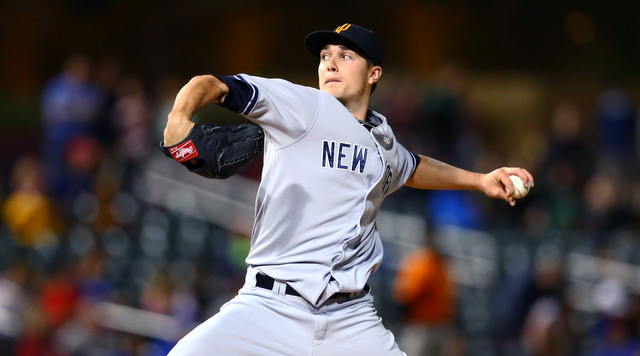
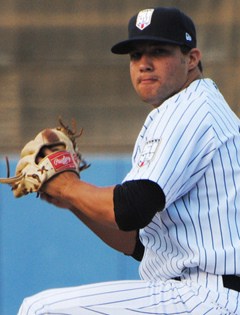
(AP Photo/Nati Harnik)

The Yankees selected two players in this morning’s Rule 5 Draft, taking lefty reliever Robert Fish from the Angels and righty reliever Daniel Turpen (above) from the Red Sox. Neither player cracked their former teams’ top 30 prospects list in the 2010 edition of Baseball America’s Prospect Handbook, but that’s par for the course in the Rule 5. The Sox originally acquired Turpen from the Giants at this year’s trade deadline in exchange for former Yankee farmhand Ramon Ramirez, and his name also popped up in the Adrian Gonzalez talks, which is not terribly interesting or relevant.

Turpen is the more polished and lower ceilinged prospect of the two. The 24-year-old Oregon State product was an eighth round pick in 2010 after a three-year career as a swingman, squeezed out of the rotation by some of the higher upside arms the perennial College World Series contenders boasted. Turpen’s strikeout rate jumped in the pros, from 5.3 per nine in school to 7.5 as a paid player, somewhat surprising for a generic sinker-slider guy. The 6-foot-4, 230 pounder sits 92-94 from a low arm slot according to BA’s Jim Callis, making him a ground ball pitcher that’s tough against righties but suspect against lefties. Over the last two seasons, Turpen’s posted a 2.77 ERA (3.27 FIP) in 136.2 relief innings over the last two seasons.

Fish, 23 in January, is the more intriguing of the two. He was a sixth round pick out of a California high school back in 2006 and spent the next two-and-a-half years as a nondescript starter (4.76 ERA, 4.34 FIP in 300.2 IP). The Angels shifted him to the bullpen at the start of the 2010 season, and although his ERA (8.93) is ugly, the peripherals at the Double-A level were fine (10.2 K/9, 3.8 BB/9). Baseball America’s Ben Badler noted that Fish (listed at 6-foot-3, 225 lbs.) is a lefty that hits 95 and can miss bats, evidenced by his 9.1 K/9 in the minors. Back in May, Halos Heaven (ugh) noted that BA graded both his curveball and changeup as average pitches, though scouting reports change over time, so don’t take that to heart. Here’s some video from this past April…

The Yankees tried to trade up in the draft so they could take righty Elvin Rodriguez from the Mets, but they were unable to get it done and he landed with the Nationals. Both Fish and Turpen will compete for bullpen jobs in Spring Training, but it’s unlikely either will stick. They almost never do. Fish will battle minor league free agent pickups Andy Sisco and Neal Cotts for the second lefty job, but his chances of making the team go right out the window if the Yankees sign someone like Pedro Feliciano, Scott Downs, or (please please please) Randy Choate. Turpen will have to outperform players like Ryan Pope and Romulo Sanchez, who are long shots as it is.

I wouldn’t expect much out of the two newest Yankees, but there’s no harm in rolling the dice on some interesting arms and seeing what sticks. With teams paying close to $5M per WAR this offseason, the Yanks would need to get just one one-hundredth of a win out of each player to justify the $50,000 selection cost, and that’s basically one scoreless inning at the big league level. The rate of return is extremely high if a Rule 5 guy sticks, even if he’s nothing more than a specialist reliever like Fish and Turpen.

Categories : Minors
Comments (11)
Dec
09

2010 Rule 5 Draft Liveblog

Posted by: | Comments (6)

The Rule 5 Draft is one of my favorite events of the year even though it’s one of the game’s most uneventful. Rarely does a selected player have any kind of impact at the big league level, nevermind sustained impact. Just three of the 17 players selected in last year’s Rule 5 stuck in the big leagues, the best of which was former Yankee prospect Carlos Monasterios. In 88.1 innings for the Dodgers, he put up a 4.38 ERA but 5.37 FIP and -0.6 fWAR. That gives you an idea of what happens here.

The Yankees reportedly have a list of five players they’re interested in, though they aren’t very optimistic that any of them will still be available when they pick. I’m not sure which teams have full 40-man rosters (you need to have at least one open spot to make a pick), though the Yankees can pick no later than 28th overall. I looked at some potential targets a week or two ago, and I also broke down which Yankee players were available last month.

The draft itself is scheduled to begin at 9am ET, and I’m going to liveblog this sucker pick-by-pick. Forgive the spelling, this thing usually moves pretty quickly.

Categories : Hot Stove League
Comments (6)

We know that the Yankees are actively seeking a second left-handed reliever this offseason, but so far the only movement they’ve made on that front involves signing Andy Sisco and Neal Cotts to minor league contracts. They have expressed interest in Pedro Feliciano, but he’s not exactly the most desirable option. I’ll continue to dream of Randy Choate, but I’m not getting my hopes up.

We have to remember that free agency isn’t the only way to acquire players, however. It may be the most efficient given the team’s vast resources, but there are plenty of other ways of securing talent. In fact, both of the Yankees current lefty relievers (Damaso Marte and Boone Logan) were acquired via trade. In this post I want to look in another direction, the Rule 5 Draft. New York’s recent history in the Rule 5 isn’t great (Jamie Hoffman in 2010, Josh Phelps in 2007), but it’s a lot easier to hit on a relief specialist than a bench player. Let’s look at some available lefty arms, starting with a former big leaguer…

(AP Photo/Jeffery Washington)

Fu-Te Ni, Tigers

You’ve probably heard of Ni, who’s been up with Detroit in each of the last two seasons. They recently outrighted him off the 40-man roster, exposing him to the Rule 5 Draft. Ni’s a traditional LOOGY, with a funky low arm slot delivery and a big old breaking ball that’s allowed him to hold lefties to a .276 wOBA in the big leagues (.357 vs. RHB). There’s really not much to break down here, he is what he is, and that’s a recently turned 28-year-old that throws left-handed and has no fewer than four years of team control left. This is the kind of player the Rule 5 Draft was made for.

Scott Diamond, Braves

Diamond in an exhibition game against the Yankees in March 2009. (AP Photo/Gene J. Puskar)

Signed as an undrafted free agent back in 2007, the 24-year-old Diamond make a strong first impression in his first attempt as full season ball in 2008 by posting a 3.13 FIP in 152.2 innings. The success continued into 2009 (3.26 FIP in 131 IP), then again into 2010 (3.22 FIP in 158.2 IP). Atlanta has a strong farm system and a lot of players worth protecting, so Diamond was a 40-man roster crunch casualty and left exposed to the Rule 5 Draft.

Diamond’s repertoire is suited for battling both left-handers and right-handers. He pounds the zone with three pitches: a low-90′s fastball backed by a curveball and changeup that qualify as no worse than average. He held both lefties and righties to a ~.250 average and ~.650 OPS against in 2010, and his strikeout numbers are solid (7.27 K/9 over the last two seasons). It’s not crazy to think that a shift to relief could add a few ticks to Diamond’s fastball and improve those strikeout numbers. Some team could pop him as a starter, but relief could be his ultimate role.

Jeremy Horst, Reds

A 21st round pick back in 2007, the 6-foot-4, 220 lb. Horst was outstanding during his first full season in Cincinnati’s system (2.48 FIP in 102 innings), but he struggled the next. After a 4.57 FIP in 162 innings last season, the Reds shifted Horst to the bullpen this spring and kept him there all season. The result was a career revival, more specifically a 2.30 FIP (9.4 K/9, 2.2 BB/9) and just two homers allowed in 72 innings across three levels. The Reds declined to add him to the 40-man roster after the season, so he’s available to any team willing to keep him on their 25-man roster for all of 2011.

Since we’re talking about a potential lefty specialist, we need to dig a little deeper, and therein lies the problem. Lefties hit .302/.342/.715 (!!!) off of him last season, righties .231/.282/.478. Why? Because he’s a changeup pitcher without much else, so there’s no weapon to consistently combat same-side batters. When Horst missed spots with his change, he’s paid dearly as those slugging percentages suggest. While it would be nice to bring in a second lefty capable of facing right-handed batters as well, the equipment isn’t there for Horst to get the job done at the major league level just yet. For shame.

* * *

I suspect the Yanks are looking for someone more established to serve as their second lefty since it’s entirely possible that Logan’s second half success was a mirage. The Rule 5 Draft might not be the avenue they want to travel, but it’s virtually harmless. The worst that could happen is that the player stinks in Spring Training and is lost on waivers at the end of March, in which case they’re out $50,000. Big whoop. If they do decide to take someone in the Rule 5 for the second straight year, they likely won’t get a chance at Diamond. He’s prime Rule 5 Draft bait and is likely to come off the board early, though Ni could still available and I’d absolutely give him a chance. Horst, eh.

The Yankees could always surprise everyone and take one of their own players, namely Wilkins Arias. The 30-year-old has done fine work (3.42 FIP) with Double-A Trenton over the last three years, but I would certainly bet against this. If they wanted to keep him, they’d have protected him. They have plenty of open 40-man spots. Filling one of those spots with a cheap, young lefty specialist next week just might be the best way to go.

Categories : Hot Stove League
Comments (23)
Nov
01

The Yankees and the Rule 5 Draft

Posted by: | Comments (26)

One of my favorite events of the baseball year is the annual Rule 5 Draft, which takes place during the Winter Meetings in December (apparently it’s going to be earlier than that this year) and is designed to help advance the careers of players stuck in the minors. The rules are pretty simple; any player selected has to stick on his new team’s 25-man roster all season or be offered back to his old club for half the original $50,000 claiming fee. The Yankees have lost a few players to the Rule 5 gods over the years, most notably Kanekoa Teixeira (Mariners) and Zach Kroenke (Diamondbacks) last season.

Last year the Yankees traded Brian Bruney to the Nationals for the player to be named later, though they worked out a deal with Washington that gave them the first overall pick in the R5D. They drafted outfielder Jamie Hoffmann, gave him a look in Spring Training, and ultimately decided to return him to the Dodgers. A few years before that they rolled the dice with Josh Phelps. Rule 5 picks rarely stick and when they do they’re often spare parts like middle relievers or bench players. Every once in a while there will be a Dan Uggla or Johan Santana or Joakim Soria or Josh Hamilton though, which is what makes it so interesting.

For all intents and purposes, high school players drafted in 2006 and college players drafted in 2007 (or earlier, of course) are eligible for this year’s Rule 5 Draft. Through the miracle of the internet, Donnie Collins provided us with a full list of Yankee farmhands – confirmed by VP of Baseball Ops Mark Newman – eligible for this year’s Rule 5 Draft. For prospect nerds like me, it’s pretty much a gold mine. Jesus Montero, despite signing as a 16 year old in 2006, is not eligible this year. Don’t ask me how, I don’t completely understand the eligibility rules, but all I know is that the team confirmed he isn’t eligible.

There are currently 43 players on the Yanks’ 40-man roster since Al Aceves, Damaso Marte, and Nick Johnson are sitting on the 60-day DL. Johnson, Lance Berkman, Austin Kearns, Chad Moeller, Marcus Thames, Javy Vazquez, and Kerry Wood all go away once free agency starts next week. Derek Jeter, Mariano Rivera, and Andy Pettitte will come off the 40-man as well, but they’re coming back or will be replaced by someone. That puts the Yanks at 36 players, and you have to assume they’ll sign a few free agents, so let’s call it an even 40. Cut candidates include Sergio Mitre, Dustin Moseley, and Chad Gaudin, but let’s play it safe and say that two of them will be back. Reegie Corona and Royce Ring can go, ditto Steve Garrison.

That gives the Yankees four 40-man roster spots to use for protecting prospects from the Rule 5 Draft. Dellin Betances and Brandon Laird are absolute no-brainers, so we’re already down to just a pair of spots. I see four realistic candidates for these spots: George Kontos, Lance Pendleton, Ryan Pope, and Craig Heyer. Almost everyone else on the list can be left unprotected for obvious reasons, and I don’t believe Melky Mesa and Bradley Suttle are advanced enough to stick on a big league 25-man roster all season. The odds are overwhelmingly in favor of them being returned at some point should they get picked.

Let’s break down the cases for Kontos, Pendleton, Pope, and Heyer…

George Kontos
The Greek God of Pitching returned from Tommy John surgery this June and transitioned from starter to reliever. Kontos pitched well after coming back from surgery (3.37 FIP in 45 IP) and is currently getting his brains beat in (8 IP, 20 baserunners, 13 runs) like every other pitcher in the Arizona Fall League. The 25-year-old righty has firm stuff (low-90′s heat, good slider, eh change) tailored for a relief role, which is realistically the only spot he’d fill for the Yanks. His minor league strikeout rate at and above Double-A is very good (8.6 K/9), but the walks are a touch high (3.5 BB/9) and he’s always been homer prone (one longball for every eleven innings pitched as a pro). The equipment is there for Kontos to be a serviceable reliever.

Lance Pendleton
The Yanks’ fourth round pick in 2005, Pendleton missed the entire 2006 season due to Tommy John surgery (damn Rice pitchers). He’s been an absolute workhorse ever since, throwing a total of 445.1 innings (3.28 FIP) in the last three years, including 154.2 this year. The elder statesmen of this group, Pendleton is already 27, so his solid but not overwhelming rates (8.0 K/9, 3.3 BB/9, 0.9 HR9) have to be taken with grain of salt since he’s always been older than the competition. I’m not sure if and how much the scouting report has changed through the years, but he was a low-90′s fastball guy with a curve and change back when he was drafted. It’s enough that he can start, and frankly he’s probably no worse than Moseley. At the very least he’s cheaper.

Ryan Pope
Pope’s always been an interesting case just because he the second player ever drafted out of the Savannah College of Art and Design. A year ago we wouldn’t have even been having this conversation, but the 24-year-old righty put himself on the map this summer after shifting into a relief role. He went from a fringy guy without swing-and-miss stuff (6.9 K/9 before 2010) to a dominant reliever, striking out 9.7 batters per nine while walking just 1.8 unintentionally. The homers are a bit of an issue (0.9 HR/9 as a reliever), but that’s life. We have to be careful with the sample (just 59 IP as a reliever), but Pope’s definitely put himself into the mix as a bullpen prospect.

Craig Heyer
Heyer’s been sneaky good since signing as a 22nd round pick back in 2007, earning the praise of Keith Law recently. Still just 24 years old, his walk (just 14 unintentional walks the last two seasons, or 0.8 BB/9) and homer (0.3 HR/9 career) rates are the stuff of legend, but the problem is that he doesn’t miss many bats (5.1 K/9). Heyer also has yet to pitch above High-A. The Yankees sent him (and Pope) to the AzFL to get a longer look, so you know he’s at least on their minds. The stuff is fine (click the link above for a scouting report), but the experience isn’t.

* * *

Of those four, I’m taking Kontos and Pope. Pendleton will almost definitely be selected since cheap spot starters/long men are always in demand around the league, but that’s the cost of doing business. Heyer might get picked, but chances are he’ll be offered back at some point. Kontos and Pope have by far the best chance of being impact players for the Yankees in 2011, and more importantly have a better chance of sticking on another club’s 25-man roster next year. The Yanks need to keep replenishing their pipeline of young and cheap strikeout relievers, and these two are next in line. If they somehow clear up a fifth 40-man spot, I’d go with Pendleton over Heyer given how much closer he is.

If you’re losing players in the Rule 5 Draft, it’s a good sign, not necessarily a bad thing. It means you have players in your system other teams covet, which is one of the caveats of a deep farm system. The Yanks have some tough decisions to make this year and well definitely lose a player or three, but that’s life. the important thing is that they keep the right ones.

Hoffmann, Kontos photos both courtesy of the AP.

Categories : Minors
Comments (26)

We received some positive feedback following last week’s mailbag, so it’s definitely looking like something worth doing. You can send your questions to us at any time via the Submit A Tip box under The Montero Watch in the sidebar, or by just emailing them in to us. This week’s topics: Javy Vazquez and arbitration, the Rule 5 Draft, Chad frickin’ Gaudin, and figuring out what the hell “cash considerations” are…

Do you think that the Yankees will offer Javy Vazquez arbitration after the season? They’ve shied away from the practice in recent years, but you risk getting a good pitcher at a reasonable salary on a one-year deal for two high picks, right? Especially if they lose picks for a Lee or Crawford this offseason. – Dominik

I’ve been thinking about this more and more as the season goes on. My stock answer has been “no,” simply because they haven’t offered anyone arbitration over the last two years, and I had no reason to believe that they would change that approach now. Now I’m not so sure.

There is a difference between Vazquez and guys like Bobby Abreu and Johnny Damon, the notable players that weren’t offered arbitration over the last few years. Those guys were really overpaid (Abreu made $16M his last year with the Yanks, Damon $13M) and stunningly bad on defense, and in Abreu’s case, he was clearly in decline offensively. Their defense negated a ton of their offensive value. Pitchers are different because a) there’s only one aspect of the game to evaluate, and b) quality arms are so damn valuable.

Of course we can’t ignore the red flags. Javy’s velocity is absolutely down this season, likely due to all those miles on his arm, and his strikeouts are down while the walks are up. His FIP (5.02), xFIP (4.62), and tRA (4.97) are the highest they’ve been in more than half-a-decade.  Believe it or not, Vazquez has benefited from some BABIP luck this year (.255), which you can’t count on going forward. That said, he’s still a very capable MLB starter that can easily hold down the fourth spot in any team’s rotation, which is what the Yanks would expect him to do. If he were to accept arbitration, he’s looking a $13-14M, which is certainly overpaying. It is just a one year deal though, and the Yanks can afford the luxury. Remember, there’s no pitching version of Nick Swisher to buy low on to fill that rotation spot.

At this point, yes, I do expect the Yanks to offer Vazquez arbitration. It’s been made clear that the team considered the two 2011 draft picks as part of the deal, and Vazquez comfortably projects to be a Type-A free agent. As you know, they have to offer him arbitration to receive those picks. Next year’s draft class is absurdly deep; a team could realistically walk away with a player that would be a top ten talent in a “normal” year despite picking in the 20-30 range. If there’s ever a draft to have an extra pick, that’s it. The Yanks also can’t lose those picks if they sign Cliff Lee or Carl Crawford or whoever.

Given the uncertainty of Andy Pettitte, plus the possibility of Lee signing an extension after inevitably being traded, offering Vazquez arbitration is a risk worth taking. Then again, I said the same exact thing about other players over the last two years, only to watch the Yanks not offer arbitration to anyone.

Which minor leaguers are eligible for the Rule 5 draft after the season? Of these, who do you think the Yankees will protect?  I’m interested to see what they do with Dellin. – Big B

College players drafted in 2007 and high school players drafted in 2006 are eligible for the Rule 5 draft this year, so that includes Zach McAllister, Dellin Betances, Ryan Pope, Bradley Suttle, Austin Krum, Justin Snyder, and Brandon Laird. Some holdovers from last year include George Kontos, Lance Pendleton, and Josh Schmidt. It’s tough to figure out exactly when players signed off the international market, so I usually just skip them when discussing the Rule 5 draft.

So how many 40-man roster spots are opening up after the season? I count nine: Chad Gaudin, Sergio Mitre, Chan Ho Park, Andy Pettitte, Mariano Rivera, Javy Vazquez, Derek Jeter, Marcus Thames, and Nick Johnson. Both Juan Miranda and Jon Albaladejo will be out of options next season, so they could be gone as well. Wilkin DeLaRosa and Dustin Moseley are imminently DFA’able, so I would count on them being gone as well. Mo and Jeter are obviously coming back, so let’s call it 11 total spots opening up after the season.

You have to figure that at least two of those spots are going to starting pitchers, two or three more are going to relievers, and two or three more are going to position players. So for all intents and purposes, let’s assume the team will have four 40-man spots to use for protecting prospects from the Rule 5 Draft.

McAllister and Laird are no-brainers, they have to be protected otherwise they will be lost. Their success at Double-A all but guarantees that. Suttle, Krum, Snyder, Pendleton, and Schmidt aren’t high priority guys, so they can go unprotected. Those last two spots come down to Betances, Pope, and Kontos.

Betances has been absolutely fantastic this year since coming back from elbow surgery (34 IP, 13 H, 2 R, 2 ER, 6 BB, 39 K), and non-contending teams will take a big arm like that and see if he can’t stick in the bigs all year. Pope has been fantastic since shifting to the bullpen (27.2 IP, 3.09 FIP, 30-6 K/BB ratio, .223 AVG against) and is a viable relief option for next season. If nothing else, he’s a guy that will always be on call in Triple-A. Kontos is coming off elbow surgery like Betances, though he’s had some success at the higher level.

I think Pope gets protected just because you can’t let such a close to the big leagues reliever go for nothing. The Yanks will need the inventory. If the Yanks don’t believe Betances can make it through the entire 2011 season on some team’s 25-man roster, they won’t protect him. They did the same thing with Ivan Nova. They could gamble on him going to camp with some team only to have him be offered back at some point. Of course Betances is a much different prospect because he has such enormous upside, so they may not be willing to risk it. Me? I’d protect him. Too risky to lose a guy the team invested so much time and money ($1M signing bonus plus all the costs associated with his rehab and surgery). Kontos is the cost of doing business, I was never a huge fan anyway.

Why is Chad Gaudin so bad this year? He was somewhat “decent” last year, and was supposed to be in the mix for the 5th starter job in ST. I don’t think we expected him to win any Cy Youngs, but mediocrity should not have been too much to ask. – Anonymous

I’m kinda surprised that Gaudin has been so dreadful. I never expected him to be awesome, but I figured he could replicate the 4.68 xFIP he posted with the Yanks last year. Instead, we’ve got a 5.60 xFIP after Gaudin put up a 3.94 xFIP in Oakland. And think, the righty has had some serious BABIP (.244) and strand rate (83.3%) luck with the Yanks.

The obvious problem is all the homeruns. Gaudin has served up nine long balls in 33.2 IP this year after giving up just 14 in 147.1 IP last year. His fly ball rate has climbed close to 10% from last year and sits at 44.6% in 2010, and his HR/FB rate is through the roof at 20%. For comparison’s sake, the league average is around 10.6% and he was at 9% last year. It’s a combination of bad luck and bad pitching. Yes, he should give up more homeruns because he’s giving up more fly balls, but not that many more homers.

Gaudin’s slider is letting him down this year (4.57 runs below average per 100 thrown after several years of being above average by a run or more), so perhaps he’s hiding an injury. Or maybe he just stinks.

MAILBAG! When a player gets traded for “cash considerations” what, exactly, does that mean? Is there a list of guidelines defining what is and is not, can and cannot be deemed cash considerations? Is there a deadline on when the cash has to be delivered? I’m thinking that it means they need to work out a deal and can’t haggle the money but are close enough where they say eff it we’ll figure it out. I am hoping, however, that there is some sort of structure to it. – Justin

I have no idea, but Keith Law does, so I asked him. His response: “Undisclosed [amount] but fixed at the time of the deal. It’s really just a straight sale, usually for ten or twenty grand.”

Simple enough. I assume it’s delivered immediately, or at a time specified when the deal is made.

Categories : Mailbag
Comments (46)

Nearly four years ago, a series of rule changes sucked all the fun out of the Rule 5 Draft by giving teams an extra year to evaluate their players before having to add them to the 40-man roster. After watching players like Shane Victorino, Dan Uggla, Josh Hamilton, and Joakim Soria get selected from 2004 to 2006, the only two players drafted since 2007 that have stuck with their new team while even just approaching a one WAR season are Brian Barton (Cardinals, 2007) and Everth Cabrera (Padres, 2008).

The Yankees haven’t acquired a player in the Rule 5 Draft and kept him on their 25-man roster for a full season since who knows when. Josh Phelps stuck around until late June in 2007, which is longer than most Rule 5 guys last. It’s not exactly an avenue most big market teams use to acquire talent. Jamie Hoffmann, the player the Yanks’ took in the latest version of the Rule 5, couldn’t even make it through Spring Training and was returned to the Dodgers earlier this week.

Last year the Yankees had four players selected in the Rule 5 Draft, though three were eventually returned. They worked out a small trade with the Twins to allow them to keep the fourth player, righty Jason Jones. Of course that was after he trashed the organization on his way out. I’m not sure the Yanks were waiting for him with open arms, if you know what I mean. This year, the Yanks lost a pair of relievers in this year’s Rule 5 Draft, righty Kanekoa Texeira and lefty Zach Kroenke.

Jamie Hoffmann crashes into the outfield wall after catching a fly ball hit by Ryan Church in the fifth inning of a spring training baseball game at Steinbrenner Field in Tampa, Fla. (AP Photo/Kathy Willens)

Texeira, acquired from the White Sox in the Nick Swisher heist and Victorino’s cousin, was selected by Seattle in the Rule 5 after posting a 2.84 ERA (3.69 FIP) and a 7.8 K/9 in 101.1 IP for Double-A Trenton last year. Baseball America rated him the Mariners’ 26th best prospect coming into the season thanks to his high-80′s sinker, sharp high-70′s slider, and occasional low-80′s changeup, however they mentioned that he’s too homer prone (0.6 HR/9 last year) for high leverage work in the big leagues.

The Hawaiian born righty has appeared in eight games for Seattle so far, allowing five hits, three walks, one hit batsman, and one earned run in 8.2 innings, striking out five. Obviously it’s a very small sample in very meaningless games, however it’s apparently enough that the Mariners plan on holding onto him when the season starts, and have even explored other ways to keep him in the organization (i.e. a trade with the Yanks). GM Jack Zduriencik drafted Texeira out of high school when he was the Brewers’ scouting director, so he certainly has a bit of a soft spot for him. Cliff Lee’s injury will force the team to carry twelve pitchers early on, and one of those spots will go to Texeira.

Kroenke, on the other hand, isn’t enjoying the same kind of success with his new organization. The 25-year-old lefty was lights out for Triple-A Scranton last year (72.1 IP, 1.99 ERA, 3.64 FIP), and Baseball America rated him Arizona’s 30th best prospect after they Rule 5′d him on the strength of his 89-91 mph heater, average slider, and fringy changeup. He’s allowed ten hits, two walks, and six runs in 5.2 innings this spring, and got his brains beat in during one particularly horrific outing against the Dodgers two weeks ago.

The Diamondbacks currently have two other lefty relievers on their 40-man roster, Clay Zavada and Jordan Norberto. Zavada’s guaranteed a spot in the bullpen after posting a 3.92 FIP in 51 innings last year, when he starting his career with 19 consecutive earned run-less appearances. And besides, he’s got a plus-plus mustache tool. The other lefty, the 24-year-old Norberto, has thrown just 23.2 innings above A-ball and Baseball America says he has plenty to work on, namely finding a second pitch. He’s unlikely to start the year in Arizona’s pen, so there’s a definite opening for Kroenke. Even with his crummy camp, they could decide to take him anyway because of all the lefty mashers (Adrian Gonzalez, Todd Helton, Brad Hawpe, Andre Ethier, etc.) in their division.

Kroenke is in a different spot than most other Rule 5 guys, because he was Rule 5′d last year as well. The Marlins’ gave him a whirl last spring, and when he didn’t stick he went through the process of being outrighted off the 40-man roster and returned to the Yanks. Because of that prior outright, Kroenke can elect to become a free agent if Diamondbacks decide they don’t want him at any point in2010. Any lefty reliever Kroenke’s age and with his pedigree would surely try his hand on the open market rather than return to an organization with no fewer than two, and possibly three, lefty relievers ahead of him on the depth chart.

The Yankees are unlikely to welcome back either of the players they lost in the Rule 5 Draft this year, but for entirely different reasons. Texeira’s effectiveness has all but earned him a spot in Seattle’s bullpen, while Kroenke’s unique situation means he’ll likely head elsewhere even if he doesn’t stick with the Diamondbacks. Thankfully the team has enough bullpen depth to absorb the losses, but losing a pair of serviceable arms is never ideal. Such is life in the Rule 5 game.

Categories : Spring Training
Comments (16)

Via Joel Sherman, the Yankees will take Dodgers’ outfielder Jamie Hoffmann first overall in the Rule 5 Draft. Hoffmann, 25, hit .291-.390-.466 with 23 doubles, 10 homers, and 15 steals between Double- and Triple-A last year. He also had an uneventful 24 plate appearance cameo with the Dodgers.

The righthanded batter was ranked the Dodgers 22nd best prospect by Baseball America prior to the 2009 season, and their handbook says he can capably play all three outfield spots. Against lefty pitchers last year, Hoffmann was a .308-.432-.542 hitter. I approve.

Update by Joe: Diamondbacks took Kroenke.

Update by Joe again: Mariners take Texeira.

Update by Joe again: Yanks pass with their own pick.

Update by Joe again: Everyone passed in round 2. That’s it, folks. Minor leaguers next.

AAA portion: Yanks pass in the first round. No team took a player from their affiliates.

AA portion: Yanks pass. Everyone passes in the second round and no Yanks are taken.

Categories : Minors
Comments (205)

… Zach Kroenke? Kiley McDaniel tweets that the Yanks might opt to take their own lefty relief prospect in tomorrow’s Rule 5 Draft, with the idea of Kroenke replacing the since traded Phil Coke. The Braves took one of their own in 1988, so it’s not unprecedented, however it seems like a waste. Sure, having two competent lefty relievers is nice, but it’s not a necessity. The Yanks can do better.

Categories : Asides, Minors
Comments (78)
Dec
09

Previewing the Rule 5 draft

Posted by: | Comments (109)

We’re hearing some buzz surrounding the Yanks’ first pick in tomorrow’s Rule 5 draft, so let’s take a look at what they’re saying.

  • First up is ESPN’s Jayson Stark, who says that the Yankees “are shopping the No. 1 pick in Thursday’s Rule 5 draft.” I doubt this happens. What they’d get in return probably wouldn’t outweigh the possible upside of the pick, so chances are they’ll just hold onto it. The only way I can see them dishing it is if they get back a player not on a team’s 40-man roster (and not Rule 5 eligible).
  • As for who they’ll take, FanHouse’s Frank Piliere thinks it will be Arquimedes Caminero. Piliere “scouted him extensively this year,” and it sounds like the pick has his blessing. The problem is that he’s 22 and pitched just 40.2 innings in relief last year, only 2.1 of which came as high as A+. Players can make that kind of jump, but it’s unlikely he’d stick.
  • Speaking of A+ ball players, Baseball America’s John Manuel lists a few names, including Jason Rice of the Red Sox. He throws gas and dominated A+, striking out 94 in 70 innings. He walked 41, though, which makes him an unlikely pick.
  • Manuel mentions two other names: Bobby Cassevah of the Angels, a ground ball machine (4.03 GO/FO ratio) who pitched to a 3.68 ERA in AA last season. Craig Baker is another name. He struck out 75 in 63 innings while closing games for the Rockies class A affiliate.
  • Chad Jennings likes Chad Tracy and Matt McBride, both of whom are right-handed outfielders who can play first base and catch. Mike mentioned Tracy in his Rule 5 post the other day.
  • Personally, I think it will be Yohan Pino. He’s more advanced than the other candidates who has displayed great control in the minors. He also owns a 1.15 WHIP. Then there’s Tommy Mendoza, also of the Angels, who also has good control.

We’re less than 24 hours from the draft. If the Internet permits, I’ll set up a chat tomorrow morning.

Categories : Analysis
Comments (109)

Update (10:30am): I’m an idiot. Tosoni was drafted in 2005, but not signed until 2006 as a draft and follow. He has one more year left before he’s Rule 5 Draft eligible. So, this is embarrassing…

Rene Tosoni's backTalk about topics I didn’t think I’d be writing about when I woke up yesterday morning. When the Yankees traded enigmatic reliever Brian Bruney to the Nationals, they received one of those generic players to be named later, and no one thought much of it. Bruney was gone, meaning the Yanks saved some cash and I would need a new reliever to despise (early favorite: Phil Coke). Not long after the trade, I mused that maybe the return would be the rights to the first pick of Thursday’s Rule 5 Draft, and whaddya know? That’s exactly what they’re getting.

Trades involving Rule 5 picks aren’t uncommon. The Reds worked out a deal with the Cubs to get Josh Hamilton in 2007 because they were afraid the Marlins would take him before they got a chance to pick. The Cubs took Hamilton with the third pick, then immediately send him to Cincinnati for $100,000.  The same basic thing is happening with the Yanks and Nats this year, except the player the Nats take will be sent to the Yanks as the PTBNL. And yes, the Yanks will tell the Nats who to pick, otherwise this deal wouldn’t make sense.

As per the Rule 5 Draft rules, the Yanks will have to keep the player on their 25-man Major League roster all season in order to retain his rights permanently. If they don’t, then the player has to pass through waivers (if a team claims him, the Rule 5 rules follow him) before being offered back to his original team. I thought it was a very shrewd move by the Yanks, because now they get to choose their return for Bruney from a massive pool of players, rather than being limited to one organization and the players they’re willing to move.

Through the magic of common sense, we know that players from 28 teams are possible picks. A team can’t pick a player from it’s own system, so that rules out everyone in the Nats’ system, and the Yanks aren’t going to have the Nats take one of their own (New York’s) prospects. It’s possible to unearth a gem in the Rule 5 Draft (Dan Uggla, Shane Victorino, and Johan Santana are R5D alumni), thought it’s extremely unlikely. The latest CBA took all the fun out of the Rule 5, because it gave teams another year before they had to protect players.

So, realistically speaking, the Yanks don’t have many places to hide a Rule 5 player. There’s always the back of the bullpen and the bench, and given their current situation, leftfield. I’m going to rule out an infielder because the Yanks felt compelled to add the likes of Eduardo Nunez and Reegie Corona to the 40-man last month. Let’s run down some possibilities after the jump, listed alphabetically.

Read More→

Categories : Minors
Comments (124)