Archive for NYC Sports Media

Peter Abraham is leaving the Journal News for the Boston Globe. Everyone already knows; no reason to pussyfoot around it. After nearly three years of dedicated service on the LoHud Yankees Blog, Pete’s headed to a gig at a much bigger paper. It’s an excellent opportunity, and it couldn’t go to anyone more deserving. While I’ll miss Pete covering the Yanks and providing multiple daily updates on the blog, I wish him only the best of luck as he transitions to the rival beat.

Mike and I met Pete at the Winter Meetings last year. We introduced ourselves, expecting we’d have a quick exchange and then be on our way. But Pete chatted with us for a while, talking Yanks, newspapers, coverage, and anything else that might have come up. We were first timers and didn’t want to look out of place. Pete helped us with any procedural questions we had. He didn’t have to do any of that. But not only did he, but it seemed to please him. He also seems happy to answer all of my annoying emails asking for information. There are so many people who wouldn’t do that, wouldn’t go out of their way to help just some blog, but Pete always did. And I’ll always appreciate that.

People have varying opinions of the man, but there are two things no one can deny. First, Pete is a good reporter who gathers and disseminates information in a timely and professional manner. Second, he gets it. He proposed the idea of the blog to his bosses at a time when blog was still a dirty word. He slogged through it when only die-hards were reading. I remember someone pointing me there during those Winter Meetings, and I wondered why the hell everyone wasn’t doing that. Since then, the industry has wised up and learned that a blog is a good medium for journalism. Pete was ahead of his time.

It’s always hard to lose someone like Pete, who has been with us for so long. All the beat writers have blogs now, but none of them are quite Pete’s. Someone will eventually fill the void he’ll leave in two weeks, but it still won’t be quite the same. I hope that some of the people who don’t think of Pete as highly as I do can at least appreciate his contribution to journalism.

Take care in Boston, Pete, and good luck.

Categories : NYC Sports Media
Comments (167)

Ben is out for the next week and a half, so to help carry the load we’ve contacted a few Yankees bloggers to help out with some guest articles. First up is Jay from Fack Youk. He takes an interesting look at the Mets and how they relate to another blue and orange New York team, the Knicks. No, this is not Yankees-related, but I think it’s a good read, as is Jay’s whole blog — his partner in crime, Matt, should hit us with something else next week.

If this isn’t your cup of tea, you can check out our trade deadline open thread and Mike’s post on what to do with Chien-Ming Wang.

The similarities go beyond just the blue and orange. Both teams are owned by father/son duos and have been plagued by recent failures despite having payrolls near or at the top of their respective sports. Each franchise has only two championships in their history and has made the playoffs exactly one out of the past eight seasons. They both have had their front offices’ dirty laundry aired in the New York tabloids in recent years.

Not that Jose Reyes ever asked a Mets intern if she was going to “get in the truck,” or Omar Minaya sexually harassed a fellow member of the front office, but there is a big distinction between having an unsuccessful franchise and having the details of why your organization is a disaster printed for the world to see. At the center of these two debacles are two executives who have/had close relationships with the owners of their teams but terrible ones with the media.

While serving as President of Basketball Operations for the Knicks, Isiah Thomas spoke with the placid monotone of someone who was heavily medicated, spouting off cliches and dropping wincers such as “To me, it’s win or die. And I literally mean death. I don’t mean walk away. I mean death. That’s how I approach it”. Omar, on the other hand has a penchant for mixing metaphors, inaccurate tensing (”He has lobby myself”) and verbal tics, you know what I’m saying?

Initially credited with making the Mets an attractive destination and recruiting players like Pedro Martinez, Carlos Delgado and Billy Wagner, Omar’s track record is tainted by severely overpaying for Luis Castillo, giving Moises Alou $15M for 414 plate appearances and locking up Oliver Perez, (who is currently humming along to the tune of a 7.42 ERA) for three years and $36M. The Johan Santana trade alone puts Minaya ahead of Thomas in terms of transactions that turned out favorably for their team, but the number of playoff appearances and dollars each team has spent speak for themselves.

Back on March 12th, 2007, with Knicks holding a record of 29-34 and sitting at 8th place in the Eastern Conference, James Dolan singed Isiah Thomas to a three year extension. Nine months earlier, Dolan had issued an ultimatum, saying the Knicks would have to make “evident progress” in order to Isiah to return as coach the following year.

The team had gone 23-59 under Larry Brown the year before, so they did improve, but the timing was curious. Dolan could have waited to see how the season turned out, but instead said “the improvement needs to be recognized now and not wait”. The team responded with a horrid 4-14 stretch and finished 7 games out of the playoffs. Thirteen months later, Thomas was “reassigned” and banned from having any contact with the team, effectively ending his tenure as Knicks GM and coach.

Immediately following the conclusion of the 2008 season, the second one in a row which concluded by the Mets getting nudged out of October on the last day of the season after holding a significant lead with less than three weeks to go, Jeff Wilpon offered Omar Minaya a three year contract extension. The timing again was questionable, as the GM had a full year left on his current deal, but Wilpon said “we think he deserves another chance to keep getting us to where we want to be”.

The Mets are currently in 4th place in the NL East and behind seven other teams in contention for the Wild Card, 5.5 games back. Unfortunately for Minaya, the on-the-field performance can be largely explained away by injuries, but the power structure of the Mets organization has come under fire as of late. First with the clumsy axing of Willie Randolph last year, but most recently the zany antics of Tony Bernazard and the ensuing unsuccessful attempted public sacrifice of beat writer Adam Rubin’s journalistic integrity, the team has become a punching bag for the New York Media. Rubin wondered aloud how he could continue his duties as a reporter covering theMets after the incident, but one has to question whether Omar can continue running them.

Even since they hired Donnie Walsh to head their basketball operations back in April of last year, the Knicks have had an air of credibility around them, even though their play on the floor was still sub-par. A well-respected veteran of the Pacers’ front office, Walsh is candid with the media and his Wikipedia page doesn’t require a separate section for “Controversy”. Could the Mets benefit from a similar move?

It’s quite unlikely that the Mets leapfrog seven teams (or three in the NL East) and sneak into the playoffs this year. Since Minaya’s new contract doesn’t even start until the end of this season and won’t end until 2012, keeping him around would be a prudent financial move. Rob Neyer doesn’t think that will play a role in the decision, though.

Has Omar passed the point of no return?

I personally don’t think so and don’t feel certain that his successor would necessarily bring a new direction to the franchise, other than the symbolic overture of axing Minaya. That said, public perception and fan placation is a big part of being a successful sports team in New York, and the Wilpon’s have to be prepared to deal with a lot of backlash if they stand by their man.

Categories : NYC Sports Media
Comments (10)

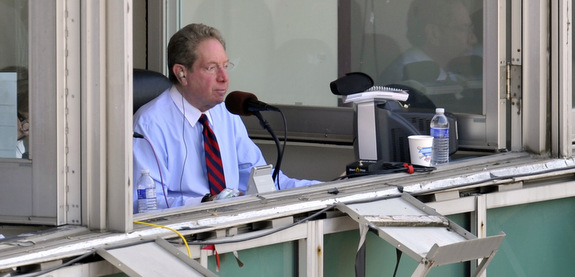
The Yankees are the richest franchise in baseball. They spend upwards of $200 million annually on payroll. They just built a new Stadium, and have furnished it with the finest accommodations. Yet there is one area where the Yankees have skimped: their play-by-play men. This criticism is particular to radio man John Sterling, of whom Post columnist Phil Mushnick has had enough. I’d like to second Mushnick’s motion to remove Sterling from the booth.

This, of course, will never happen. Sterling has been the radio play-by-play man for the past 20 years, and has a contract which reportedly runs through 2011. Still, his shortcomings have become more pronounced over the past few seasons, to the point where there is now a blog named for his poor calls. But because Sterling is so entrenched in the Yankee family, there is no chance of him going anywhere, no matter how many errors he makes in describing the scene.

Mushnick shares a handful of examples from this past weekend alone. The most egregious came during Saturday’s game, when Sterling mistakenly called Hideki Matsui’s double a home run. This coming on a ball that didn’t even hit the wall on a fly. Matsui ripped it, no doubt, and Sterling fired up the home run call, beginning with “It is high,” proceeding to “it is far,” and then finishing with the exclamation, “It is gone!” But it wasn’t. Yankees fans have grown accustomed to this false call, though most of the time Sterling utters the first two, but concludes with “it is caught,” many times before the warning track.

Another example Mushnick describes is one I experienced personally on Friday night. Waiting outside Gate 8 for my friend to show up, I was stuck listening to Sterling’s call. There’s really nothing worse than standing right outside Yankee Stadium and having to hear Sterling describe what’s happening just beyond the wall. Derek Jeter, leading off the bottom of the first, hit a liner to left. Denard Span caught it at his waist, but the way Sterling described it I was sure Jeter had doubled off the wall. A train screeched by at that point, so I wasn’t able to hear his correction. It wouldn’t have been necessary had he gotten the call right the first time.

Sterling is also wont to blame others for his own blunders. If the scoreboard count is incorrect, forget about it. He’s John freaking Sterling, he doesn’t need to keep track of the count. Never mind that he has the YES monitor right in front of him. This leads to another criticism. Last week, I believe against Toronto but it could have been Baltimore, the home plate ump was signaling strikes by putting up a fist in front of his chest. This apparently annoyed Sterling, since he couldn’t see the ump’s call. Far be it from him to look at the monitor to see the call.

Not only does he regularly bungle calls throughout games, but he also apparently 1) has no memory of the recent past, and 2) doesn’t bother to learn the players on the roster. On May 7, in a tie game against the Rays, Jose Veras trotted out for the ninth, which would have been his third inning of work. This was just to buy a bit more time for Mariano Rivera, and pretty much everyone knew that. Sterling probably did, too, but he commented that he couldn’t remember the last time Veras had pitched three innings. This would have been a benign comment had Veras not pitched back-to-back three-inning affairs just two weeks before. He pitched three innings on April 18th against Cleveland, in the blowout game, and then pitched 3.1 in the 14-inning game against Oakland. Regarding knowledge of the roster, my dad called me from the Jersey Turnpike during Spring Training, bemoaning Sterling’s lack of knowledge about Mike Dunn, who had just entered the game. Is it so much to ask a guy whose job is to talk about the Yankees to know the players on their 40-man roster?

We could take all day and chronicle the shortcomings of John Sterling, and some of us might have fun doing so. Yet no matter how much we complain about his errors in the booth, he’ll still be ready to go at 7 p.m., as he is most weeknights — the man hasn’t missed a game yet. However, the entire issue boils down to this: John Sterling’s ego is so massive that it gets in the way of his ability to call the game. Like Tim McCarver, Sterling is in love with the sound of his own voice. That sometimes leads to unintentional humor, like his drawn out “off the mezzzzzzzanine” calls when home runs hit off that part of the park, or like IIH, IIF, IIC’s Warble Index. Most of the time, though, he’s too busy mocking people who think about and analyze baseball to accurately call a game.

Mushnick sums up his stance thusly:

But something’s gotta give — either Sterling gets better (most unlikely), gets his time reduced by a fresh voice (why not?) or gets out.

And the idea that New York baseball fans, the last 20 years and counting, deserve better is too parochial. What baseball fans, and where, deserve this?

The answer to Mushnick’s rhetorical is no one, anywhere. This goes especially for the Yankees. The team is rich enough to bring us multiple $100-million players and a ritzy new Stadium, but can’t find the courage to remove a force which has been detracting from their brand for the past five, ten years? That’s what kills me the most: the Yankees talk endlessly about their powerful brand, yet that brand is represented in large part by John Sterling. He is like an ambassador for the team, spreading their message via AM radio waves. And on an almost nightly basis, he embarrasses that brand.

Yankee fans deserve better. They deserve to have games called accurately by someone or someones who understand not only the Yankees, but baseball as a whole. They deserve someone who will do his or her homework and bring fresh ideas to the fans who listen by radio. They don’t deserve John Sterling and his ego. Unfortunately, we’ll have to deal with it for at least two more seasons after this one.

And to think, we almost had Vin Scully.

Just for kicks:

The jiggle

Jim Norton on the irritating Sterling

Categories : NYC Sports Media
Comments (224)

Newspapers are dying, but that’s old news. It’s been happening for years. The industry has made few, if any, adjustments to the digital revolution, and now they’re all suffering for it. This has led to numerous publications ceasing operations, and we haven’t seen all of it yet. Not by a long shot.

Craigslist has made newspaper classifieds obsolete. Online publications, fueled by ad networks, have decimated the artificial scarcity which fueled inflated ad prices since the beginning of last century. Online publications in general have led many to forego their newspaper subscriptions. Even legal notices, a nearly effortless form of revenue, could be going away. There aren’t many industries which could survive this level of revenue loss.

Jason at It Is About The Money, Stupid asked an interesting question of the newspaper downfall as it relates to baseball: “What does that mean for the media business? Where do the writers go? To the Web, obviously, but can ALL of them afford to rely on an ad-based revenue model?” It’s something media companies are going to have to think hard about, because they’re running out of time.

Soon enough, print publications will be a rarity. Some will continue operation — I don’t think the Daily News, which still turns a profit, will be dying any time soon. For most publications, Web will be the way to go. The problem for publishers is that the Web is far more democratic than print. People have a choice, and with dozens of alternatives they’re not always going to pick the hometown paper. Sometimes they’re not even going to pick the paper of record. They’re going to pick the publication that fits best with their own worldviews.

What, then, happens to “objective” reporting? While I don’t believe any news that filters through humans can be truly objective, there is certainly value in hard facts. That’s the basis of nearly everything in the news industry. Digital media might handle the facts in a manner more palatable to the general public, but news organizations are the ones which gather the facts in the first place. If they die out, how will we find the facts on which we pontificate?

Former Giants beat writer Jeff Fletcher understands this. He summed it up perfectly on his blog a few months ago: “Even on the easier stuff … you need someone there to ask the questions.” Absolutely you do. That’s how we obtain information, by asking questions. Fletcher also notes the obvious, that writers need to be paid for their efforts. They have to pay the bills somehow, and journalism can be a time-consuming endeavor.

By no means do I have all the answers for how journalism will adapt to the digital world. I do read everything I possibly can on the matter, but even the most in-depth experts don’t have hard and fast solutions. What I do know is that instant-money-making ideas like micropayments will not work. How many times do you read a news article? Once, probably. Then it’s never read again, for the rest of eternity. Is that something a consumer should pay for? Probably not, but at the very least it’s a strong argument against the analogy between music and print. News organizations as nonprofits? Great idea in principle, poor because it would involve direct government involvement, and the watched funding the watchdog doesn’t sound like a good idea.

What’s it going to be? First, journalists, editors, executives, and even the public will have to rethink the nature of a news organization. No longer can newspapers afford bustling newsrooms. No longer can they act like they’re the only show in town. No longer can they try to force a sense of scarcity when there exists true abundance. The base level of a news organization needs to change in order to adapt to a new environment. This means decentralized and bottom-up networks of journalists and editors working together, rather than competing with one another, to disseminate the news.

As I’ve long explained to friends, as it relates to baseball, the costs of reporting are simply too high. Think of all the times you see PeteAbe post from an airport. Think of all the road trips and the hotel rooms. Think of expenses incurred in the normal course of duty. Those costs add up big time, to the point where most future organizations won’t be able to afford them. This hurts for baseball writers, because as Fletcher explained, access is key. Yet what we haven’t seen is new organizations combining forces to provide full coverage. Want the facts while your team is in Detroit? Partner with a news organization from that city to provide you coverage. They file the report, the local beat writer adds the color. Not only does this help cut costs, but it also puts pressure on beat writers to be knowledgeable about more teams, since they will be called upon to cover them when they’re in town.

This conversation could go on forever, but in the interest of brevity I’ll cut short here. If you want to read further into how news organizations can adapt to the new century, I’d recommend the following: The Starfish and the Spider by Ori Brafman, Wikinomics by Don Tapscott, and What Would Google Do? by Jeff Jarvis. (Full disclosure: those are our Amazon Associates links). I’d also recommend Jarvis’s blog Buzz Machine, as well as David Carr of the New York Times.

I’d also like to say that if you’re not already reading It Is About The Money, Stupid, you should be. Jason is just excellent. Just wait until he has two, three full years of this under his belt. He and Craig from Shysterball should have a real future with this gig.

Categories : NYC Sports Media
Comments (24)

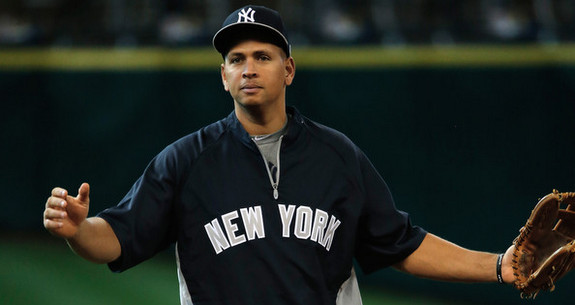
Since his arrival in the Bronx in Feb. 2004, Alex Rodriguez has turned into the whipping boy for the New York media. Despite being the best Yankee hitter and one of the game’s top offensive threats over the last five seasons, nothing A-Rod does is good enough, and everything he does off the field is magnified to the nth degree.

Since the end of January, the so-called A-Rod problem has been a dominant feature of sports radio and the back pages on a near-daily basis. First, Joe Torre called him A-Fraud. Then, Selena Roberts reported the news of a failed PED test six years ago. Then, he admitted more than any other Major League player had since this drug scandal broke in 2003. Then, he had to undergo surgery for a torn labrum. The Yankees, said a lot of mediots, may even be better off without A-Rod.

Here at RAB, we’ve scoffed at that notion. Unless the Yankees plan on replacing A-Rod with the 1981 version of Mike Schmidt, the Yankees are always better off with Alex Rodriguez. That’s just a fact of baseball.

While most New York reporters are content to dump on A-Rod, one has had enough. Ken Davidoff, in an article Jonah Keri calls the best of 2009, takes everyone to task for this absurd hatred of Alex Rodriguez. He writes:

All right, world, you have your chance now. For the next six to nine weeks, you’ll get to see what life is like without Alex Rodriguez. You’ll view the mighty, regal Yankees, rid of their “albatross.” You’ll look at Mr. Perfect, Derek Jeter, liberated from the cumbersome task of playing alongside one of the greatest players in baseball history.

Based on what people have been saying out there, I’m betting the Yankees go 35-1 while A-Rod rehabilitates from arthroscopic surgery…

Somehow, the belief is now pervading that the Yankees will be better off without A-Rod: That he costs as much in anguish and headaches as he pays in home runs and walks.

I don’t get it. It doesn’t make sense on any level, and the only evidence used to back it up – that the Yankees haven’t reached a World Series since they acquired A-Rod – could also be deployed to prove that A-Rod’s a heck of a player, but he ain’t no Clay Bellinger.

Davidoff goes on to eviscerate those who think A-Rod is somehow a problem for the Yanks. He implicitly accuses his fellow brethren of sheer hypocrisy when he notes that A-Rod’s drug use puts him “in the majority of ballplayers from his era.” He slams Bud Selig, the architect of baseball’s image problem, for tsking A-Rod, and he wonders why anyone bothered to make much ado about nothing over A-Rod’s comments about Jose Reyes.

My favorite part though is the way Davidoff ends his column:

If the Yankees do struggle, however, if the new guys can’t live up to the expectations and the old guys can’t reach back for better days, then perhaps the haters will finally have their question answered. They’ll finally realize the old “Be careful what you wish for” axiom.

Nah. They’ll probably just hate A-Rod all the more for getting injured.

As tongue-in-cheek as that is, the sad truth is that Davidoff is right. If the Yanks do well, fans, commentators and Mike Francesca will say that the team doesn’t need A-Rod. If the Yanks struggle — if Joba, CC and A.J. can’t get the outs they should get, if Jorge isn’t healthy, if Jeter’s age shows — it will all be A-Rod’s fault for not doing something sooner. Welcome to the Bronx Zoo.

Categories : NYC Sports Media
Comments (130)

It’s de rigeur for anyone covering the Yankees to write about how different Derek Jeter and Alex Rodriguez are. One is the Yankee Captain. He knows winning. He has intangibles (and a, um, $189 million contract). The other is a paid mercenary who pads his stats and just wants to be the center of attention. He hurts the team and is a pox on New York.

One of those players has his contract coming up for renewal at the end of next year, and while the Yanks probably wish they could dump Alex Rodriguez in 22 months, it is Derek and his contract who will be at the eye of that storm. That this decision is still two years away isn’t impacting anyone from writing about, and the latest reporter to opine on the situation is Ian O’Connor. Let’s see what he had to say:

This franchise player can’t be trusted with the franchise. It has nothing to do with a hip that could bench A-Rod until who knows when, and everything to do with a lack of leadership skills and common sense that would allow him to use steroids, to tell all sorts of tall tales about his drug use and to wish out loud that Reyes played for the Yanks.

Just another circle of reasons why the Yankees should extend the contract of A-Rod’s most conspicuous ex-friend, Jeter, whose deal will expire at the close of next season. They need to keep Jeter beyond 2010, if only to serve as an A-Rod deodorant…

Jeter should be anywhere from 65 to 100 hits shy of 3,000 at the end of his current deal. The Yankees can’t possibly finance A-Rod’s hollow home-run derby while denying the face of their last dynasty — and the face of all drug-free players — his chance to become the first man in franchise history to clear 3,000 hits.

The captain will be 37 in the summer of 2011, the first season of a potential extension. He will need to rely on his intangible grace more than ever as his physical skills decline.

But if any golden oldie is worth the gamble, Jeter’s the one. The Yanks gave him $189 million for leading them to the four championships. They should offer him another $45 million over two years for helping them build the new palace across the street in the Bronx.

O’Connor’s justification for an inexplicable raise is that it would be his last contract no matter what. The Yankees would be giving Jeter a gracious send-off by overpaying one of the richest athletes in New York. Brilliant!

If this is the type of argument writers are going to make until and unless the Yankees lock up Jeter through the end of his career, I dread the next two years. When the time comes, the Yankees will have to evaluate their commitment to Jeter not through some nostalgic lens of a World Series last won in 2000 but rather through one that judges what Derek can do for the Yanks in 2011 and beyond.

There will be a spot on the team for the Captain if he is willing to take it. He’ll be 37, and he won’t be a viable short stop. He also won’t earn $20 or $22.5 million a year. Intangibles aren’t worth the farm, and those covering the Yanks shouldn’t sound so naive about Derek Jeter.

Categories : NYC Sports Media
Comments (100)

Today is a watershed day for the media but not in a good way. In Colorado, in what is the surest sign of a very troubled industry, the 150-year-old Rocky Mountain News has closed its doors. Throughout the nation — from Philadelphia to San Francisco — newspapers are facing extinction.

In New York, the so-called media capital of the world, Newsday, the Cablevision-owned, Long Island-based daily, is in trouble. The paper’s parent company had to take a $404.2 million write-down on Newsday after the paper, according to the AP, “recorded an operating loss of $407.6 million on $107.1 million in revenue.”

In light of this dire financial situation, Newsday is planning to charge for all online access to the paper. Facing a highly competitive online world that hasn’t matured economically, this move could be the deathknell for Long Island’s own paper.

PaidContent.org, the industry site for online content, had more about Newsday’s decision and what it might mean for their business model:

While financial pubs like WSJ.com and FT.com have been able to get away with asking readers to cough up subscription fees because business professionals are more willing to pay for specialized business news, the thought of a general newspaper doing so when so much is free is largely considered dubious. Still, the challenges newspapers are dealing with leaves them little choice but to try to get money directly from users.

Newsosaur’s Alan D. Mutter, told me he believes Newsday has a shot, but within limits. “Yes, I think they can start charging for web content. More and more publishers will, because they can’t afford to produce content without doing so. You can’t charge for sports scores, stock prices or generic breaking news. The key will be providing content that is valuable and exclusive.”

Basically, Newsday is banking on more revenue through paid subscribers than they could generate through advertising money on a higher-trafficked but still free site. I think this could work if they keep their extensive blogs free.

On the baseball front, it’s hard to consider this good news, and while RAB has contributed content to the paper’s Yankee blog, it would be tough to see the paper hide its daily work behind a paid wall. Gone would be the words of Wallace Matthews, Ken Davidoff and Kat O’Brien. If the free blog posts live on though, Newsday can still drive daily visitors to its site for dynamic content, and it can maintain its place in the sports media world. No matter the outcome, though, it’s tough out there for a newspaper.

Categories : NYC Sports Media
Comments (22)

In today’s Daily News, Anthony McCarron would have us believe that Derek Jeter is frustrated with the Alex Rodriguez situation. That’s what the headline says, and that’s what his article intimates.

Upon closer reading, however, this concept utterly breaks down. Let’s excerpt only Derek Jeter’s quotes and not McCarron’s reporting/analysis.

“I’m not addressing Alex’s situation until everybody’s here…”

“I’m not going to do it every single day,” Jeter said… “Are things a distraction? It’s a distraction when you talk about it every single day…”

“Every year it’s something,” Jeter said Tuesday. “Last year…I’m sure you go back, there was something. It’s the Yankees, there’s always a story at some point. A lot of the guys who’ve been here, they’re used to it. Not something of this level, but used to answering questions about some other things. Once baseball activities begin, hopefully we can concentrate on that.

“I understand you guys have a job to do, I really do,” Jeter told reporters. “But we have a job to do, too, and it’s much better for me, much better for the team to address it one time and not continually address it day after day. If everyone (in the media contingent) was down here today, I’d address it today.

“A lot of times, situations where there’s controversy, guys pull for each other and pull together a little more. That’s what you hope for.”

That, my friends, is not Derek Jeter getting frustrated over Alex Rodriguez. That is Derek Jeter, after 13 seasons, unleashing his pent up fury over the New York media. It’s been a long time coming.

Derek, as Joe Torre and Tom Verducci make abundantly clear in their recent book, has been the even-keeled leader in the Yankee Clubhouse. While not as outspoken as many of his critics would like him to be, he leads by example. He certainly knows about and masterfully exploits the give-and-take surrounding the Yanks and the hyper-sensitive media. This is, in a way, the first real crack we’ve seen in Derek’s armor, and I applaud it.

At some point, the media is going to have to acknowledge its role in the steroid scandal through something other than misguided righteous indignation. These reporters were in the clubhouse every day; they saw the players; they must have known something about what was going on. Yet, none of them bothered to pursue the story ten years ago. So they resort to over-the-top coverage and attempt to sow dissent among the Yanks, the Giants, whichever player tests positive today.

Derek is right to take these reporters to task, and he’s doing today exactly what a captain should be doing. He’s protecting his teammates from what has turned out to be a rather vicious media machine. I certainly don’t expect the press to kowtow to baseball players. I’m a firm believer in the First Amendment and feel that a healthy press is a vital to the American democracy. But at some point, these reporters need a lecture like the one Derek gave yesterday. Good for him.

Categories : NYC Sports Media
Comments (69)

For the past three years I’ve subscribed to MLB.tv, and this year shouldn’t be any different. The $120 per year has always paid for itself in terms of entertainment dollars per hour, and now that they’ve lowered the price to $110, that goes even more so. No, I can’t watch Yankees games on it, but I can watch the Yanks on TV and have another game in front of me on my monitor. Or, if I’m feeling really ambitious, I can hook up my second monitor, allowing me to watch the Yanks, watch another game, and comment on the game thread.

As Brad Stone of the New York Times notes, there are a few upgrades to the MLB.tv package this year. It sounds like they’re going for a Netflix streaming system, rather than having the user select a speed: “Technology by Swarmcast, a content delivery network with headquarters in Minneapolis and Tokyo, will help the league determine the speed of a fan’s Internet connection and adjust the quality of the video accordingly.” So if we’re somewhere between the 800K and 1.5MB quality, we’ll get something in the middle, not the lesser of the two.

My favorite upgrade is that you can now overlay radio broadcasters on the TV feed. Sick of Kay? Listen to Sterling. Sick of them both? Listen to the out of town radio announcer. I’m not sure how widely used this feature will be, but it does raise the possibility of a feature I’ve been pondering for a while.

Why not really open up the platform? Allow users to start their own announcing channels. An individual or group could enter a special room, kind of like our live chats, where they can provide their own play by play and color commentary. Other users can then overlay that rather than a mainstream broadcaster. I can see this not only being a fun feature for fans, but something that could drum up some more interest in the MLB.tv service. Most people do not want to watch baseball on their computers, but I’m sure a number would give it a shot if they either got to call the game themselves, or if they got to listen to a less insufferable commentator.

On the technical end, the downside is that the amateur commentators won’t have a view of the whole field like the guys in the booth do. That could be remedied, I suppose, by providing multiple camera angles to the amateur announcers. Would MLB and the broadcasters be willing to do that? I’m not sure, but I don’t see why not. In fact, that might be another feature in itself, the ability to watch the game from any camera in the park.

The question which will determine the feasibility of this: How will the media outlets react? They pay big bucks for the exclusive rights to broadcast games, and they might not be on board with amateur announcers cutting into the time of their professionals. MLB won’t want to compromise their relationships with these outlets, so if they say no, that could render this idea DOA. Still, it’s something which I think would bring more viewers to the MLB.tv platform and which would provide an opportunity for new voices to be found.

Categories : NYC Sports Media
Comments (49)
Dec
11

A big RAB thank you

Posted by: Benjamin Kabak | Comments (106)

With the Winter Meetings wrapping up today, I just wanted to take a minute to thank everyone who has stopped by over the last days. On Monday, we set a new RAB record with a hair under 30,000 page views; on Tuesday, we topped that record and hit 34,000; on Wednesday, we blew past Tuesday’s total to end the day with over 42,000 page views. In other words, with Mike and Joe in Vegas covering the meetings and my running the wires in New York, we’ve pulled in over 108,000 page views in three days.

On a similar vein, Rob Neyer penned an interesting piece on his acceptance into the BBWAA. He’s certainly a bit ambivalent about inclusion, and one of his passages strikes a chord:

when I was hired to write for ESPN’s Web site in 1996, nobody told me to respect my elders. So I didn’t. If I thought Tracy Ringolsby was writing foolishly, I said so. If I thought Tom Verducci had crossed the line from intelligent analysis (of which he’s highly capable) into subjective dim-wittedness, I said so. And usually not with any surplus of grace. I believed then (and believe now) that my job, my responsibility, is to entertain and to educate, and that “not ruffling feathers” falls way, way down on the list somewhere.

That gets at the root of what we do. Yes, we’re fans covering our favorite team. But at the same time, we don’t give the Yanks and the papers that cover them a free pass. I cover the stadium issue quasi-fanatically because there’s been an utter lack of skeptical and accurate reporting. Joe takes issue with the New York Post because they more than push that line Neyer mentions. Mike delves into the minors because few others do. We like to hope that we bring something new and unique to the table, and I guess we’re doing something right.

So thank you to the regulars and thank you to the new folks who have stopped by. We’ll be here all winter and into the season as well. Make sure you come back.

Categories : NYC Sports Media
Comments (106)