Welcome to December. The offseason’s busiest month has arrived and that means gobs of rumors and transactions. That is every bit as true for the 2018 going on 2019 Yankees as it was the 2013 going on 2014 Yankees. In fact, this month’s edition of our MLBTR Archives series includes over 1,600 words of copied and pasted MLB Trade Rumors blurbs alone. Then we added our commentary on top of that.
Anyway, the Yankees went 85-77 in 2013 and missed the postseason. By time December 1st rolled around they’d already re-signed Derek Jeter, signed Brian McCann, and shown interest in Jhonny Peralta, Omar Infante, and Brandon Phillips as backup plans in case Robinson Cano signed elsewhere, which of course he did. December 2013 was one of the busiest months in recent Yankees history. Let’s go back in time five years.
December 2nd, 2013: Yankees Sign Brendan Ryan
3:27pm: Ryan will receive $2MM in 2014 and 2015, tweets Joel Sherman of the New York Post. The Yankees hold a $2MM club option for 2016 that becomes a $1MM player option if it is declined, he adds.
Two years and a player option! What a time to be alive. The Yankees acquired Ryan in an ultra-rare September trade because Jeter got hurt and they needed someone to play shortstop the final few weeks of the 2013 season. They then re-signed Ryan to this contract to be their utility guy. It went how everyone expected. Ryan didn’t hit (37 wRC+) but he played some nifty defense from 2014-15. He of course exercised his player option for 2016 and, to shed the salary, the Yankees included him in the Adam Warren-Starlin Castro trade. The Cubs immediately released him. Ryan spent the 2016-17 seasons in Triple-A and did not play at all this past season.
December 2nd, 2013: Yankees Will Not Offer $200MM To Cano
The Yankees will not offer star free agent second baseman Robinson Cano a deal for over $200MM, reports Jeff Passan of Yahoo Sports. With a current offer of seven years and $160MM already on the table, the club plans to stand on that figure and does not foresee wiggle room of greater than about $15MM, says Passan.
The Yankees’ final offer to Cano was seven years and $175M, so that maxed out that reported $15M in wiggle room on top of the $160M offer. At this point, it still felt like only a matter of time until Robbie re-signed with the Yankees. No other teams were showing serious interest yet and the Yankees had made him a monster contract offer. He was holding out for more and the Yankees were obviously willing to wait him out.
December 2nd 2013: American League Non-Tenders
GM Brian Cashman says that the Yankees will non-tender infielder Jayson Nix, tweets Anthony McCarron of the New York Daily News. The 31-year-old veteran appeared in 87 games for New York last season, putting up a .236/.308/.311 line in 303 plate appearances. The club will also non-tender reliever Matt Daley and infielder David Adams. New York confirmed the moves via press release.
And thus ends the Nixy era. Nix spent two years in pinstripes, hit .239/.307/.340 (78 wRC+) in 505 (!) plate appearances, and was let go after the 2013 season. He bounced from the Phillies to the Pirates to the Royals in 2014 and has been out of baseball since 2015. Also, wow were people made the Yankees non-tendered David Adams. I mean irate. He still had some prospect shine at the time but it didn’t really work out. Adams bounced around the Double-A and Triple-A levels for various organizations from 2014-16 and hasn’t played since. He rejoined the Yankees as a minor league instructor last year and this summer he managed one of their rookie Gulf Coast League teams.
December 3rd, 2013: Mariners Have Emerged As Major Players For Robinson Cano
The Mariners have emerged as a major player in the Robinson Cano sweepstakes, several sources told Wallace Matthews of ESPNNewYork.com. With the Yankees not wanting to go to seven years or as much as $200MM, an industry source with knowledge of the negotiations termed the Yankees chances of retaining Cano at “less than 50-50.”
Haha real funny guys knock it off.
December 3rd, 2013: A’s Likely To Trade Brett Anderson Next Week
3:54pm: The Yankees are also interested in Anderson, according to Yahoo’s Jeff Passan (on Twitter). According to Passan, the A’s are likely to deal Anderson at next week’s Winter Meetings.
Acquiring Brett Anderson always seems like a good idea until you actually acquire Brett Anderson. Injuries limited him to 163 innings total from 2011-13, the Athletics traded him soon after this rumor to the Rockies for Drew Pomeranz, and then Anderson made eight starts for Colorado around injuries. He became a free agent after the 2014 season and has bounced around since. He made 17 starts for the A’s this season. It is the fourth most games he’s started in his ten-year big league career.
December 3rd, 2013: Quick Hits: Granderson, Beltran, Trumbo, Cano
The Yankees have signed right-hander Brian Gordon to a minor league deal, according to Ken Davidoff of the New York Post (on Twitter).
You might remember Brian Gordon from such appearances as those two random starts he made in June 2011. Bartolo Colon and David Phelps hit the disabled list at the same time and the Yankees were desperate for a spot starter. Gordon exercised the opt-out clause in his minor league contract with the Phillies, the Yankees scooped him up, and he allowed six runs in 10.1 innings in two starts.
That was 2011. The Yankees released Gordon about a month later so he could go to Korea. He played there for a few years before returning and inking this new minor league contract with the Yankees. Gordon spent the first half of the 2014 season with Triple-A Scranton, where he allowed 46 runs in 77.2 innings before being released at midseason. He hasn’t played since. Rough.
December 6th, 2013: Yankees Sign Kelly Johnson
The Yankees have signed Kelly Johnson to a one-year contract, the team announced today. Terms of the deal weren’t made public but ESPN’s Buster Olney reports that the deal is for exactly $3MM (Twitter link), giving Johnson a small raise from the $2.45MM he earned with Tampa Bay in 2013.
A few weeks ago, as I was waiting for Game One of the World Series to start, I thought to myself “Matt Kemp is probably the best DH an NL team has used in the World Series in quite some time.” So I looked it up. Turns out the Dodgers used Justin Turner and Joc Pederson at DH in 2017 and those guys are pretty good, plus the Cubs used Kyle Schwarber at DH in 2016, so I was wrong. Kemp wasn’t the best DH an NL team used in World Series in a while.
I mention this because that search led me to discover that Kelly Johnson started at DH in Game One of the 2015 World Series for the Mets. True story. He started at DH, went 0-for-1 with a hit-by-pitch, then was replaced by pinch-hitter Michael Cuddyer against a lefty in the late innings. How about that? Anyway, I was overly excited about the Johnson signing. He then hit .219/.304/.373 (93 wRC+) while bouncing all around the infield for the Yankees before being traded to the Red Sox for Stephen Drew. Boston then sent him to the Orioles for Jemile Weeks. In the span of three seasons (2012-14), Johnson played for all five AL East teams.
December 7th, 2013: Yankees Receiving Significant Interest In Brett Gardner
After inking outfielder Carlos Beltran last night, the Yankees have received “significant interest” in Brett Gardner, reports Andy McCullough of the Star-Ledger (via Twitter). The club is willing to deal Gardner, says McCullough, though it is not actively shopping him.
Death, taxes, Brett Gardner trade rumors in the offseason. I should note that some of these events are out of order because deals get agreed to one day and made official another day, and when MLBTR updates their post, the timestamp gets changed. At this point the Yankees had already signed Beltran and Jacoby Ellsbury. Those two joined Gardner, Ichiro Suzuki, and Alfonso Soriano. Five outfielders for the three outfield spots plus DH. Gardner was out on the trade market and the Yankees kept him, which is pretty much exactly what happened every offseason from 2009-17. Injuries and Soriano getting old fast cleared up the outfield jam rather quickly.
December 7th, 2013: Yankees Re-Sign Hiroki Kuroda
The Yankees and Hiroki Kuroda finalized a one-year, $16MM contract last night that will allow the right-hander to earn up to $500K worth of incentives, according to Joel Sherman of the New York Post (on Twitter). Kuroda, a client of Octagon’s Steve Hilliard, will earn $250K for reaching the 190-inning and 210-inning milestones, according to Sherman.
Hiroki Kuroda was the right pitcher at the wrong time for the Yankees. They had Kuroda from 2012-14 and they needed him from 2017-19. Kuroda was the man. He was a no nonsense plow horse who racked up 620 innings and +11.2 WAR in three seasons in pinstripes, all on one-year contracts. One of the best one-year contract signings in franchise history, hands down. Heck, Kuroda was three of the best one-year contract signings in franchise history. I miss this guy.
December 7th, 2013: Yankees Agree To Sign Jacoby Ellsbury
The Yankees have agreed to sign Jacoby Ellsbury, according to Mark Feinsand of the New York Daily News (via Twitter). Jon Heyman of CBSSports.com first reported that the two sides were closing in on a seven-year pact. It is believed the deal will top Carl Crawford‘s $142MM, seven-year deal with one estimate pegging the deal at about $150MM, according to Heyman.
This date, December 7th, 2013, is still the highest trafficked day in RAB history. It’s not even close, really. It surpassed July 9th, 2010, the day of the Cliff Lee non-trade. The hot stove blew up on December 7th, 2013. On that day:
- The Yankees agreed to sign Ellsbury.
- The Yankees agreed to sign Beltran.
- The Yankees agreed to re-sign Kuroda.
- Curtis Granderson left for the Mets.
- Robinson Cano left for the Mariners.
Yep, that’s how you get the most visited day in RAB history. As for Ellsbury, gosh what a mess. It was a terrible contract at the time and you could tell that because he was Scott Boras’ top client that offseason and the top Boras client never signs the week before the Winter Meetings. The Yankees had to blow Boras and Ellsbury away with an offer to get him to sign that early. Supposedly the Yankees had been told Cano would be leaving a few days earlier, so they hustled to sign Ellsbury before the Cano news became public and they lost leverage. If that’s the deal they cut with leverage, I don’t want to know what would’ve happened with no leverage.
In his five seasons with the Yankees Ellsbury has hit .264/.330/.386 (98 wRC+) with +7.9 WAR while playing in 520 of 810 possible games, and there’s still two more years to go. There’s a decent chance he’ll never play another game with the Yankees too. This is on the short list of the worst free agent signings in history, Yankees or otherwise.
December 8th, 2013: Yankees Open To Trading Ichiro Suzuki
The Yankees have begun discussing Ichiro Suzuki in trade talks with other clubs, Chad Jennings of the Journal News reports. Jennings notes that this does not mean an Ichiro deal is imminent.
You will be surprised to learn there was minimal interest in a 40-year-old outfielder who hit .262/.297/.342 (72 wRC+) one year earlier. Ichiro is an all-time great. First ballot Hall of Famer. But that two-year contract the Yankees gave him for 2013-14 made no sense from a baseball perspective. We know ownership went over the front office’s head to re-sign Ichiro and it seems clear they were hoping to cash in on his pursuit of 3,000 hits, a milestone he didn’t reach until 2016.
December 8th, 2013: New York Notes: Cashman, Santana, Pelfrey, Ibanez
The Yankees have checked on free agent right-hander Mike Pelfrey, tweets CBSSports.com’s Jon Heyman.
Mike Pelfrey! Big Pelf had a 5.19 ERA (3.99 FIP) with the Twins in 2013 and fortunately this rumor didn’t go anywhere, because he allowed 23 runs in 23.2 innings in 2014, also with the Twins. Pelfrey was still in the big leagues as recently as 2017. Never would’ve guessed it. I thought he was done in like 2015.
December 9th, 2013: Jeff Samardzija Rumors: Monday
Although the Yankees like Samardzija, they may not have the sort of prospects the Cubs are seeking, writes Joel Sherman. One member of the Cubs organization told Sherman that the Yankees “have no upper-level talent.”
It was true! The Yankees’ best prospects during the 2013-14 season were Gary Sanchez, Slade Heathcott, Mason Williams, and Tyler Austin. They all finished the 2013 in Double-A and were hardly MLB ready. The Cubs held on to Samardzija that offseason and eventually sent him to the Athletics for Addison Russell and former Yankee Billy McKinney at the 2014 trade deadline.
December 10th, 2013: At Least Seven Teams Interested In Eric Chavez
Jon Heyman of CBS Sports reports that at least seven teams are interested in free agent third baseman Eric Chavez. According to Heyman, the Rangers, Rays, Pirates, Braves, Nationals, Diamondbacks and Yankees have all checked in on Chavez, though New York’s recent signing of Kelly Johnson may close that door.
Bringing Eric Chavez back from the dead was one of the most successful reclamation projects in baseball in recent years. The guy was basically done in 2010 and 2011, then, from 2012-14, he hit .277/.342/.483 (120 wRC+) with 28 homers and +3.0 WAR in 648 plate appearances. That’s a mighty fine part-time player. Chavez went to the Diamondbacks in 2013 and returned to the Diamondbacks in 2014. He joined the Yankees front office in 2015 before leaving for the Angels with Billy Eppler in 2016. There was some thought Chavez would replace Mike Scioscia as Angels manager this offseason, but that didn’t happen. The Yankees struck reclamation project gold with him in 2012.
December 10th, 2013: East Notes: Mets, Burnett, Phillies, Benoit
The Yankees have had “lots of internal discussions” about free agent reliever Joaquin Benoit, USA Today’s Bob Nightengale reports (via Twitter). The Yankees would like to add two bullpen arms.
The Yankees would like to add two bullpen arms? Where have I heard that before? Benoit was still in his heyday in 2013. He threw 67 innings with a 2.01 ERA (2.87 FIP) for the Tigers that season and was very in demand during the 2013-14 offseason, so he signed a multi-year contract with … the Padres? The Padres. Benoit had a 1.49 ERA (2.32 FIP) in 2014 too. Then the wheels came off in 2015 and he bounced around a bit. From 2010-16, Benoit threw 427 innings with a 2.40 ERA (3.23 FIP) and +11.0 WAR. That’s a heck of a six-year run for a pitcher who had major shoulder surgery at age 31 in 2009.
December 11th, 2013: Eight Teams Showing Interest In Johan Santana
Eight teams have expressed interest in left-hander Johan Santana, reports Andrew Marchand of ESPN New York. The Yankees, Mets, Twins, Rays, Orioles, Royals, Brewers and Pirates have all expressed varying levels of interest.
Johan in his prime was something else, man. His 2004-06 seasons (2.75 ERA and 2.92 FIP in 693.1 innings) were as dominant a three-year stretch as we’ve seen from any non-Kershaw since peak Pedro Martinez. By December 2013 though, Santana’s shoulder was cooked. He had a 4.85 ERA (4.09 FIP) in 21 starts with the Mets in 2012 and didn’t even pitch in 2013 because of injuries. I was totally cool with giving him a minor league contract. The Orioles eventually signed him — the Blue Jays signed him in 2015 too — but he never did take the mound. Santana received ten Hall of Fame votes last year, the same number as Jamie Moyer, and fell off the ballot on his first year of eligibility. He was a monster at his peak. One of the best changeups I’ve ever seen.
December 11th, 2013: Indians Told Masterson He Won’t Be Traded
The Indians are said to be open to listening to offers on Justin Masterson, and the Yankees have emerged as a possible suitor, according to Bob Nightengale of USA Today. Nightengale reports that the Yankees would be interested in acquiring Masterson in a deal involving Brett Gardner. A third team would likely be required, since the Indians don’t have a need Gardner (Twitter links).
Oh man, I completely forgot about Justin Masterson. That dude’s career was all over the place. His ERA+’s from 2008-13: 147, 99, 84, 122, 79, 110. A Gardner-for-Masterson trade would’ve been a disaster for the Yankees because Masterson started to break down in 2014. He had a 3.45 ERA (3.35 FIP) in 193 innings in 2013 and 5.79 ERA (4.62 FIP) in 188 innings total the rest of his career. Masterson was active as recently as 2017 though, in Triple-A with the Dodgers. Somehow he’s still only 33. Jon Heyman says Masterson is doing missionary work now.
December 11th, 2013: West Notes: Hoes, Doolittle, Rockies, Gregorius
Diamondbacks shortstop Didi Gregorius has drawn some interest from the Yankees, tweets Joel Sherman of the New York Post. The D-Backs reportedly could use their shortstop surplus to land a starting pitcher, but the Yankees are in the market for starters themselves and don’t seem to be a good fit in that regard.
December 11th, 2013: The first time we heard the Yankees connected to Gregorius. It wasn’t until 12 months later that the Yankees acquired Sir Didi. Brian Cashman has said the Yankees were after Gregorius for a long time, dating back to his time with the Reds. Didi hit .252/.332/.373 (91 wRC+) with seven homers in 103 games for Arizona in 2013 and everyone was wondering what the Yankees saw in him. Now it’s hard to imagine the Yankees without him.
December 12th, 2013: AL Central Notes: Jackson, Pelfrey, Garza, Butler
The Tigers have discussed trading Austin Jackson to the Yankees in exchange for Brett Gardner, Bob Elliott of the Toronto Sun reports. Both players have been above-average fielders in center over their careers and have comparable career batting lines, though Gardner is a better base-stealer and Jackson has more doubles pop.
Huh, I don’t remember this at all. Gardner was 29 at the time and coming off a .273/.344/.416 (109 wRC+) line and +3.3 WAR season in 2013. Jackson was 26 and he hit .272/.337/.417 (108 wRC+) with +3.2 WAR. Same player! Except Gardner was three years older and had one fewer year of team control. I reckon I would’ve been all for a Gardner-for-Jackson trade at the time and hey, maybe I was and I don’t remember it. Fortunately the Yankees didn’t do it. Gardner was a 112 wRC+ and +3.3 WAR player in 2014. Jackson slipped to 86 wRC+ and +1.1 WAR and has been a journeyman fourth outfielder since.
December 17th, 2013: AL East Links: Floyd, Ackley, Ortiz, Rays
Ken Rosenthal of FOX Sports reports that there’s no traction to trade talks between the Yankees and Mariners regarding Dustin Ackley (Twitter link).
This was December 2013. The Yankees didn’t trade for Ackley until July 2015. Ackley was coming off back-to-back poor seasons with the Mariners and the Yankees were looking to buy low on a former top prospect, like they did with Gregorius and Aaron Hicks. Eventually they landed Ackley and it didn’t work out. He was a +0 WAR player in 51 games in pinstripes. Ackley’s spent the last two seasons in Triple-A with the Angels and Fabian Ardaya (subs. req’d) wrote a great article in September about Ackley coming to terms with being a bust.
December 17th, 2013: New York Notes: Reynolds, Baker, Murphy, Tejada
Joel Sherman of the New York Post reports that the Yankees have also expressed interest in Jeff Baker as a potential right-handed bat to get some time at second base and third base (Twitter link). Baker mashed against lefties in 2013, posting a .314/.407/.667 batting line with 10 homers.
That’s Jeff Baker, career .296/.350/.509 (126 wRC+) hitter against lefties to you. He hammered southpaws and played several positions, albeit none of them well, and I wanted him on the bench. I wanted him in place of Ichiro, if I remember correctly, but it didn’t happen. The Marlins gave Baker two years and he was limited to 131 sub-replacement level games with them from 2014-15.
December 18th, 2013: Choo Turned Down Seven-Year Offer From Yankees
While the market for Shin-Soo Choo has been slow to develop, he could have already found a home had accepted a lavish offer from the Yankees. Jeff Passan of Yahoo Sports reports that even after signing Jacoby Ellsbury to a seven-year, $153MM contract, the Yankees offered Choo a seven-year, $140MM contract. Agent Scott Boras reportedly countered by asking for Ellsbury money, and the Yankees instead elected to sign Carlos Beltran to a much cheaper three-year, $45MM pact.
Good gravy, could you imagine if the Yankees had signed Ellsbury and Choo to seven-year contracts that offseason? Choo’s been the more productive hitter than Ellsbury to date, but, over the last five seasons, these two have been worth +15.3 WAR combined while being paid $197.3M. Spending almost $13M per WAR seems … inefficient.
December 19th, 2013: Yankees To Sign Carlos Beltran
It didn’t take long for the Yankees to move on from losing Robinson Cano. The Yankees have officially announced the signing of Carlos Beltran to a three-year deal. The contract is reportedly worth $45MM and will pay Beltran an even $15MM per season as well as provide him with a no-trade clause. Beltran is represented by agent Dan Lozano of the MVP Sports Group.
The Yankees finally got around to announcing the Beltran deal on December 19th. The two sides agreed to terms on December 7th. Anyway, the Beltran deal worked out a lot better than I expected. He struggled and battled injuries in 2014, but otherwise he hit .270/.327/.470 (116 wRC+) in pinstripes. Pretty good for ages 37-39. And the Yankees cashed him in as a trade chip too. Not bad. Not bad at all. It still bugs me the Yankees didn’t sign him in 2005 though. What a blunder.
December 19th, 2013: Yankees Designate Brett Marshall For Assignment
The Yankees announced that they have designated Brett Marshall for assignment. The move will make room for the newly-signed Carlos Beltran on the 40-man roster.
Marshall had some prospect shine back in the day and apparently he made three appearances with the 2013 Yankees? I don’t remember that at all. Six runs in 12 innings in his only MLB action (to date).
The Cubs claimed Marshall on waivers after this and he’s spent the last few seasons bouncing around Double-A, Triple-A, and independent leagues. This past season Marshall had a 4.56 ERA with 108 strikeouts and 79 walks in 132.1 innings for three different independent league teams.
December 26th, 2013: Minor Moves: Matt Daley, Chris Narveson
After non-tendering Matt Daley in early December, the Yankees have agreed to a new minor league deal with the 31-year-old right-hander, per the team’s transactions page. Daley pitched well in six innings for the Yankees in 2013 and owns a career 4.38 ERA with 9.2 K/9 and 3.1 BB/9 in 86 1/3 big league innings.
Daley somehow made 13 appearances with the 2014 Yankees. He allowed four homers and eleven runs in 14.1 innings. Daley retired after the season and he joined the Yankees as a scout. He’s currently working his way up the organizational ranks and probably isn’t far off from running one of the scouting or player development departments.
December 26th, 2013: Quick Hits: Tanaka, Eaton, Cardinals, Reds
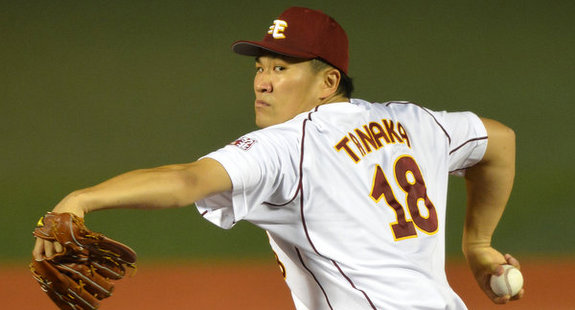
Masahiro Tanaka‘s posting period opened this morning and the Yankees have already contacted Tanaka’s agent Casey Close, Newsday’s Marc Carig reports.
At long last, Tanaka hit the market. We went through the usual “they might not post him” nonsense for the first few weeks of the offseason. MLB and NPB agreed to rewrite the posting agreement that winter and it allowed Tanaka to negotiate with any team. It was no longer a blind auction with the high bidder winning the player’s negotiating rights. Anyway, the day after Christmas, Tanaka hit the market.
December 30th, 2013: Yankees Plan To Incur 2014-15 Int’l Spending Penalties
The Yankees plan to spend $12MM-$15MM on the 2014-15 international amateur free agent market, incurring $10MM-$12MM in penalties, Kiley McDaniel of Scout.com reports. That $12MM-$15MM figure would not include potential spending for Masahiro Tanaka, who is not subject to international bonus pools that govern spending for most Latin American amateurs.
Gosh, the 2014-15 international spending spree was such a failure. The Yankees spent $30M total between bonuses and penalties and got basically nothing out it. Estevan Florial is far and away the best prospect from the 2014-15 international haul and he was a lower profile signing late in the signing period. Big bonus guys like Nelson Gomez, Jonathan Amundaray, Juan De Leon, Miguel Flames, and Wilkerman Garcia all failed to develop.
The money is whatever. Who cares if the Yankees blow $30M on prospects? The real downside was being limited to $300,000 bonuses in the 2015-16 and 2016-17 signing periods. The Yankees still landed some good prospects those years (Roansy Contreras and Luis Medina, most notably), but they had no chance at the top prospects. Seven-figure guys like Vlad Guerrero Jr., Juan Soto, Adrian Morejon, Michel Baez … the bonus cap took the Yankees out of the running for all of them. Sigh. The 2014-15 signing spree was well-intentioned. It worked out about as poorly as possible though.