Archive for Payroll

Jan
22

2013 Payroll Breakdown: Part Four

Posted by: | Comments (118)

Since we last met, the Yankees addressed nearly all of their arbitration business by signing Phil Hughes, Boone Logan, and Joba Chamberlain to one-year contracts that were a bit more pricey than MLBTR’s projections. Here’s an updated look at the team’s payroll situation for the upcoming season…

Assuming Robertson wins his arbitration hearing (doesn’t make a big difference either way), the Yankees already have $203.825M in real dollars (not average annual value for luxury tax purposes) tied up in 17 roster spots. They’ve opened each of the last five seasons with a real-dollar payroll in the $203-214M range, meaning they have approximately $10.2M to spend on the remaining 23 40-man roster spots if they’re willing to again open the season at a similar level.

The 15 players on the 40-man but not in the big leagues will earn less than the league minimum — the pro-rated minimum in the show and something much less in the minors. I’ve seen those players estimated at $2.5M total which I think might actually be a little light in the Yankees’ case. Remember, Alex Rodriguez and Michael Pineda are going to open the season on the 60-day DL and will have their 40-man spots occupied by other players. Let’s call it $3.5M for the non-active roster 40-man players.

Ivan Nova, David Phelps, Chris Stewart, Frankie Cervelli, Eduardo Nunez, and Clay Rapada are in their pre-arbitration years but project to open the season on the 25-man roster. They’ll earn something close to the league minimum, so $3M for the group ($500k each). Those six combined with the 15 non-25-man players brings us to $210.325M for 38 players. Jayson Nix and Matt Diaz are the early favorites to fill out the bench, and they signed minor league contracts that will pay them $900k and $1.2M in the big leagues, respectively. We’re now at $212.425M for a full 40-man roster.

The Yankees still have a number of holes to fill, but at this point I think we should all stop expecting them to find a legitimate starting catcher. Maybe (hopefully) they’ll claim George Kottaras and his meager $1M salary to, if nothing else, compete for the job in the camp. It’s not like they’d be taking on a huge financial commitment or anything. They still need a DH and miscellaneous depth pieces, both on the bench and for the pitching staff. More minor league contracts are inevitable, but there still appears to be some room left in the payroll to acquire a real big leaguer who improves the club. I expect that to happen at DH.

Categories : Analysis
Comments (118)
Jan
02

2013 Payroll Breakdown: Part Three

Posted by: | Comments (34)

Since our last installment, the Yankees have signed Kevin Youkilis, re-signed Ichiro Suzuki, and avoided arbitration with Brett Gardner. Here’s an updated look at the team’s payroll situation for 2013…

That’s a total of $201.1M for 17 roster spots in terms of real dollars, meaning actual 2013 salaries and not the average annual value for luxury tax purposes. The Yankees have opened each of the last five years with a payroll in the $200-2014M range (again, real dollars), leaving them approximately $13M to fill the remaining 23 40-man roster spots assuming they’re willing to spend a similar amount.

The 15 players who are on the 40-man but will not be on the 25-man active roster will earn less than the league minimum. Those guys have split contracts that pay them one amount in the show (something close to the league minimum) and another in the minors (much less). I’ve been estimating those guys at $500k each to make life easy ($7.5M total), but I’ve also seen others estimate that total at $2.5M. Either way, it eats up a chunk of that remaining $13M or so.

Chris Stewart, Eduardo Nunez, David Phelps, Ivan Nova, and Clay Rapada are all in their pre-arbitration years and will pull down a combined $2.5M or so in 2013. That gives us to $203.6M for 22 roster spots, but the 15 non-active roster guys bring us into the $206.1-211.1M range. Two of those last three roster spots could go to Matt Diaz ($1.1M) and Jayson Nix ($900k), who are not on the 40-man at the moment. Either way, the Yankees have something like $3-8M to fill out the roster if they intend to open the season at a similar to level to the last five years.

I don’t expect New York to acquire a real starting catcher at this point, so their remaining holes include a DH and various bench pieces (right-handed hitting outfielder, utility infielder, etc.). Diaz, Nix, and Nunez could fill out the bench, but I hope they’ll seek out at least one more quality reserve player and some minor league contract guys to provide competition in camp. As much as I’d like to see them acquire Jason Kubel, I don’t see it happening. If the Yankees are only willing to spend that $3-8M or so for those remaining spots, the pickin’s will be very slim.

In case you missed it, earlier today I took a super early look at the team’s 2014 payroll situation.

Categories : Analysis
Comments (34)
Jan
02

2014 Payroll Breakdown: Part One

Posted by: | Comments (169)

(Gregory Shamus/Getty)

Although the calendar just flipped to 2013, I think we’re all looking ahead to 2014 as far as the Yankees’ payroll is concerned. The club plans to get under the $189M luxury tax threshold one year from now, and because of the way the tax is calculated, they’ll have to stay under that amount for the entire 2014 season. The Yankees haven’t finished a season with a sub-$189M payroll in about ten years, so it’s a significant cut o matter how much ownership and the front office try to downplay it.

The luxury tax is based on the average annual value of contracts* on the 40-man roster and is basically adjusted daily, meaning the “tax hit” for players who don’t spend the entire season on the 40-man (called up late, traded, etc.) is pro-rated. Bonuses count as well, as does the team’s portion of the league’s player benefits. Players benefit costs are shared equally by the 30 teams and will be valued at a touch less than $10.8M in 2013, but they are expected to go up to about $12M for 2014. Just like that, the $189M is really $177M as far as what can actually be spent on players.

Obviously a whole lot is going to change over the next 22 months, but the Yankees have started to plan for 2014 by going heavy on one-year contracts this offseason. Here is where the current 40-man roster stands with regards to the 2014 payroll…

The Yankees have just four players under contract for 2014, but those four soak up 42.8% (!) of the $189M limit, or 45.7% of the $177M limit, if you prefer. There’s a decent chance two of those players (A-Rod and Ichiro) will be non-playable and need some kind of replacement. It seems like a safe bet that Jeter will exercise his player option, though I suppose he could decline the option and demand a multi-year contract if he has a huge year. That would be something.

Obviously A-Rod won’t hit all five of those homer milestones in 2014. He’s sitting on 647 career homers right now and will miss about half of 2013 due to his hip injury, and you know what? It would be pretty great for 2014 payroll purposes if he managed to hit 13 homers next season to take care of that first milestone. He’d need to have a monster campaign in 2014 to trigger the 714th homer bonus, which is unlikely to happen at this point. Even A-Rod in his prime would have trouble hitting enough homers to trigger that bonus. Saving that $6M would be pretty big in the grand scheme of things, think of it as the ability to acquire a $17-18M player at the trade deadline.

Nova would need to spend about four months in the minors next season to avoid being arbitration-eligible in 2014, which doesn’t seem all that unrealistic if he continues to pitch the way he did in the second half. Pineda would need to spend about three months in the minors to delay arbitration, but remember, he will collect service time while on the DL at the start of the season. He’d have to be activated off the DL when healthy in May or June, then be optioned down and basically spend the rest of the season in Triple-A. I could see the Yankees sending Pineda down for the two or three weeks to delay free agency a year, but not three months to delay arbitration, especially if he’s healthy and throwing well.

Ten players who project to be full-time big leaguers in 2013 are due to hit free agency next winter, including three starting pitchers and half the bullpen. Cano’s free agency is the elephant in the room, as he’s expected to command a nine-figure contract in an age when so many teams have so much money to spend. You don’t have to try all that hard to envision the Tigers, Dodgers, Angels, Red Sox, Nationals, Rangers, Mariners, Cubs, or Giants making a run at him. I expect the Yankees to re-sign him to a huge contract, and if it’s worth say $23M annually (eight years, $184M?), the Yankees will be left with $73.1M to spend on 35 (!) 40-man roster spots during all of 2014. Doable for sure, but it won’t be easy given the current market.

* I get questions about this every single day. The luxury tax is based on the average annual value of the contracts. Front-loading, back-loading, side-loading, or whatever else you can think of won’t help. MLB will also step in should there be any blatant luxury tax circumvention, such as signing Cano to a one-year, $5M deal for 2014 with a nine-year, $200M player option. It won’t help at all.

Categories : Analysis
Comments (169)
Dec
05

2013 Payroll Breakdown: Part Two

Posted by: | Comments (74)

This is probably something I should have pieced together last week, prior to the Winter Meetings, but better late than never I suppose. Here’s a breakdown of the Yankees’ current payroll situation for 2013…

That adds up to $182.55M for only 15 40-man rosters spots, and that’s real dollars being spent. It’s not average annual value for luxury tax purposes. The 15 players who are on the 40-man roster but not on the 25-man active roster will earn the league minimum ($480k-ish), so let’s just estimate them at $7.5M total ($500k each). That brings us up to $190.05M with ten roster spots to fill.

The Yankees have started each of the last five seasons with an Opening Day payroll between $200-214M (again, real dollars), and I assume they’re willing to spend that much again this year. We know they’re trying to get under the $189M luxury tax threshold for 2014, but they’re theoretically in the clear for 2013. Opening next season with a similar payroll means they have anywhere from $10-24M to spend during the remainder of the offseason, and their holes include a right fielder, a catcher, a good utility infielder, and bench pieces. League minimum guys like Chris Stewart, Eduardo Nunez, David Phelps, Ivan Nova, and Clay Rapada mean it’s really $7.5-21.5M for five roster spots.

Barring an unexpected trade, it’s tough to see the Yankees spending much money on a backstop given the available options and their reported disinterest in A.J. Pierzynski. Even a (very unlikely) trade for Carlos Santana wouldn’t put a big dent in the budget because he’s due just $550k next season as part of his long-term contract. A right fielder could range anywhere from dirt cheap (Nate Schierholtz at $2M?) to pretty pricey (Justin Upton at $9.75M?). Jeff Keppinger could wind up with $4-6M annually while Asdrubal Cabrera is owed $6.5M. I guess that’s the going rate for a replacement third baseman/high-end utility infielder.

As frustrating as it is to watch the Yankees sit on the sidelines so far this week, I do think there’s some good to come from it. Some of the recently-signed free agent contracts have struck me as big overpays, talking specifically talking about guys like Angel Pagan, Marco Scutaro, and Shane Victorino. All nice players in their own way, but they got more money and one more year than I expected. Avoiding an overpay like that is a good thing for New York for obvious reasons, 2014 payroll plan or not. Either way, hopefully they’re planning to spend on the high end of that $7.5-21.5M range over so they can make one more serious run before scaling back payroll.

Categories : Analysis
Comments (74)
Oct
28

2013 Payroll Breakdown: Part One

Posted by: | Comments (63)

The Yankees intend to get under the $189M luxury tax threshold by 2014, and they’re going to have to starting taking action this offseason to make sure that happens. Throughout the winter we’ll check in on the club’s payroll situation as they make roster moves to see how they’re setup for 2013 and potentially 2014 as well. Free agency will open sometime soon depending on the length of the World Series (it’ll start no later than ten days from now no matter what), so let’s first look at the money the Yankees have coming off the books this winter. It’s not a small amount.

I’m assuming Soriano will opt-out of his contract, which seems likely. The Yankees will pay $8.5M of Burnett’s salary next year after paying $11.5M last year, so that’s cool. Feliciano has a $500k buyout coming to him as well. Put it all together — (Pending Free Agents) minus (Scheduled Raises) minus (Dead Money & Buyouts) — and the club will have approximately $72.64M coming off the books this offseason. I’m ignoring minimum salary pickups like Derek Lowe, because who cares about guys making the minimum.

Anyway, I count nine arbitration-eligible players this offseason: Phil Hughes, Brett Gardner, David Robertson, Joba Chamberlain, Boone Logan, Jayson Nix, Casey McGehee, Frankie Cervelli, and Chris Dickerson. Dickerson and Cervelli are on the Super Two bubble, so they might fall short. McGehee seems like a safe bet to either be non-tendered or traded, clearing his salary. Hughes, Robertson, and Logan are due considerable raises (relative to last year’s salary) while Joba and Gardner will get slightly smaller raised due to their injuries. This will be expensive class though, probably an increase of $10M or so compared to last year. Suddenly that $72.64M becomes $62.64M. Once MLBTR posts their salary projections we’ll have a much better idea of the arbitration situation.

With that money, the Yankees will need to find a catcher, a right fielder, a DH, a late-inning reliever, at least one starting pitcher (preferably two), a bench, and miscellaneous depth players. That’s assuming they’re willing to spend as much in 2013 as they did in 2012. It is more than enough money, but Brian Cashman & Co. will need to find payroll-friendly solutions if they’re going to stick to this 2014 payroll plan. Either that or they’re going to be signing a bunch of players to one-year contracts, which isn’t necessarily a bad thing. I’d love to see both Kuroda and Pettitte on one-year pacts, that would be my ideal starting pitching solution.

As the offseason progresses and players to start to sign — both free agents and arbitration guys — we’ll have a better idea of what the Yankees will spend in 2013 compared to 2012. I think this will be the team’s busiest offseason since 2008-2009 (it probably won’t even be all that close when it’s all said and done), but it’ll be interesting to see how the Yankees plug those holes given what appears to be an utter lack of viable alternatives. This might be a winter heavy on trades and not free agent signings.

Categories : Analysis
Comments (63)

"Can you believe those M-Fers called us cheap?" (REUTERS/Steve Nesius)

Now that just about all of the Yankees’ offseason business has been addressed, we can take one final look at the team’s (approximate) payroll for the upcoming season. A lot has happened since we last checked in, most notably the Eric Chavez and Raul Ibanez signings. Brett Gardner, Russell Martin, and Boone Logan have since avoided arbitration as well, and yesterday the Yankees added David Aardsma for good measure. Here’s a look at the team’s commitments for the 2012 season…

The money listed is in terms of average annual value, which is what is used to calculate the luxury tax. The players’ actual salaries are slightly different in some cases, but nothing crazy.

All told, that gives us $205.05M for 25 players, three of whom will contribute nothing to the team this season. Joba and Aardsma are going to be out until midseason, so that $205.05M is filling 20 roster spots on Opening Day. The other five spots will go to guys making the league minimum — Ivan Nova, Michael Pineda, Eduardo Nunez, Frankie Cervelli, and a mystery reliever — so that adds another $2.5M to our grand total ($500k each). The projected Opening Day 25-man roster will cost roughly $207.55M.

The remaining 15 players on the 40-man roster will cost less than the league minimum since they’ll earn a different salary in the minors, but let’s conservatively estimate their salaries at $500k each and $7.5M for the group. The brings the approximate cost of the entire 40-man roster to $215.05M. In reality, those last 15 players will end up making something like $4-5M combined, if that. Add in player benefits  — which are typically estimated at $10M and count against the luxury tax — brings us to a $225.05M payroll for luxury tax purposes. Last year the team was taxed on a $212.7M payroll, so at least we’re in the ballpark. This year’s luxury tax penalty would be $18.82M or so.

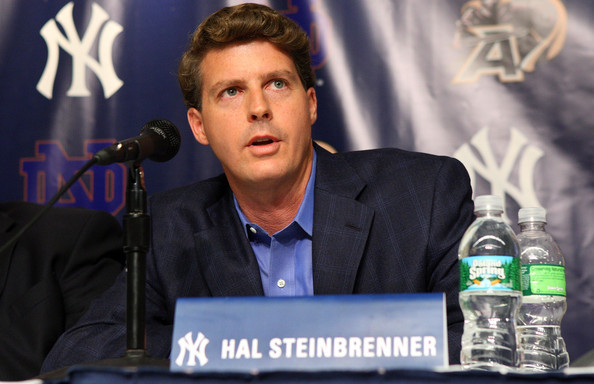
Had the Yankees kept Burnett and instead used him as that last mystery reliever, the luxury tax payroll would have been $229.55M assuming they would have still signed Ibanez, Aardsma, and Chavez. I don’t know if /how much the Yankees have in reserve for a potential trade deadline addition, and chances are they don’t either. That’s probably one of those things Brian Cashman brings to Hal Steinbrenner on a case-by-case basis. The roster is pretty much set right now though, barring injury or something completely unexpected. I don’t anticipate any significant changes to the 25-man roster or payroll through the rest of Spring Training, and this year’s Yankees figure to be the most expensive baseball team in history.

Categories : Analysis
Comments (74)

It’s been less than a month since we last checked on in the Yankees’ projected 2012 payroll, but a lot has changed. Just about all of it in the last week or two as well. The Michael Pineda/Jesus Montero trade didn’t change anything financially (at least not significantly) since they’re both in their pre-arbitration years, but the Hiroki Kuroda signing and arbitration settlements sure did. Andruw Jones agreed to come back, Cory Wade inked a new deal … and that’s pretty much it. Here are the gory details…

The money listed is in terms of average annual value, which is what the luxury tax is based on. The players’ actual salaries are slightly different in some cased, but nothing crazy.

So that’s all of it, 22 players owed a maximum of $208.875M and a minimum of $206.475M. One of those 22 is not on the team anymore, and for simplicity’s sake, let’s assume Martin, Gardner, and Logan each win their arbitration cases. That gives us 21 active players and a $208.875M payroll, though Feliciano is only active in the sense that he’s taking a spot on the 40-man roster. It’s really 20 active players for that price.

The Yankees have been talking about spending just $2M or so on a DH, but I think that’s their way of trying to drive Johnny Damon‘s down more than anything. I expect them to end up spending about $4-5M on the DH, but anything more would surprise me. If they sign a DH for $5M and fill the remaining four roster spots with guys making the league minimum, the 25-man payroll would be approximately $215.875M, up a couple million up from the $212.7M that was luxury taxed in 2011. We haven’t even included the rest of the 40-man roster or stuff like player benefits (which gets taxed as well) yet either.

The other 15 players on the 40-man roster will make the league minimum, though let’s call it 16 players since Feliciano will be stashed on the 60-day DL so another player can be added at some point. Calling it $8M for those players is conservative ($500k each), since they’ll make a substantially smaller salary while in the minors. The $8M is probably closer to $3M in reality, if that. Player benefits are taxed and typically estimated at $10M, which brings us to $233.875M, conservatively. Just imagine if they add a player or two at the trade deadline.

None of us are privy to the Yankees’ financial info, but chances are they can support a payroll much higher than the $200M or so they’ve been spending in recent years. We can’t say that for sure, but it’s a reasonable assumption. I do however think the commissioner’s office and players union have discouraging them from raising payroll any further, just like they’ve encouraged small market teams (the Marlins and Athletics, specifically) to spend more in recent years. Raising the payscale for many second and third tier players over a handful of superstars is probably a net win for the union.

Anyway, that’s my one-paragraph semi-conspiracy payroll theory. As Stephen will explain later today, the club is going to have to make several tough decisions if they’re serious about getting under the $189M luxury tax threshold two years from now, but for now we don’t have to worry about that. The Yankees will again spend an absurd amount of money of their 40-man roster in 2012, far more than any other team.

Categories : Analysis
Comments (80)
Dec
14

The $189M Payroll: Part 2 of 2

Posted by: | Comments (33)

This post was written by Moshe Mandel and Stephen Rhoads

In part 1 of this series we went through six different payroll scenarios for the Yankees over the next decade. We were careful to distinguish between total savings and CBA savings, noting that how you treat the difference in payroll can make a big difference. Where you come down on the question of how much the Yankees can save is very much determined by which figures you’re examining. Let’s use Scenario 1 as an example. In this Scenario, payroll goes from $210M in 2013 to $189M in 2014, and then goes back to $210M in 2015. We summarized the savings accordingly:

2014: Payroll at $189M
Payroll savings: $21M
Revenue sharing refund: $10M
Luxury tax savings ($21M*50%): $10.5M
Total saved: $41.5M

2015: Payroll back at $210M
No payroll savings
No refund
Luxury tax savings ($21M*50%) – ($21M* 17.5%): $6.825M
Total saved: 6.825M

2016: Payroll stays at $210M
No payroll savings
No refund
Luxury tax savings: ($21M*50%) – ($21M*30%): $4.2M
Total saved: $4.2M

2017: Payroll stays at $210M
No payroll savings
No refund
Luxury tax savings: (21*50%) – (21*40%): 2.1M
Total saved: $2.1M

TOTAL SAVINGS: $54.625M
CBA Savings: $23.125M

Now, how you account for 2014 really determines whether the savings are significant or not. We peg the initial savings figure for 2014 at $41.5M saved. This number is comprised of a $21M reduction in payroll, a $10M refund from revenue sharing, and a $10.5M savings in luxury tax. However, the $21M reduction in payroll and the $10.5M reduction in luxury tax don’t really have anything to do with the new CBA per se. This $30.5M savings is a savings they could have gotten at any point in the last decade simply by reducing payroll. Thus, the $30.5M is comprised of savings prompted by the CBA, but it’s not comprised of savings emanating from the new CBA. It’s a $30.5M they could have gotten at any point in the last few years and chose not to. It’s still a cash item – it’s not depreciation in a cash flow statement – and it still means more money in the coffers, but it’s not a CBA savings per se, at least in our estimation. This is an important distinction.

In 2015, the payroll goes back to $210M, which means there are no payroll savings and no revenue sharing refund. There is a luxury tax savings though, as the new CBA allows teams to “reset” the luxury tax by going under the threshhold in just one season, an option that was unavailable under the old agreement. This means that any savings reaped due to the reduced tax rate can be attributed to the new CBA and can therefore be included as “CBA” savings. In this particular scenario, these savings are comprised of a $6.825M difference in what their bill would have been had they not gone under $189M in 2014 compared to what it is since they did go below the threshold. In other words, had they not gone under $189M in 2014, their luxury tax rate in 2015 would have been 50%. Since they did, it’s $17.5%. The difference is $6.825M. This is a real CBA savings and it plays out over the 2016 and 2017 as well (rate goes up to 30% and 40%, respective, per the CBA). Thus, the total amount saved in Scenario 1 is about $55M, but only $23M of it is prompted by the new CBA. Here’s the summary, then, of all six scenarios and how much the team could save by going with each option.

Scenario 1 ($210M to $189M in 2014, returns to $210M in 2015 and beyond): total savings of $55M, CBA savings of $23M.

Scenario 2 ($210M to $189M in 2014, stays at $189 for 3 seasons): total savings of $147M, CBA savings of $53M.

Scenario 3 ($210 to $189M in 2014, stays at $189 for 2 of 3 seasons): total savings of $116M, CBA savings of $54M

Scenario 4 ($220M to $189M in 2014, returns to $220M in 2015 and beyond): total savings of $76M, CBA savings of 29M.

Scenario 5 ($220M to $189M in 2014, stays at $189M for 3 seasons): total savings of $199M, CBA savings of $59M.

Scenario 6 ($220M to $189M in 2014, stays at $189M for 2 of 3 seasons): total savings of $152M, CBA savings of $59M.

Clearly the Yankees would save the most total money in Scenarios 2, 3, 5 and 6. In these scenarios, they’re dropping their payroll down to $189M and keeping it there for a substantial amount of time. The most they could save would be in Scenario 5, in which they shave nearly $40M off their payroll and maintain the reduction. In this case they’d net nearly $200M more, $59M of which would be a derivative of the new CBA.

These gains would be real, but they’re not entirely relevant for our purposes. Saying the team could save nearly $200M in Scenario 5 is true, but it’s also true they could save $75M right this moment if they dropped their payroll down by $75M. Of course, they haven’t done that at any point in recent memory. Our concern is the CBA savings.

The team would obviously save the most by dropping the payroll and keeping it low. Their tax bill would be lower, and they’d receive money back from the revenue sharing refund. However, these CBA-related savings don’t seem to amount to more than $60M. If they don’t maintain the new low payroll, the savings are even less. In Scenarios 1 and 4, in which they drop the payroll for one year and return it to prior levels immediately after, they’d only save $23M-$29M over four years. At most, this amounts to a little over $7M per year. In the latter scenarios, this annual savings figure rises to a little less than $12 million per year.

It’s our opinion that if the Yankees were interested in saving fifteen to thirty-five million dollars a year in payroll and tax, they should have done it already. They could have done it at any point in the last decade. We’re told that the new CBA incentivizes them to get below $189M to incur specific savings, but we see that the only time those savings are truly noteworthy is in the unlikely scenario in which the Yankees stay under $189M for a significant amount of time. Furthermore, we see that the CBA-related savings, at their most extreme, are about $12M a year. Are the Yankees really concerned about $12M a year in “new savings”? Are they suddenly concerned about the fifteen to thirty-five million dollars a year that they could have been saving all along? Perhaps most importantly, are they willing to forgo top free agents and risk missing the postseason to garner those savings?

Without further guidance as to what the true long-term goal is, we can’t get more specific than this. But it seems to be the case that the team will only realize serious, significant gains if they make a permanent move towards a payroll level more reminiscent of the early part of the last decade. Perhaps we’re stuck in the denial stage of the 5 stages of grief. It’s hard for us to understand the prospect of a “new normal” in which the payroll drops 10-20% while the team simultaneously reaps greater and greater revenues from a lucrative television network and new stadium. It’s even harder for us to understand risking contention in an increasingly competitive American League with an already-expensive roster to simply eke out a pittance in savings relative to the team’s balance sheet. But this may be the new Yankees reality, in which the Steinbrenners reach for a modicum of fiscal responsibility at the expense of some performance certainty. If it is, we all need to adjust our expectations accordingly.

Categories : Analysis
Comments (33)
Dec
14

The $189M Payroll: Part 1 of 2

Posted by: | Comments (50)

This post was written by Moshe Mandel and Stephen Rhoads

Yesterday Joe walked through the different stages of grief Yankee fans have been going through since learning that a $189M payroll was a realistic option in the near future. Part of my frustration when reading this (still in stage 2, I suppose) was that I didn’t have a firm handle on how much money the Yankees would actually be saving. If the amount they could potentially save ranges into the nine figures territory, then it’s hard to quibble with the team tightening the belt. If it was significantly less, then a whole host of options come into play, including the possibility that the team is not serious about getting below $189M in 2014 and was using Sherman to broadcast their bluff in advance of the Yu Darvish bid.

Accordingly, Moshe and I have run the numbers for six different payroll scenarios. We used the basic parameters set forth by Sherman in this quote to try and estimate the proper figures for each scenario:

For if they are at $189 million or less for the three seasons from 2014-16, they not only avoid paying one cent in luxury tax, which would rise to 50 percent for them as repeat offenders, but they also would get roughly $40 million in savings via the to-be-implemented market disqualification revenue sharing program. However, only teams under the luxury-tax threshold get reimbursed in this program, which is designed to prevent big markets such as Toronto and Washington from receiving revenue sharing dollars, which in turn will lower how much teams such as the Yanks pay (as long as they are under the threshold).

And even if they just went under $189 million for 2014 before going over again in 2015, the Yankees would receive serious benefits. They would get about $10 million in the revenue sharing disqualification program. Also, by simply going under the threshold once, the Yankees would go back to having a 17.5 percent tax rather than the 50 percent that begins in 2014 for them if they never go under. Keep in mind that since the luxury tax went to 40 percent for them in 2005, the Yankees have averaged paying $25.75 million in tax annually.

In the first three scenarios, we use a $210M payroll in 2013, and then assume that they go back to $210M in later years. In the second three scenarios, we use a $220M payroll. In each scenario, we provide savings figures per year. At the bottom of each scenario we provide a total amount saved, and also provide what we’re calling “CBA Savings”. This figure emanates directly from the new CBA, and would include revenue sharing refunds, and luxury tax savings resulting from a new, lowered rate. It would not include the $21M they’d save from going from a $210M payroll to a $189M payroll, for instance. We get down to business after the jump.
Read More→

Categories : Analysis
Comments (50)
Nov
29

Breaking down the payroll, part two

Posted by: | Comments (68)

It’s been a little over a month since we last broke down the Yankees’ payroll, but a lot has changed since then. Robinson Cano and Nick Swisher had their clubs options officially picked up, Andrew Brackman was cut loose, Rafael Soriano did not opt-out of his deal, and CC Sabathia signed a new contract extension. Let’s take stock of who the team currently has under contract for next season…

Freddy Garcia‘s new one-year contract is not yet official, but all reports indicate that it will have a $4M base salary plus incentives. That brings us up to a dozen players and a total payout of $177.125M. Using MLBTR’s projections, the Yankees will have another $17.9M tied up in their six arbitration-eligible players. Chris Dickerson just missed the Super Two cutoff, so he’s not yet eligible for arbitration. That’s $195.025M for 18 players.

There are currently 22 pre-arbitration players on the 40-man roster, and the new CBA raised the minimum salary to $480k. If we estimate those 22 guys at half-a-mil each, it’s another $11M on the payroll, bringing us to $206.025M for 40 players. It doesn’t work like that though, not all 22 of those guys will be in the big leagues this year. Cory Wade, Ivan Nova, Jesus Montero, and Eduardo Nunez seem to be the only guys with a realistic chance of sticking all year. The other 18 pre-arbitration guys will spend the majority of the year in the minors and earn minor league salaries.

Adding Wade, Nova, Montero, and Nunez to the 18 players above gives us a payroll of $197.025M with three spots on the 25-man active roster left open. Preferably, one of those spots will go to Andruw Jones, another to a starting pitcher, and the last to someone filling the Eric Chavez role (backup corner infielder, lefty bat off the bench). The Yankees are all but guaranteed to go over the $200M mark next season, even if they just re-sign Andruw and fill the last two spots with Hector Noesi and Brandon Laird.

If the Yankees are planning to stick to that $200M limit they’ve talked about in recent years, then they won’t be making any major signings this winter without shipping some salary out. They could save a few bucks if the arbitration salaries are lower than projected, but it’s unlikely to be enough to land a big name pitcher. The Yankees are either going to have to start next season with a higher payroll than what they’ve indicated they’d like it to be, or they’re going to have to get creative to make major upgrades this winter.

Categories : Analysis
Comments (68)