Archive for Gary Sheffield
Remembering the Sheffield Era
Posted by: | CommentsAfter more than two decades in the big leagues, Gary Sheffield officially called it a career yesterday, 16 months after playing in his final game. He suited up for eight different teams and was an All-Star with five of them, thrice finishing in the top three of the MVP voting but never taking home the hardware. A career .292/.393/.514 hitter with 509 homers and far more walks (1,475) than strikeouts (1,171), Sheff was a brilliant offensive force on the field and a jerk off it.
When he joined the Yankees prior to the 2004 season, he did so only because George Steinbrenner wanted him. Just about everyone else preferred Vladimir Guerrero, who was six years younger than Sheff and more multi-dimensional, capable of beating you with his bat, his speed, or his arm. Instead it was Sheffield who joined the Yankees, at the cost of a three-year contract and a little more than $36M. After dealing with Raul Mondesi for the past two years, the Yanks finally had a capable replacement for Paul O’Neill in right field.
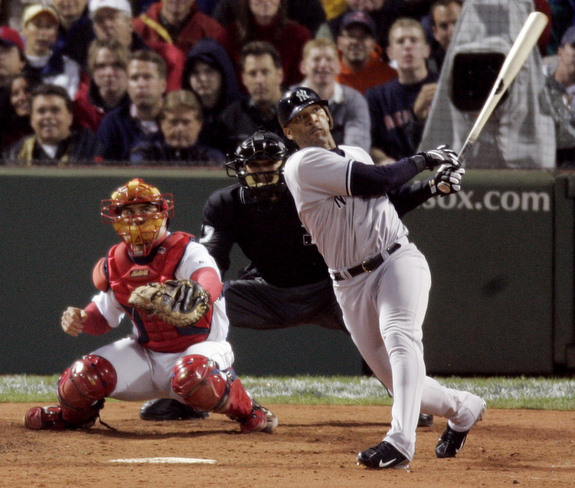
Sheff stepped right into the heart of a rebuilt Yankees’ lineup in 2004, hitting fifth behind the likes of Kenny Lofton, Derek Jeter, Alex Rodriguez, and Jason Giambi at the outset of the season. It wasn’t long before he forced his way into a more glamorous lineup spot, replacing Giambi as the cleanup hitter in late-May before forcing A-Rod down a spot and assuming three-hole responsibilities in late-June. Sheff led the team in slugging percentage (.534), OPS (.927), homers (36), and runs scored (117) that year, placing second in the AL MVP voting. The winner? That would be Guerrero, who hit .317/.394/.565 overall and .370/.427/.688 in the final 45 games of the season to get the Angels into the playoffs.
The Yankees quickly dispatched of the Twins in the ALDS that season, in part due to Sheffield’s game tying-two run homer off Brad Radke in Game Two. Like everyone else on the club, he demolished Red Sox pitching in the first three games of the ALDS (9-for-13 with three doubles and a homer) before seeing his bat fall silent in the final four contests (just 1-for-17). “I never thought it would end like this,” said Sheff after the series, echoing the thoughts of the city.
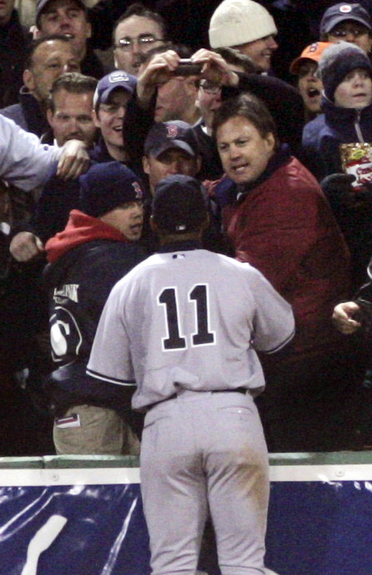
As it tends to do, time passed and the Yankees were back in action in 2005. A-Rod and Sheffield formed what was arguably the game’s most devastating three-four combo that year, hitting a collective .306/.401/.562 with 82 homers and 253 RBI. Sheff’s contribution to that was .291/.379/.512 with 34 homers and 123 RBI, a performance that led to an eighth place finish in the MVP voting. Alex took home the award. Perhaps his most memorable moment of the year came in mid-April, when a fan at Fenway Park hit him in the face as he fielded a ball in the right field corner. Sheff pushed the fan before firing the ball back to the infield, with security intervening before anything else could transpire.
“Something hit me in the mouth. It felt like a hand,” Sheffield said afterward. “I thought my lip was busted. I tried to get his hand out of my face so I could continue on with the play. To get punched in the mouth, you don’t expect that in a baseball game. It could have been worse if I didn’t hold my composure. I almost snapped, but I thought about the consequences.”
The incident motivated the Yankees to another first place finish in the AL East, though they bowed out to the Angels in five games in the ALDS. Sheffield’s sixth inning run scoring single got the Yankees on the board in Game Four, helping them to a come-from-behind win that prolonged their season. His three hits in Game Five weren’t enough though, and for the second time in as many seasons with New York, his season came to a premature end.
At age 37, Sheffield came out of the gate on fire in 2006, hitting .341/.390/.516 with four homers in his first 22 games. He suffered a left wrist sprain after colliding with Shea Hillenbrand on April 29th, an injury that signaled the beginning of the end of Sheff’s tenure in the Bronx. After trying to play through the injury, Sheffield eventually hit the disabled list and had surgery to repair a dislocated tendon and torn ligaments in the wrist. He was expected to miss the remainder of the season, prompting the Yankees to go out and trade for Bobby Abreu as a replacement in right field and the three-spot of the lineup.
A late-September return found Sheffield without a defensive home, so the team had him try first base for the first time in his career. It was a disaster in every way, because Sheff wasn’t hitting after surgery or saving runs with his glove. A 1-for-12 effort against the Tigers helped the Yankees to their second straight ALDS exit. With Abreu on board and under contract for 2007 with an option for 2008, Brian Cashman had a choice to make. He picked up Sheff’s $13M club option and turned to the trade market.
The Sheffield era in the Bronx came to an end similar to the way the Sheffield era ended in Milwaukee, Florida, Los Angeles, and eventually Detroit. He ran his mouth on his way out the door, calling out then-manager Joe Torre for what he felt was preferential treatment towards white players. After the HBO Real Sports interviewer pointed out that the team’s most popular player, Derek Jeter, was African American, Sheff responded by saying he “ain’t all the way black.” Bridges were burned and Sheffield was hastily traded to the Tigers on November 10th, less than two weeks after the end of the World Series, for three minor league pitchers.
Sheffield was tremendously productive during his time in New York, just like he was everywhere else. He hit .291/.383/.515 with 76 homers in 347 games for the Bombers, providing big hits and MVP-caliber performances in 2004 and 2005. His famous bat waggle and lightning quick swing were mimicked by kids playing wiffle ball all over the Tri-State Area, but in the end, Sheffield’s temper and paranoid racist thoughts led to a swift and unceremonious exit. His comments resulted in boos every time he came back to Yankee Stadium as a visiting player. Sheff retires with one World Series ring (1997 Marlins) and a long and remarkable career that should get him some Hall of Fame consideration, but his insecurities, occasional selfishness, and off-the-field persona have left a bad taste in the mouths of many.
Checking in with former Yankees
Posted by: | CommentsContrary to popular belief, the Yankees aren’t the only team trying to acquire players at the winter meetings. In fact, some other teams are even trying to acquire players that played for the Yanks at one time or another. Jon Lane at YESNetwork.com rounded up the latest on some former Bombers, including Johnny Damon, Hideki Matsui, Gary Sheffield, and Kerry Wood. One former Yank he did not mention is Tom Gordon, who I’ve seen in the halls in the few times. Flash lives in the area and does some broadcasting work for MLB Network Radio, but Gordon Edes says the 43 year old is trying to find a team willing to take a chance on him. He hasn’t appeared in a game since early-May 2009, so I wouldn’t hold my breath if I were him. Still kinda cool to see him hanging around though.
For your consideration: Gary Sheffield
Posted by: | Comments
If the 2010 season were to start today, the Yankees’ bench would be thin on both power threats and right-handed hitters. Eric Hinske, a lefty, has departed for Atlanta, and the bench will feature some combination of Randy Winn, Francisco Cervelli, Ramiro Peña, Jamie Hoffmann and Brett Gardner. If Winn is the most feared bat off the bench, opposing pitchers will yearn to face those pinch hitters.
One player is still out there, though, who could give the Yanks some pop off the bench. As I was browsing MLB Trade Rumors’ unsigned All Star team post this morning, my eye wandered to the honorable mentions where Gary Sheffield’s name stuck out. Other than Johnny Damon, Sheffield is the biggest power threat among those still looking for a job, and I wonder if the Yanks would consider a reunion. It would behoove the team to do so.
For many, just a mention of Gary Sheffield’s name is enough to raise some eyebrows. The notoriously outspoken player left the Yankees in a huff when he was traded for not much of anything following the 2006 season. Although his teammates liked him, he and Joe Torre had a rocky relationship, and Sheffield seemed to think he always deserved more than he got. Yet, he could mash along with the rest of them. During his three seasons on the Yanks, he hit .291/.383/.515 with 76 home runs and 269 RBIs.
Yet, Sheffield put up those numbers nearly half a decade when he was obviously much younger than he is today. The upcoming 2010 season will be his age 41 year, and that lethal bat with that intimidating waggle has slowed down a bit. It hasn’t, however, slowed down as much as one might think. Last year, in part-time duty with the Mets, Sheffield hit .276/.372/.451. His wOBA was a very respectable .359, and he can still get on base and hit for power. Offering Sheffield a $1-$2 million take-it-or-leave-it deal wouldn’t be a waste of money, and landing him for a minor league deal with a Spring Training invite would be even better.
There are, of course, some red flags, and Steve at TYU addressed them a few weeks ago when he advocated for a Gardner/Sheffield outfield platoon. First, the idea that Sheffield should do anything other than pinch hit or DH should be off the table. His defense — never great in the first place — has been abysmal of late. In 46 games in left for the Mets, he had a -11.6 UZR. Second, as Steve noted, Sheffield wanted to be an every-day player last year. Would he embrace a bench role? At age 41, if he wants to stay healthy and keep playing, he has to.
For the 2010 Yankees as they are currently constructed, a dearth of right-handed bench threats remains one of the team’s last spots of weakness. Brian Cashman could do far worse than Sheffield if he’s looking to fill it. Whether both sides could overcome their past differences and work out a deal remains to be seen, but it’s worth a shot.
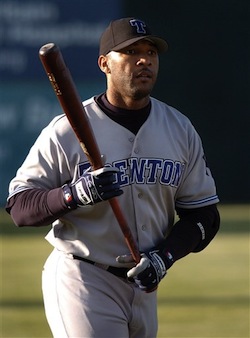
Above: Gary Sheffield waits to bat during his 2006 rehab assignment in Trenton. (AP Photo/Jessica Hill)
By the Decade: After O’Neill
Posted by: | CommentsFor the sixth installment of our look back at the Yankees By the Decade, we hit the outfield and start in right. Paul O’Neill was the player of the decade for the Yanks in right during the 1990s, but as the 2000s dawned, his days were clearly numbered. Following the 2001 World Series, he retired, and the Yanks were left with a gaping hole.
So just how did the team fill the void left by Number 21′s retirement? The chart below shows all of the decade’s right fielders who played 10 or more games in the field. The bottom line represents the overall total line including the 18 players who did not make the cut. Those guys made only a combined 148 ABs among the lot of them anyway.
| AB | Hits | 2B | 3B | HR | RBI | BB | IBB | HBP | K | GDP | BA | OBP | SLG | |
|---|---|---|---|---|---|---|---|---|---|---|---|---|---|---|
| Bobby Abreu | 1388 | 408 | 91 | 9 | 40 | 236 | 185 | 2 | 5 | 266 | 29 | .294 | .376 | .459 |
| Gary Sheffield | 1087 | 312 | 53 | 1 | 61 | 221 | 152 | 15 | 18 | 149 | 28 | .287 | .380 | .506 |
| Paul O'Neill | 1046 | 287 | 57 | 1 | 36 | 162 | 92 | 5 | 2 | 146 | 36 | .274 | .330 | .434 |
| Raul Mondesi | 581 | 146 | 36 | 3 | 25 | 81 | 61 | 8 | 4 | 103 | 9 | .251 | .325 | .453 |
| Nick Swisher | 434 | 107 | 30 | 0 | 24 | 71 | 85 | 2 | 3 | 113 | 12 | .247 | .369 | .482 |
| Shane Spencer | 257 | 68 | 13 | 2 | 6 | 32 | 21 | 1 | 5 | 59 | 3 | .265 | .329 | .401 |
| Bernie Williams | 194 | 55 | 15 | 0 | 8 | 29 | 11 | 0 | 0 | 17 | 8 | .284 | .317 | .485 |
| J. Vander Wal | 142 | 40 | 12 | 1 | 3 | 13 | 12 | 0 | 0 | 33 | 4 | .282 | .335 | .444 |
| Ruben Sierra | 128 | 31 | 9 | 0 | 6 | 20 | 13 | 2 | 0 | 20 | 2 | .242 | .310 | .453 |
| Melky Cabrera | 111 | 34 | 3 | 0 | 2 | 14 | 14 | 2 | 0 | 10 | 5 | .306 | .384 | .387 |
| Karim Garcia | 100 | 26 | 4 | 0 | 3 | 14 | 6 | 1 | 0 | 21 | 2 | .260 | .299 | .39 |
| Juan Rivera | 92 | 28 | 6 | 0 | 6 | 16 | 7 | 0 | 0 | 15 | 2 | .304 | .354 | .565 |
| David Justice | 89 | 21 | 5 | 0 | 3 | 14 | 13 | 1 | 0 | 18 | 3 | .236 | .33 | .393 |
| Bubba Crosby | 86 | 18 | 1 | 1 | 1 | 6 | 3 | 0 | 1 | 16 | 0 | .209 | .244 | .279 |
| Eric Hinske | 53 | 12 | 1 | 0 | 7 | 10 | 5 | 1 | 2 | 16 | 0 | .226 | .317 | .642 |
| Xavier Nady | 48 | 13 | 5 | 0 | 1 | 6 | 2 | 0 | 0 | 7 | 2 | .271 | .300 | .438 |
| David Dellucci | 44 | 8 | 1 | 0 | 1 | 4 | 3 | 0 | 2 | 9 | 2 | .182 | .265 | .273 |
| Aaron Guiel | 39 | 11 | 1 | 0 | 4 | 7 | 2 | 0 | 1 | 6 | 0 | .282 | .333 | .615 |
| Shelley Duncan | 34 | 10 | 0 | 0 | 2 | 6 | 1 | 0 | 0 | 8 | 1 | .294 | .306 | .471 |
| Matt Lawton | 32 | 4 | 0 | 0 | 2 | 4 | 4 | 0 | 2 | 6 | 0 | .125 | .263 | .312 |
| Kevin Thompson | 29 | 6 | 1 | 0 | 1 | 5 | 7 | 0 | 0 | 9 | 0 | .207 | .361 | .345 |
| Kenny Lofton | 17 | 6 | 0 | 0 | 0 | 2 | 2 | 0 | 1 | 1 | 0 | .353 | .450 | .353 |
| Gerald Williams | 12 | 0 | 0 | 0 | 0 | 0 | 1 | 0 | 0 | 4 | 0 | .000 | .077 | .000 |
| Totals | 6191 | 1680 | 347 | 19 | 246 | 989 | 711 | 40 | 46 | 1079 | 151 | .271 | .348 | .453 |
Some of those names bring back some bad memories. Remember when the Yanks tried to plug in a right field hole left wide open by Gary Sheffield’s injury with Aaron Guiel and Kevin Thompson? Remember when Karim Garcia started picking fights with fans in Fenway? Remember when Raul Mondesi was thought to be the next great Yankee warrior who would don the mantle left by Paulie? Those certainly weren’t the days.
After the 2002-2003 dark ages in right field, two players dominated the decade. Gary Sheffield landed in New York in December 2003 as a solution to their right field woes. He carried with him a prickly attitude but seemed ready to make a go of it in the Bronx. For two years and a half years, before an injury cut short his 2006 campaign, he delivered. As the right fielder, he hit .287/.380/.506 with 61 home runs and an overall OPS+ of 135. He came in second in the MVP voting in 2004 and made the All Star team twice.
In 2006, though, Sheffield hurt his wrist and never recovered his stroke. The Yankees made a move to acquire Bobby Abreu in mid-season, and Sheffield found himself a man without a position. He made his displeasure known and was dispatched the Tigers for three promising young arms. In return, the Yankees received Kevin Wheelan, Anthony Claggett and Humerto Sanchez. Sanchez is a Minor League free agent; Claggett was traded to the Pirates; and only Wheelan remains with the Yanks. The returns have not yet amounted to much, the Yanks were rid of Sheffield’s contract and demeanor.
To replace Gary Sheffield, the Yanks acquired Bobby Abreu from the Phillies in a salary dump deal. Philadelphia sent Abreu and Cory Lidle to the Yanks for C.J. Henry, Carlos Monasterios, Jesus Sanchez and Matt Smith. Abreu went on to hit .294/.376/.459 with the Yanks, and no one played more right field this decade that Bobby. Yet, last winter, with the Yanks ready to get younger and more athletic, Brian Cashman was more than willing to let Abreu walk. As Sheffield was dumped on the Tigers rather unceremoniously, the Yanks bid Abreu a quick farewell.
So then, who is the right fielder of the decade? Both Abreu and Sheffield were paid far more than their actual value, and both were atrocious in the field. Sheffield put up a combined WAR of 5.8 while in pinstripes, and Abreu put up a 5.7 mark in the same category. Because of his monster 2004, I have to give the edge to Gary, but he doesn’t have a slum dunk case for it.
As the Yankees look ahead to 2010 and a new decade, the fun-loving Nick Swisher is holding down the right field spot. He won’t put up the offensive numbers of a Sheffield or even Abreu, but he is a worthy successor to the spot. Who will we be toasting in ten years in right though remains a mystery.
Assessing the Sheffield deal three years later
Posted by: | CommentsOver the weekend, the Yankees unceremoniously released Humberto Sanchez to clear some 40-man space on their roster. For Sanchez, just 25, it was quite the fall from grace. Just a few years ago, he was one of the Tigers’ top three prospects, and now he is unemployed and oft-injured, full of talent but unable to realize it.
For many Yankee writers and analysts, this move was a white flag from the Yankees. That the Yankees would just flat-out release Sanchez, acquired after the 2006 season from the Tigers in a package for Gary Sheffield, showed a bad return in that trade.
As Bryan Hoch wrote, “As a whole, the Gary Sheffield deal hasn’t worked out very well for the Yankees. Anthony Claggett got torched in his big league debut and Kevin Whelan hasn’t made it up to the big leagues yet.” I find myself disagreeing with Hoch.
The prospects the Yankees got back from the Tigers haven’t been as good as anyone hoped. Sanchez had Tommy John surgery and hasn’t really recovered. He could sign a Minor League deal with the Yanks and earn his way back into consideration. But when the Yanks brought him up for a cup of coffee last September, they expected him to be in contention for a bullpen spot this spring. Whispers of future closer potential swirled around him.
Meanwhile, Anthony Claggett and Kevin Whelan are what they are. They will both turn 25 this summer, and Claggett did indeed get shelled in his lone big league appearance. Whelan is still toiling down at AA. If the two of them ever reach the big leagues and stick around, it will be as replaceable middle reliever types. It would seem then that the Yanks didn’t get much in return for Sheffield.
At the same time though, they didn’t give up much either. Since leaving New York, Sheffield has been largely forgettable. After missing most of 2006 with a wrist injury, he had a good bounce-back year in 2007 but fell off the table in 2008. In 247 games for the Tigers — an average of 123 a season — he hit .247/.354/.433 with an OPS+ of 106. As New Yorkers now, Sheffield was released by the Tigers in Spring Training and hitched his wagon to the Mets’ ship. In 28 PAs prior to last night, he was hitting .136/.321/.318 with a 66 OPS+.
Now, with those numbers, it seems as though the Yankees gave up not much to get back nothing, but there’s a missing piece to this puzzle. The Tigers took on all of the $13 million owed to Sheffield in 2007. For the Yanks, it became a win as soon as the deal was completed. The team exercised Sheffield’s option with the idea of trading him and actually got back three pieces in return. They could have let him walk, paying him the buyout on the option but tried to turn him into something useful.
In the end, the trade didn’t really work out well, but Hoch has it wrong. It didn’t work out well for either side. Gary Sheffield didn’t really become the bat the Tigers needed, and the pitchers the Yankees received didn’t really become, well, anything. But the Yanks took a player who could have become a free agent and turned him into three Minor League pitchers. That is a successful trade.