Archive for What Went Wrong
Season Review: Miscellaneous Pitchers
Posted by: | CommentsAs we wrap up our seemingly never-ending review of the 2012 season, it’s time to look back on the last handful of pitchers. These are the guys who spend some time on the big league roster this year but not much, ultimately contributing little in the grand scheme of things.
Adam Warren
After losing the long man competition to David Phelps in Spring Training, the 25-year-old Warren got his big league shot when both CC Sabathia and Andy Pettitte hit the DL in late-June. He made a spot start against the White Sox and got absolutely pounded, surrendering six runs on eight hits (two homers, one double, five singles) in 2.1 innings. Warren walked two and struck out one. He spent the rest of the regular season back in Triple-A but did get recalled when rosters expanded in September, though he did not appear in a game.
Chad Qualls
Acquired from the Phillies in early-July, the 34-year-old Qualls appeared in eight games with the Yankees. He allowed five runs and ten hits in 7.1 innings with more walks (three) than strikeouts (two), though he did generate a bunch of ground balls (51.9%). His most notable moment in pinstripes was probably retiring the only two men he faced (Kendrys Morales and Mark Trumbo) on July 13th, keeping the deficit at three and allowing the Yankees to mount a late-innings comeback. The Yankees traded Qualls to the Pirates for Casey McGehee at the deadline.
Justin Thomas
Plucked off waivers from the Red Sox early-May, the 28-year-old Thomas spent the rest of the summer in Triple-A before getting the call when rosters expanded in September. The left-hander appeared in four games, allowing three runs in three innings. To his credit, Thomas did retire six of seven left-handed batters he faced with New York (two strikeouts). The Yankees designated him for assignment to clear room on the roster for David Aardsma late in the season, and Thomas has since moved on as a minor league free agent.
D.J. Mitchell
Mitchell, 25, also lost the long man competition to Phelps in camp. He went down to Triple-A for a few weeks before resurfacing when the Yankees needed an arm in early-May and then again in mid-July. He made four appearances total — two in each big league stint — and allow two runs on seven hits in 4.2 innings. Like Qualls, he walked more batters (three) than he struck out (two) but generated a healthy number of grounders (57.9%). Mitchell was traded to the Mariners as part of the Ichiro Suzuki and spent the rest of the year in the minors.
Ryota Igarashi
Igarashi, 33, was claimed off waivers from the Blue Jays in late-May and managed to appear in two games with the Yankees. He allowed one run in one inning against the Mets on June 8th and three runs in two innings against the Blue Jays on August 12th. Both stints in the big leagues were very temporary, as he was sent down right away in favor of a fresh arm. It’s worth noting that Igarashi was a monster down in Triple-A, pitching to a 2.45 ERA (2.11 FIP) with 13.50 K/9 (34.4 K%) in 36.2 innings as the team’s closer. The Yankees dropped him from the 40-man roster in August and he signed a new deal with a team in Japan earlier this offseason.
David Aardsma
The Yankees signed the 30-year-old Aardsma to a one-year, $500k contract in late-February knowing he was unlikely to contribute much this year since he was rehabbing from Tommy John surgery. The right-hander suffered a setback in June which delayed his rehab, but he progressed far enough that the team adding him to the active roster in late-September. He appeared in just one game before the end of the season, allowing a solo homer in an inning of work. After the season the Yankees exercised Aardsma’s $500k option for 2013 and will have the former Mariners closer in the bullpen to open next season.
Season Review: Miscellaneous Position Players
Posted by: | CommentsAs we wrap up our seemingly never-ending review of the 2012 season, it’s time to look back on the last handful of position players. These are the guys who spend some time on the big league roster this year but not much, ultimately contributing little in the grand scheme of things.
Dewayne Wise
He was sparingly used during his three months on the roster, but the 34-year-old Wise hit .262/.286/.492 (106 wRC+) in 63 plate appearances for the Yankees. He also retired both batters he faced while pitching in a blowout loss. The team originally recalled him to fill Brett Gardner‘s roster spot before cutting him loose following the Ichiro Suzuki trade. Wise went 9-for-18 with a double, a triple, and three homers during an eight-game stretch in late-June/early-July, but his greatest contribution to the club — besides the bunt that turned the season around — was his non-catch against Indians in late-June.
Chris Dickerson
Had the 30-year-old Dickerson not been on the minor league DL early in the season, chances are he would have been recalled to take Gardner’s spot instead of Wise. He instead had to wait until rosters expanded in September, and he went 4-for-14 (.286) with two homers and three steals in his limited playing time. Most of his action came as a defensive replacement in the late innings. I like Dickerson more than most and think he can be a useful left-handed platoon outfielder who also provides speed and defense, but it’s obvious the Yankees aren’t interested in giving him an opportunity. For shame.
Melky Mesa
Mesa, 25, was the team’s only true rookie position player this year. He came up when rosters expanded in September and only appeared in three games — one as a pinch-runner and two as a late-innings replacement in blowouts. Mesa did pick up his first career hit and RBI in his first big league plate appearance, singling on a ground ball back up the middle. His most notable play was a base-running blunder, when he missed the bag while rounding third base on an Alex Rodriguez single in extra-innings against the Athletics. Mesa would have scored the game-winning run, but alas. Rookie mistake.
Darnell McDonald
The Yankees got a little cute prior to the All-Star break, claimed the right-handed hitting McDonald off waivers from the Red Sox before heading up to Fenway for a four-game set. The Sox were set to throw three left-handed starters in the four games, so the 34-year-old figured to see some playing time against his former team. McDonald instead received just four plate appearances, made outs in all of them, and collided with Curtis Granderson in center field. A run scored on the play. Embedded Red Sox? Embedded Red Sox.
Ramiro Pena
Rakin’ Ramiro was on the roster for less than a week this season. The Yankees called him up after Alex Rodriguez had his hand broken by Felix Hernandez in late-July, but he was sent back down following the Casey McGehee trade a few days later. In between, the 27-year-old infielder singled once in four plate appearances and got into two other games as a pinch-runner. Pena became a minor league free agent after the season, ending his seven-year stint with the organization.
Season Review: The Front Office
Posted by: | CommentsJust as with the manager and coaching staff, it’s difficult to evaluate a front office from the outside. Yes we can see the moves they make and speculate on moves they didn’t make, but we’ll never know the inner workings and all of the factors involved. Things like opportunity cost and the club’s internal evaluation of players are beyond our scope. Remember, a move can both make perfect sense at the time and be laughably bad in hindsight.
The Yankees started the year by making a series of front office changes in January, most notably hiring former Cubs GM Jim Hendry as a special assignment scout and promoting pro scouting director Billy Eppler to assistant GM. I’m a fan of having multiple voices in the front office and Hendry is well-regarded within the game, so I liked his hiring just as I liked the Kevin Towers hiring back in 2010. The Eppler promotion was significant because for the first time since Brian Cashman took over as GM, an obvious line of succession had been established. Eppler was the runner-up to Jerry Dipoto for the Angels GM job last winter and now appears to be in line to replace Cashman down the road.
On the field, the Yankees made a number of great, good, okay, poor, and disastrous moves like every other team. Signing Hiroki Kuroda to a one-year contract was a masterstroke while the Jesus Montero-Michael Pineda trade went sour in less than three months. Low-cost, one-year stopgap solutions like Eric Chavez, Raul Ibanez, and Clay Rapada worked out well while others like Chris Stewart and Andruw Jones did not. Minor league free agent signings like Jayson Nix and Dewayne Wise contributed while midseason pickups like Chad Qualls, Casey McGehee, and Steve Pearce were non-factors. Derek Lowe worked out fine after being plucked off the scrap heap in August.
The Yankees made one significant midseason move, acquiring Ichiro Suzuki from the Mariners for two young arms. The 39-year-old agreed to a set of conditions prior to joining the team, specifically that he would move over to left field, bat towards the bottom of the order, and sit against tough lefties. Ichiro performed so well (.322/.340/.454, 114 wRC+) that he forced his way into regular playing time and a higher spot in the lineup by the end of the season. Even Ichiro’s biggest detractors (i.e. me) have to admit he gave the team a big shot in the arm down the stretch.
At the same time, I do feel the Yankees dragged their fit a bit making in-season upgrades. Obviously Brett Gardner‘s three setbacks contributed to that, but the team also didn’t act swiftly when it was obvious bullpen help was needed. Both Mariano Rivera and David Robertson went down with injuries in May, then a few weeks later Cory Wade completely imploded. The only help they brought in before the deadline was Qualls, who predictably stunk. It appeared as though the Yankees were counting on Joba Chamberlain‘s return from elbow and ankle surgery to shore up the bullpen, whether that was actually the case or not.
The Yankees intend to get under the $189M luxury tax threshold in 2014, and the front office has major work to do these next 15 months or so to make that happen. The Pineda trade was, by far, the team’s most long-term move this year and so far the worst case scenario has played out. The right-hander’s ability to rebound following shoulder surgery may be the biggest factor in getting under the luxury tax threshold. The Kuroda signing and Ichiro trade worked out marvelously this year, but fair or not, the performance of the front office going forward will be heavily influenced by the results of that swap with the Mariners.
Season Review: Joe Girardi & Coaching Staff
Posted by: | CommentsEvaluating a manager and his coaching staff is a very difficult thing for outsiders. The vast majority of their work takes place behind the scenes, so we’re left looking for clues in places they might not be. That pitcher learned a changeup? Great job by the pitching coach! That hitter is only hitting .250 when he usually hits .280? Fire the hitting coach! We have no idea what clues we dig up are actually attributable to the coaching staff, so we end up guessing.
Because of that, I don’t want to review Joe Girardi and his coaching staff in our typical “What Went Right/What Went Wrong” format. This review is almost entirely subjective and we can’t really pin anything (good or bad) on the coaching staff specifically. We know Curtis Granderson essentially revived his career after working with Kevin Long two summers ago, but having a specific example like that is very rare. Instead, we’ll have to take a broader approach.
Joe Girardi
I think 2012 was Girardi’s worst year as Yankees’ manager. Every manager makes questionable in-game moves during the season, but I felt Girardi made more this year than he had in any year since 2008, and it all started in the very first inning on Opening Day with the intentional walk to Sean Rodriguez. That still bugs me.
Girardi has long been considered a strong bullpen manager given his ability to spread the workload around and squeeze water out of scrap heap rocks, but this year he leaned very heavily on Boone Logan, David Robertson, and Rafael Soriano. Working Soriano hard wasn’t a huge deal because he was expected to leave after the season, but Logan made more appearances in 2012 (80) than any other reliever under Girardi, including his time with the Marlins. Robertson appeared in 65 games despite missing a month with an oblique injury. Part of it was a lack of alternatives (blame the front office for that) and the tight race, but this was something that started before the Yankees blew their ten-game lead.
Girardi also had two notable meltdowns (for lack of a better term), lashing out at a fan following a loss in Chicago and then getting into a shouting match with Joel Sherman after calling him into his office. Maybe my conduct standards are too high, but that kind of stuff is a major no-no in my book. It stems from pure frustration and there is zero good to come from it. Girardi didn’t have a bad year as manager, he did a fine job guiding the team despite an overwhelming about of injuries, but I feel that he’s had better years in the past.
Larry Rothschild & Kevin Long
When the Yankees hired Rothschild as pitching coach two years ago, he came to the club with a reputation of improving both strikeout and walk rates. That is exactly what has happened overall, and we can see it specifically with someone like CC Sabathia (strikeouts, walks). Obviously the personnel has changed over the last few years, but the Yankees managed to get productive seasons from scrap heap pickups like Bartolo Colon and Freddy Garcia last year while getting better than expected production from Hiroki Kuroda and even Andy Pettitte this year. We don’t know how much of a role Rothschild played in all of this, but the team’s pitching staff has exceeded expectations the last two years.
Long, on the other hand, came under big-time scrutiny following the club’s offensively-inept postseason showing and Mark Teixeira‘s continued decline from elite all-around hitter to pull-happy, one-dimensional slugger. At same time, he remade Granderson and helped Robinson Cano go from good to great. Long does preach pulling the ball for power and apparently that contributed to the team’s poor postseason, but the roster overall is built around guys who pull the ball for power. Outside of Cano and Derek Jeter (and later on, Ichiro Suzuki), the Yankees lacked hitters who could hit to the opposite field. Like Rothschild, we don’t know how much a role Long has played in all of this, and I’m not even convinced preaching power these days is a bad thing given the decline in offense around the league.
Tony Pena, Mike Harkey, Rob Thomson & Mick Kelleher
Not really much to add here. Thomson, the third base coach, does have a knack for being a little overly-aggressive with his sends in tight games while at other times he will hold guys who would have clearly been safe, but every third base coach does that. The Yankees have had an above-average stolen base success rate in recent years (77-79%), so I guess Kelleher is doing a fine job of reading moves and relaying that info over at first base. Other than that, we have very little basis for which to judge these guys on. Despite the whole “everyone should be fired because there are obviously better coaches available!” mentality than can fester following an embarrassing playoff loss, all indications are the entire staff will return fully intact next year.
What Went Wrong: Yankee Stadium
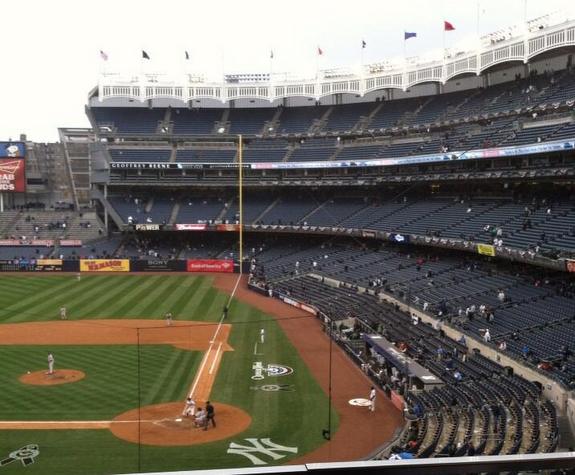
Posted by: | CommentsThe current version of Yankee Stadium is now four years old, so we have enough data to definitively say something like “the place gives up homers like crazy.” It’s no longer a small sample size fluke, like we argued back in April 2009. We also have enough data to say that the place can be pretty lifeless at times, and that seemed to be especially prevalent this season. The place is only four years old, so it’s a problem.
Attendance
For the most part, attendance over the last eight years has held pretty steady, and therein lies the problem. There should have been a spike when the new building opened, just like there was when the old place closed…
| Total | Per Game | Capacity | MLB Rank | |
|---|---|---|---|---|
| 2012 | 3,542,406 | 43,733 | 87.0% | 6th |
| 2011 | 3,653,680 | 45,107 | 89.7% | 7th |
| 2010 | 3,765,807 | 46,491 | 88.9% | 7th |
| 2009 | 3,674,495 | 45,364 | 86.7% | 8th |
| 2008 | 4,298,655 | 53,069 | 92.3% | 5th |
| 2007 | 4,271,083 | 52,729 | 91.7% | 7th |
| 2006 | 4,243,780 | 52,392 | 91.2% | 5th |
| 2005 | 4,090,692 | 50,502 | 87.9% | 5th |
There was a spike after the 2009 World Series, but for the most part the new place was selling seats at a similar rate to the old building (before the closing spike). I doubt the Yankees expected that. The problem was especially noticeable in the postseason this year, when there were swaths of empty seats in the club’s five home playoff games. Was the lack of postseason attendance overstated? Definitely, but the fact that there were empty seats to talk about in the first place is a problem.
Obviously we can point to the ticket prices as a culprit for the less than stellar attendance, but I don’t believe it’s that simple. Maybe it is, I just happen to think there are more factors in play. The economy has sucked the last few years, parking prices are ridiculous, stuff like that contributes as well. I never have trouble finding $20-ish dollar tickets to a typical regular season game, but I’m one person, one data point. The Yankees have won plenty in recent years, so performance isn’t an issue.
Long story short, the Yankees aren’t going to drop ticket prices because they’re still selling a ton of tickets. The prices are set at what people are willing to pay (not team payroll, contrary to what many seem to believe), and they won’t drop until people stop paying. Given the size of the city and surrounding areas in addition to the high tourist traffic, I wouldn’t count on it happening anytime soon.
Atmosphere
This one is entirely subjective, though I suppose you could bring a decibel meter to the park like they did with CitiField. Good luck finding historical data for the Old Stadium to use as a comparison. Besides, crowd noise isn’t the be-all, end-all of stadium atmosphere.
Anyway, has the atmosphere of the old Stadium been overstated in comparison to the new place? Absolutely. Trust me, that place wasn’t exactly rockin’ all the time like you’ll be led to believe. It was definitely more energetic than the current Stadium though, there’s no doubt about that in my mind. Why is this? Tons of reasons, really. The building itself doesn’t provide great acoustics, but that’s not a “the Yankees screwed up!” thing, that’s a “the City of New York says you can’t build like that anymore” thing. Is the security crew too harsh? Maybe, I’ve never had an issue though. There are a lot of factors beyond the team control here.
One part of the stadium experience the Yankees do control but have largely ignored in recent years is the quality of the between-innings entertainment. How long has the Cap Game been going on? The Subway Race? I mean, the YMCA-dancing grounds crew was neat the first time and literally never again after that. I have yet to see anyone say “oh great, it’s Cotton Eye Joey!” during a game. Monument Park as well, it’s hidden way in center field and can’t really be displayed, even if you’re sitting up in the grandstand and just looking around.
I also think the Yankees have generally done a poor job of cultivating fans in recent years. They don’t have any caravan events, don’t let kids run the bases after games, don’t do any of these super-fan-friendly things other teams around the league do. Yeah I can get to the park early and shake hands with a fringe roster player at the ticket gate every so often but who cares? Baseball is more of a generational sport than any other, dads and sons and grandkids all enjoy it together. I don’t think they’ve done enough to reel in the younger fans out there, the ones who are still impressionable.
This turned into more of a rant than I expected, so my bad. I think the new Stadium is pretty awesome in general, I love the nice wide corridors and the restrooms that are actually properly sized and all sorts of other stuff. The food choices could be a little better, but that’s terribly important to me personally. The postseason attendance and atmosphere problems this year were very noticeable though, and they really helped make some of the other deficiencies at the new building stand out. It’s never going to be the old Stadium in part because what we remember of the old Stadium has been romanticized and no longer jibes with reality, but I still feel it’s lacking compared to other state of the art facilities.
Attendance data via ESPN.
What Went Wrong: Farm System
Posted by: | CommentsTwo years ago, the Yankees enjoyed a brilliant season by the farm system in which almost everything went right and nothing went wrong. Jesus Montero took a step forward to become a star prospect, Manny Banuelos dazzled, Gary Sanchez debuted, the college arm trio of Adam Warren, David Phelps, and D.J. Mitchell excelled, and even the enigmatic Dellin Betances and Andrew Brackman had strong seasons. As a result, the team’s farm system ranked fifth and ninth in baseball by Baseball America and Keith Law, respectively.
Last season was more of a normal year in the minors, with the usual number of breakouts and breakdowns, injuries and surprises. After the season, the team’s system was ranked tenth and 13th by Law and Baseball America, respectively. Those rankings were released after the Yankees traded Montero as well, who was easily their best prospect. They had a high-end of a middle of the road system, if that makes sense. This year though, things down on the farm were definitely far from normal. An awful lot more went wrong than right.
Injuries
When Baseball America published their list of the team’s top ten prospects earlier this month, five (!) of the top eight prospects were players who missed significant time with injury this year. Top prospect Mason Williams dislocated his shoulder diving for a ball and had season-ending surgery in early-August. Number two prospect Slade Heathcott didn’t appear in his first game until mid-June because he was recovering from his second left shoulder surgery in as many years. Number seven prospect Angelo Gumbs tore his left elbow ligament on a swing and was done in late-June.
The two most significant minor league injuries came on the pitching side. Preseason top prospect Manny Banuelos missed a few starts in April with a sore back, then landed on the DL with a bone bruise in his elbow in mid-May. That kept him on the sidelines for the rest of the year, and early last month he finally went under the knife and had Tommy John surgery. He’s expected to miss all of 2013. Preseason number two pitching prospect Jose Campos, part of the Montero trade, came down with elbow inflammation and didn’t pitch after late-April. Last we heard, the club was “hopeful” he’ll be ready in time for Spring Training. The duo combined for eleven starts this year, six by Banuelos in Triple-A and five by Campos in Low-A.
Lesser prospects like Austin Romine (back), Zoilo Almonte (hamstring), Abe Almonte (hamstring), Corban Joseph (shoulder), David Adams (neck), Zach Arneson (shoulder), Jeremy Bleich (shoulder), Dan Camarena (shoulder), Dan Burawa (ribs), Greg Bird (back), Jordan Cote (shoulder), and Matt Tracy (hamstring) all missed time with injury this year. The team’s two Rule 5 Draft picks — righty Brad Meyers (shoulder) and lefty Cesar Cabral (elbow) — missed the entire season with injury. Meyers has already been returned to the Nationals while Cabral will get another look in Spring Training. The injury problem got so bad that first round pick Ty Hensley was found to have an “abnormality” in his pitching shoulder prior to signing. It’s not even a real injury, something in his shoulder just isn’t the way it’s supposed to be. It hasn’t stopped him from pitching yet though, so fingers crossed.
Underperformance
If you were one of the lucky Yankees farmhands who didn’t get hurt this summer, there’s a pretty good chance you didn’t play up to expectations. Betances, my preseason number three prospect, pitched to a 6.44 ERA with nearly as many walks (99) as strikeouts (124) in 131.1 innings. He pitched so poorly that he had to be demoted from Triple-A to Double-A. Preseason number seven prospect Dante Bichette Jr., last year’s first rounder, followed up his Rookie Level Gulf Coast League MVP effort by hitting .248/.322/.331 with three (!) homers in 522 plate appearances for Low-A Charleston. Those are just the big names.
Warren made his big league debut with a disastrous start against the White Sox, but otherwise spent most of the year in Triple-A and pitched almost exactly as he had a year ago. Repeating a level and not improving is underperformance in my book, especially for a guy who spent four years at a major college program. Ravel Santana returned from his brutal ankle injury to hit just .216/.304/.289 with 68 strikeouts in 247 plate appearances for Short Season Staten Island. Former first rounder Cito Culver (.215/.321/.283) continued to look like the overdraft he was labeled way back on draft day.
Of the top ten players on my Preseason Top 30 Prospects List, only Sanchez managed to avoid the injury bug and live up to expectations. The other nine either got hurt or underperformed. Add in the spending restrictions implemented by the new Collective Bargaining Agreement that limited the team’s ability to import high-end talent, and the Yankees’ farm system took a massive hit this year. With the 2014 payroll plan looming, the lack of progress from the team’s top prospects may be crippling in a few years.
* * *
Of course, it wasn’t all bad down on the farm this year. Tyler Austin hit a combined .322/.400/.559 across four levels and emerged as one of the game’s best pure hitting prospects. Williams was excellent before hurting his shoulder and Heathcott starred after returning from his injury, plus Sanchez and Ramon Flores continued to progress as well. Mark Montgomery appears to be the team’s next great homegrown reliever, Cuban veteran Ronnie Mustelier came out of nowhere to hit his way into the big league conversation, and lower-ceiling arms like Chase Whitley and Brett Marshall are now on the cusp of the big leagues.
Barring trades and all that usual offseason stuff, the Yankees still boast four surefire top 100 prospects in Williams, Heathcott, Sanchez, and Austin. We can quibble about the exact order but it doesn’t really matter, they are four of the 100 best — really the 75-80 best — prospective big leaguers in the game. There are a ton of question marks after that though, and the club lacks impact talent at the upper levels of the farm system. When the various organizational rankings come out in the spring, the Yankees will probably rank somewhere in the 15-20 range among all farm systems, buoyed by the four top 100 guys. There isn’t much impact beyond those four though.
What Went Wrong: McGehee & Pearce
Posted by: | CommentsThe Yankees went into the season thinking Andruw Jones was going to be their designated left-handed pitching masher, and for the first half of the season he was. Things went horribly wrong for Jones in the second half, and when coupled with Alex Rodriguez‘s hand injury in late-July, the Yankees were suddenly very light on right-handed power and thus susceptible to lefty pitching. They acquired two players to help fill that void, neither of whom worked out.
Casey McGehee
Acquired from the Pirates for Chad Qualls (!) just prior to the trade deadline, the 30-year-old McGehee brought with him a track record of hitting southpaws and an 86 wRC+ in 293 plate appearances for Pittsburgh. He bounced between first and third bases in his first few starts with New York, and he actually hit well early on: 6-for-21 (.286) with three doubles, three walks, and the team’s third longest homer of the season. McGehee looked like a shrewd deadline pickup, but instead things fell part.
He went 2-for-22 (.091) with six strikeouts and no walks in his next seven games, and fell so out of favor that the Yankees sent McGehee all the way down to Low-A Charleston. It was a procedural move that allowed the team to recall him sooner than the usual ten days. All told, McGehee hit just .151/.220/.264 (28 wRC+) in 59 plate appearances with the Yankees, including 7-for-37 (.189) against lefties.. He was obviously left off the postseason roster, and after the season he elected free agency after being removed from the 40-man roster.
Steve Pearce
The Yankees originally signed Pearce way back at the end of Spring Training, and he spent two months absolutely mashing in Triple-A (173 wRC+). Pearce exercised an opt-out clause in his contract in early-June, forcing the Yankees to either release him or trade him to a team willing to place him on their 25-man big league roster. A few days later he was dealt to the Orioles for cash, but nearly three months after that he was back in pinstripes — the Yankees acquired Pearce from the Astros for cash after Houston claimed him off waivers from Baltimore earlier in the summer.
Pearce, 29, made his debut with the team as the cleanup hitter against the Blue Jays on August 28th, and he responded by scoring the winning run on a walk, wild pitch (move to second), ground out (move to third), and sacrifice fly. Pearce hit a two-run homer against the Orioles two weeks later, but that was pretty much it. He hit .160/.300/.280 (66 wRC+) in only 30 plate appearances with the team, including a 4-for-24 (.167) mark against southpaws. The Yankees designated Pearce for assignment when Brett Gardner came off the DL in late-September, and the Orioles subsequently claimed him off waivers. That was that, neither he nor McGehee contributed much to the team’s cause in 2012.
What Went Wrong: Eduardo Nunez
Posted by: | CommentsThe Yankees didn’t have much need for a utility infielder a few years ago, back when Alex Rodriguez, Derek Jeter, and Robinson Cano were locks to play 150+ games every season. Things have changed in recent years as A-Rod has started to breakdown and Jeter started to receive more and more rest. Ramiro Pena did the backup infield thing for a while, but Eduardo Nunez wrestled the job from him by hitting .301/.350/.421 with three homers and 13 steals in 200 midseason plate appearances last summer while Jeter (calf) and A-Rod (knee) were on the DL.
Nunez, 25, opened 2012 as the utility infielder for the second year in a row, and he hit a solid .294/.356/.373 with six steals in the team’s first 31 games. He was playing primarily against lefties while either Jeter or A-Rod would spend the game at DH or even on the bench entirely. Nunez was contributing enough with the bat, but the problem was his perpetually sketchy defense.
He committed four errors in those first 31 team games: one at short, one one at second, and two at third. We’re talking routine plays too, like this throw. There were several other botched plays as well, including two on ground balls to third in the first two innings against the Rays on May 10th. Tampa scored two unearned runs as a result, plus they tried to bunt towards Nunez several other times throughout the game. Joe Girardi lifted him for defense after the fifth inning, and a day later the Yankees sent Eduardo down to Triple-A to work on his defense.
The plan was to limit Nunez to the middle infield in hopes that consistent playing time at the same spot would improve his glovework, but he responded with two errors in his third Triple-A game. Five days later he jammed his thumb and had to be placed on the DL. Nunez missed close to two months with the injury, so he only managed to play in 44 minor league games. He made five errors in those 44 games, all at shortstop. The Yankees recalled Nunez when rosters expanded in September, and he hit .289/.293/.421 with five steals in 41 sporadic plate appearances. He also committed three more errors, all at short.
Nunez served as the team’s primary DH against left-handers in the postseason, though he took over at shortstop full-time after Jeter fractured his ankle in Game One of the ALCS. He went 3-for-11 (.273) in five postseason games, most notably taking Justin Verlander deep in the ninth inning of ALCS Game Three. In three playoff games at short, he made one error that was inconsequential in the grand scheme of things. Girardi, as he had done during the regular season, lifted Eduardo for defense late a few times.
All told, Nunez hit .292/.330/.393 (93 wRC+) with one homer and eleven steals in exactly 100 plate appearances for the big league team in 2012. Anecdotally, most of his defensive issues seemed to come on routine plays. Whenever there was a hot shot or he had to range far for a ball and make a quick throw, he seemed to do fine. The defensive problems seemed to pop up most when he had time to think. The Yankees continued to give him chances and Brian Cashman says he views Nunez as a shortstop long-term, but he had an opportunity to cement his place in the team’s long-term plans this year only to throw it away. (Pun completely intended)
What Went Wrong: Romine, Stewart & Cervelli
Posted by: | CommentsThe Yankees came into this season knowing Russell Martin was going to be their full-time catcher, but the backup job was up for grabs. Frankie Cervelli was the incumbent and Austin Romine was the high-ish profile prospect who broke into the show as a September call-up a year ago, so the best man in Spring Training was going to win. As it turned out, neither had what it took.
Austin Romine
Romine, 23, wound up with taking exactly zero plate appearances in Spring Training. He dealt with back inflammation — an injury that caused him to miss time last summer as well — in camp and suffered a setback towards the end of March. Romine didn’t get into minor league rehab games until July and it wasn’t until late-August that the Yankees activated him off the DL and send him down to Triple-A. He wasn’t brought back for a September call-up.
All told, Romine batted just 195 times between the minor league regular season and the Arizona Fall League in 2012. Instead of possibly spending the year cutting his teeth as the big league backup, it was a lost season in which the Yankees were unable to find out anything about Romine at the Major League level. Pretty much the only good news was that they never actually burned a minor league option this year, so he still has all three left. Some consolation prize.
Chris Stewart
The Yankees were concerned about their upper level catching depth in the wake of Romine’s back injury, so at the end of Spring Training they swung a somewhat surprising move, sending right-hander George Kontos to the Giants for the 30-year-old Stewart. Just like that, the team had a new backup catcher and the competition in camp was rendered moot.
Stewart, true to his reputation, didn’t hit a lick this year. He got on everyone’s good side with a handful of timely RBI singles in April, but overall he produced just a .241/.292/.319 (65 wRC+) batting line in 157 plate appearances. I thought his defense was solid but not as good as advertised — he threw out only eight of 35 attempted base-stealers (22.9%), for example — so Stewart struck me as a classic Nichols’ Law catcher. Considering the team’s midseason bullpen woes, Kontos (2.47 ERA and 2.80 FIP in 43.2 innings for the Giants) would have been a nice piece to have around.
Frankie Cervelli
There was no more room left at the inn after acquiring Stewart, so the Yankees demoted Cervelli to Triple-A at the end of Spring Training. As if that wasn’t bad enough — Cervelli hadn’t spent extended time in the minors since 2009 — the Triple-A squad had to play on the road all season due to extensive renovations at PNC Field in Scranton. Frankie went from being the team’s backup catcher to a full season’s worth of bus rides in about five minutes.
Cervelli, 26, was supposed to go down and show the team what a huge mistake they had made, but instead he hit just .246/.341/.316 (89 wRC+) in 417 plate appearances. The Yankees recalled him as the third catcher in September but only got him into three games due to the tight race with the Orioles. To Cervelli’s credit, he worked a hard-fought two-out, six-pitch walk in his first of two big league plate appearances, coming around to score the game-winning run in the 12th inning against the Red Sox in Game 161. Nice moment, but hardly a season worth remembering.
What Went Wrong: Joba & Cory Wade
Posted by: | CommentsThe Yankees opened the season with what appeared to be an enviable amount of relief depth, plus there was more on the way at midseason. Unfortunately, as the saying goes, the best laid plans…
Joba Chamberlain
When the season started, everyone knew the 27-year-old Chamberlain was going to be a non-factor until at least midseason. The right-hander blew out his elbow in early-June of last year, and the recovery time for Tommy John surgery is typically 12 months. He talked about coming back in May while the team cautioned that it might not be until July, but all of the speculation became moot when Joba suffered an open dislocation of his right ankle while jumping on trampolines with his son at a children’s play place in late-March.
Surgery and a lengthy rehab process followed, and it wasn’t until mid-July that he pitched in his first minor league rehab game. The Yankees weren’t counting on him to return this year but Joba insisted he would be back, and sure enough he was activated off the DL on July 31st. He was scheduled to make one final Double-A rehab start that night, but the club had traded Chad Qualls for Casey McGehee earlier in the afternoon and didn’t want to play with a short bullpen.
Joba was terrible early on. He allowed two runs in 1.2 innings in his first appearance and ten runs in his first eleven appearances (10.1 innings). His fastball hummed in around 94-96 and his slider was sharp, but his command was non-existent. That’s pretty typical for guys coming off elbow reconstruction. The good news is that Joba finished very strong, allowing just one unearned run in his final eleven appearances and 10.1 innings while striking out 13 and walking just one. He got hit hard in the postseason and I mean literally — the barrel of a broken bat hit him square in the right elbow and kept him out for a few days.
Although the Yankees did get 20.2 late-season innings out of him, 2012 was essentially a lost year for Joba. The ankle injury delayed his return and when he did get back on the mound, he wasn’t anything special (4.35 ERA and 4.01 FIP). It’s encouraging that he finished well and I suppose it’s good news that missing all that time due to injury will keep his salary down next year, but I think the Yankees would have preferred to have Chamberlain healthy as soon as possible and contributing to the bullpen.
Cory Wade
Joba’s injury last season opened the door for Wade, who pitched to a 2.04 ERA (3.76 FIP) in the second half after being plucked off the scrap heap. The 29-year-old Wade was expected to be an important middle innings cog coming into 2012, giving the club solid right-handed depth behind Mariano Rivera, David Robertson, and Rafael Soriano. He was stellar early on (1.46 ERA and 1.15 FIP in his first ten outings and 12.1 innings) and took on a setup role when Rivera and Robertson went down with injuries in early-May.
Wade pitched fairly well as the de facto right-handed setup man, allowing just six earned runs (3.60 ERA and 4.30 FIP) in his next 17 outings and 15 innings, but the wheels came completely off the bus in mid-June. He allowed one run in three straight appearances from June 16th-22nd, then got hammered for four runs in 0.2 innings by the Indians four days later. Three days after that, the White Sox crushed him for six runs in 2.1 innings. Joe Girardi let him wear that one, leaving Wade in to throw a career-high (by far) 58 pitches.
The Yankees had little choice but to send the soft-tossing right-hander to Triple-A, and outside of one-game appearance as the 26th man during a doubleheader against the Red Sox (three runs in 0.2 innings), he didn’t return until rosters expanded in September. Wade’s solid work in the minors (2.27 ERA and 4.12 FIP in 31.2 innings) was unfortunately not an indication that his command/mechanical issues were a thing of the past. He surrendered four runs in 5.2 innings during the season’s final month, but he deserves props for throwing a perfect 14th inning in the crazy extra-innings comeback win over the Athletics.
All told, Wade pitched to a 6.46 ERA (4.50 FIP) in 39 innings for the Yankees this year. His strikeout (8.77 K/9 and 22.2 K%) and walk (1.85 BB/9 and 4.7 BB%) rates were dynamite, but batters absolutely punished him whenever he caught too much of the plate with his soft stuff. That happened far too often once the calendar flipped over to June. The Yankees designated Wade for assignment in early-October and the Blue Jays claimed him off waivers a week later, ending his brief tenure in New York. Between get picked off the scrap heap last summer and falling apart in the middle of this season, he gave the team about a full season’s worth of solid relief work (2.28 ERA and 3.44 FIP in 67 innings).