Archive for Phil Hughes

Amidst the news from the GM Meetings can word from Brian Cashman, via Chad Jennings, that both Joba Chamberlain’s and Phil Hughes‘ innings cap in 2010 will “not be significant.” After years of discussion about innings limits, the Yanks are ready to let their youngster loose, and it makes sense. Joba threw over 160 innings this year, and a 30-inning bump would put him at 190 innings. That’s a threshold reached by just 21 other AL pitchers in 2009.

The decision to let Hughes’ innings limit slide is of another nature. As Mike just noted, Hughes as a major part of the 2009 bullpen but threw only 106 innings because of it. At The Yankee Universe, Moshe Mandel speculates that a lack of an innings cap for Hughes is motivated by the 146 innings he threw in 2006. The Yanks may be willing to allow Hughes throw approximately 175 innings in 2010 because of that past.

Categories : Asides, Pitching
Comments (39)

Over the next week or so, we’ll again break down what went wrong and what went right for the 2009 Yankees. The series this year will be much more enjoyable than the last.

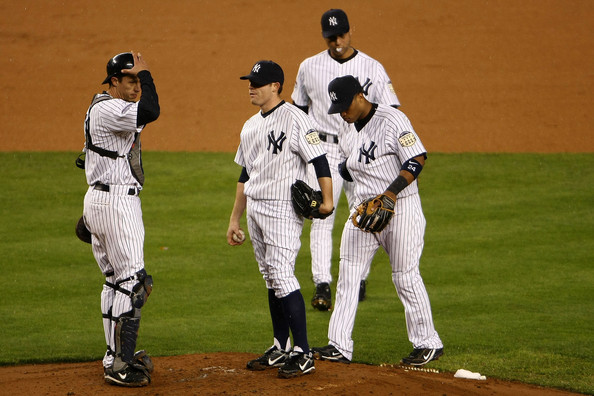
Phil Hughes, Al Aceves, and David Robertson

The Yankees came into 2009 feeling good about their bullpen. After all, the same cast of characters posted the seventh lowest ERA (3.79), second lowest FIP (3.82), second best strikeout rate (8.66 K/9), and tenth best walk rate (3.53 BB/9) in the league last year. Unfortunately, that group of relievers was unable to repeat that performance in the first month of this season. Their FIP in April was awful (5.41) and their ERA even worse (6.46), and it was a major reason why the team was in third place with a negative run differential on May 1st.

Thankfully, the Yanks had enough bullpen depth to not just replace one or two pieces, but to make wholesale changes. The first step in the makeover came on April 25th, when Phil Hughes was summoned from Triple-A to take over for the injured Chien-Ming Wang. Al Aceves replaced the overmatched Anthony Claggett on May 5th, and David Robertson took the place of the injured Brian Bruney three weeks later. Edwar Ramirez and his 33 baserunners allowed (6 homer!) in 17.1 IP was banished to the minors mid-May, and Jose Veras was mercifully designated for assignment a little later on.

After allowing three earned runs or less in five of his seven starts, Hughes shifted to the bullpen in early June to make way for Wang. He became the primary setup man to Mariano Rivera in short order, allowing everyone else in the bullpen to settle into roles more suitable for their skills. Hughes held opponents to a .172-.228-.228 batting line as a reliever, posting a ridiculous 65-13 K/BB ratio and an unfathomable 1.83 FIP after moving to the bullpen.

Aceves, meanwhile, became Joe Girardi’s jack of all trades. He was used in long relief, short relief, in matchup situations, you name it. He allowed less than a baserunner per inning, and his 80.2 IP as a reliever was the most by a Yankee since Scott Proctor’s 100.2 IP back in 2006. Aceves effectively bridged the middle innings gap from the starter to Phil Hughes all by himself.

Most teams would be happy with a pair of guys like Hughes and Aceves in their bullpen, but the Yankees didn’t stop there. Rookie David Robertson developed from promising prospect into a bullpen force, leading all American League pitchers by striking out 12.98 batters per 9 IP (the second place guy, Joakim Soria, was more than a full strikeout behind him).

Once all of the new pieces were in place, the Yankee bullpen went from weakness in April to strength the rest of the way. They finished the year with a solid 3.91 ERA, and placed second in the league in strikeout rate (8.44 K/9) and third in walk rate (3.46 BB/9). The names had to be changed, but Girardi’s bullpen once again finished the season as one of the strongest in the game.

Photo Credits: Getty Images, Reuters Pictures, AP

Categories : Analysis
Comments (38)

In the winter of 2007-2008, when River Ave. Blues was still in its blog infancy, the hot topic of the Hot Stove League was Johan Santana. The Twins were gearing up to trade their lefty ace, and the Yankees were deeply involved in the negotiations.

As the winter dragged on, we staked out a position deemed extreme by many — but not Yanks’ GM Brian Cashman. “Save the Big Three,” we proclaimed, as it became clear that any Johan Santana deal would probably include some combination of Phil Hughes and Ian Kennedy along with other top prospects or Major League contributors. The money, we argued, would be better spent on CC Sabathia a year later when the big man hit free agency. Plus, we reasoned, the Yanks wouldn’t have to pay twice for CC, first in prospects and then in dollars, as they would for Santana.

When all was said and done that winter, our position held the day, but it was not without controversy. Throughout 2008 and even into 2009, a debate raged among Yankee fans over that non-trade, and when the Yanks missed the playoffs in 2008 for the first time since 1994, Cashman and the anti-trade faction received its fair share of criticism.

Yet, last winter, the pieces fell into place. The Yanks landed CC Sabathia, and this year, that signing has paid off in a big way. CC took home MVP honors after the ALCS, and after posting tremendous numbers this season, Sabathia has powered his way through three playoff starts. It’s been wine and roses for the Yanks and CC this year.

With the Yanks gearing up to face the Phillies in the World Series, let’s take a look at how those pieces from the Santana trade are doing. I’m going to assume that the most popular iteration of the trade — Phil Hughes, Ian Kennedy and Melky Cabrera for Johan Santana — would have gotten the deal done. The Yanks probably would have thrown in a fourth lesser prospect as well.

Phil Hughes
Still just 23 years old, Hughes has been one of the most heralded young arms in recent Yankee history. He made his debut in 2007 and threw admirably as one of the youngest starters in the league. His 2008, however, was a complete wash. He started the season 0-4 with an ERA of 9.00 and then missed May, June, July and August with a variety of injuries. By the end of 2008, Yankee fans were wondering about the hype, and many rued not trading Hughes when his stock was high.

This year, though, has been an utter revelation for Yankee fans and Phil Hughes. He made a few spot starts in place of Chien-Ming Wang and flashed some decent stuff, but the youngster really came into his own upon moving into the bullpen. As the 8th inning bridge to Mariano, Hughes went 5-1 with a 1.44 ERA in 44 games. In 51.1 innings, he walked just 13 and struck out 65. He put up a 22.7 RAR and a 2.2 WAR out of the bullpen, and without Hughes in the 8th, the Yanks’ season would have played out much differently.

Melky Cabrera
For Melky, 2008 was a setback. He was the subject of many trade rumors and didn’t play well at all. He hit .249/.301/.341 and lost his starting job to Brett Gardner by early August. This year, though, with increased competition from Gardner, Melky responded in turn. Although he faded a bit down the stretch, Melky hit .274/.336/.416 with a career-best in home runs (13), doubles (28) and OPS+ (97). In the ALCS, he went 9 for 23 with four RBI and three walks. At 25, Melky has 2148 Major League plate appearances under his belt and could yet turn into an adequate offensive outfielder.

Ian Kennedy
Similar to Hughes, Kennedy had a terrible 2008. He also went 0-4 with a gaudy 8.17 ERA and found himself demoted after not pitching poorly. To make matters worse, he flashed an attitude unappreciated by many in New York. This year, he had a strong start at AAA but came down with an aneurysm in his arm. He made a triumphant return to the Majors and threw an inning against Anaheim in mid-September. He is currently throwing in the Arizona Fall League where he has allowed five earned runs in 11.1 innings but has a 13:1 K:BB ratio. He will probably factor into the Yanks’ 2010 plans.

Johan Santana
The centerpiece of the deal landed in New York after all but in Queens and not the Bronx. He has been a bright spot amidst a dismal Mets team. With the Mets, he has gone 29-16 in 59 starts. He has a 2.79 ERA in the NL and has struck 352 while walking 109 in 401 innings. His K/9 IP in the NL is 1.6 strike outs lower than it was in the AL. This season, his velocity started trending downward, and he missed the final six weeks of the season after undergoing surgery to remove bone chips in his arm. The Mets still owe him at least $98.5 million over the next four seasons or $118 million over five.

Late last week, Cashman spoke with John Harper of the Daily News about this very topic. “When we added David Cone from Toronto,” Cashman said “we were a piece away at the time. But when Santana became available, in my opinion we weren’t a piece away yet. So I told ownership, ‘Listen, six months really isn’t a long time to wait – though it turned out to be a long time for me, to be honest – and if we can have the patience and discipline, I can’t guarantee you we’ll be able to get Sabathia, but think about what our organization will look like if we can add him and keep these other assets.’”

And so today, those assets are still in place. The Yankees are playing the World Series with CC Sabathia, Phil Hughes and Melky Cabrera primed to contribute. Although Ian Kennedy hasn’t yet been what we expected and Melky has hit some development roadblocks over the last few years, the Yankees are right where they expected to be when Cashman turned down the Santana offer. I certainly think it’s worked out nicely for them. Do you?

Categories : Analysis
Comments (138)

One of the main reasons why we’re anxiously waiting for the clock to strike 8:20 tonight is Phil Hughes. The Yanks’ youngster who dominated the 8th inning this year couldn’t get the job done against the heart of the Angels’ lineup on Thursday, and he has now allowed nine hits and three earned runs in 4.2 innings this October. Speaking with MLB.com’s Brittany Ghiroli yesterday, Dave Eiland said that Hughes has to fix a mechanical flaw in his delivery. “[It's] just a minor adjustment and he knows it,” Eiland said. “It’s just staying within yourself — just trust it and not trying to make that good stuff you have even better. Because you do that [and] you get a little jumpy, you get a little quick through your delivery and you affect your command. And that’s what is happening.”

The Yankees still trust Hughes, as they should, and odds are good that he plays a key role in tonight’s Game 6. Hopefully, the work Eiland and Hughes put in yesterday and today have solved the problem, and the Bridge to Mo will remain ever strong.

Categories : Asides, Pitching
Comments (35)

When it comes to young pitchers, uncertainty abounds. Teams draft pitchers with an idea of their talent level and potential, but neither brings any guarantees once the pitcher begins his professional career. Sometimes the talent doesn’t correlate to the results. When it does, the pitcher then has to face increasing levels of competition until he reaches the majors, the most difficult challenge of anyone’s career. Along the way anything can go wrong, leaving a once promising career in a shambles. Even as teams employ better measures of a player’s true ability level, they cannot erase the uncertainty that comes with pitching prospects — or, as TINSTAPP would say, inexperienced pitchers.

In recent years we’ve seen another level of uncertainty, that of a pitcher’s role. No one embodies this uncertainty like Joba Chamberlain. A 2006 draftee, Chamberlain dominated the minors as a starter in 2007, moving through both A+ and AA levels. He possessed such electric stuff that the Yankees thought they could use Chamberlain at the major league level in 2007. The only hitch was that he’d pitch out of the bullpen. The reasons were twofold. First, the Yankees desperately needed another reliable option to set up Mariano Rivera. Second, finishing the season in the bullpen would keep Chamberlain’s innings in check, a concern for all young pitchers but especially for Chamberlain, who had not only limited professional experience, but only about 210 innings in college.

Chamberlain continued his dominance in the major league bullpen, allowing just one earned run, a solo homer, over 24 innings. It begat one of the winter’s two debates: should Joba be a starter or reliever? The two sides took firm stances. The reliever crowd had seen enough. Joba’s performance over those 24 innings fully convinced them that his proper role was in the bullpen. The starter crowed wanted to see if he could fulfill his top-end starter potential. In that role he’d be more valuable than a relief pitcher, even a top closer. The debate raged in 2008, as Chamberlain started lights out in the pen (though not as lights out as his small 2007 sample) and then pitched well in the rotation.

While the debate over Phil Hughes hasn’t been as heated and didn’t divide the fan base as much, there are still questions as to Hughes’s proper role. For the most part, Hughes has been a mediocre starter in the majors and a lights out setup man. With that visual evidence in place, some think that he’s better suited for the bullpen. Others think that the move to the bullpen was the confidence booster Hughes needed to fulfill his potential as a starter. After all, it was in the bullpen that Hughes started to resemble his scouting report. If he can take that back to the rotation, the Yankees could have the ace they envisioned when they drafted him in 2004.

But why are fans so intent on knowing each pitcher’s role — definitively and right now? Both sides of the debate are guilty of this. The starter side wants to see both Hughes and Joba in the bullpen until they prove they can’t handle it. The reliever side wants to see them put in their proper place as soon as possible, so they can maximize their values. If the Yankees are smart, they’ll ignore the calls to take a side and continue developing both Joba and Hughes as pitchers, rather than as starters or relievers.

There was a time in baseball when pitchers bounced back and forth between the bullpen and rotation. This was based on team need and performance. Earl Weaver is often cited for employing this philosophy. He thought that pitchers should break into majors as relievers, and only move to the rotation when they proved they could handle the bigs and the team needed them in that spot. This meant some bouncing around between the rotation and the bullpen, but that shouldn’t be much of an issue. After all, these guys are pitchers. One of my favorite bits of advice for writers is that writers write. In the same way, pitchers pitch. Forget roles; just pitch.

The idea is older than me, but it seems that teams have put more of an emphasis on roles in recent years. There are a few reasons for this, but neither seems provable or particularly valid to me. First is that bouncing a guy between the rotation and the bullpen can cause injury. That notion was reinforced for the Yankees last August when Joba Chamberlain injured his shoulder after transitioning from the bullpen to the rotation. That, however, represents just one instance of correlation to the theory. There is certainly no causation present, and to my knowledge there isn’t even a study which posits a greater correlation. The idea that pitchers are put at risk to injury when moving between the bullpen and rotation is anecdotal at best, and downright wrong at worst.

The second concern relates to roles themselves. From comments Phil Coke made earlier in the season, the guys in the bullpen prefer having a defined role. That’s fine, but since when do baseball teams make decisions based on the players’ wishes? Again, pitchers pitch. If a guy can’t mentally prepare for any role, then he’s not as versatile as a pitcher who can take the ball whenever called, whether to start the game, as a mop-up man in a blowout, or in the seventh, eighth, or ninth inning. But, because teams — or, at least, the Yankees — are so obsessed with roles, we sometimes don’t get to see a pitcher’s true potential.

Because the nature of pitching is so volatile, it’s tough to define a pitcher’s role early in his career. Obviously, starters provide more value than relievers, but what if a pitcher is better suited to late-inning relief work? That raises the further question of whether the pitcher should be put in his best possible role, or in the role that provides the team with the most overall value. In the case of unnecessarily pigeonholing relievers, we might not get to see where a pitcher thrives, because he’s kept from that role. So instead of setting a player’s role, perhaps teams should be more flexible — and train their pitchers to be more flexible as well.

Pitchers pitch, and not all pitchers are the same. Those are two key ideas in the starter vs. reliever debate. Good starters provide more value than top relievers, but some pitchers are better suited to relief work. The results should bear that out. The best way, then, to determine a pitcher’s fate is to try him out in all types of roles while keeping his ultimate rule undetermined. Over time, a pitcher’s performance should indicate the answer. If more teams employed this philosophy, maybe we wouldn’t get totally moronic, whiney columns from national baseball writers who have nothing better to write about. But more importantly, we’d see pitchers defining their own roles, rather than having the team define the role for them.

Categories : Pitching
Comments (34)

Like most (all?) of you guys, I spent my Sunday evening watching Phil Hughes pitch part of the 8th inning in the Yankees’ series clinching win over the Twins. And also like most of you, I was waiting for Hughes to throw either Denard Span or Orlando Cabrera a curveball, a curveball that ultimately never came. In fact, just 3 (3!) of the 59 pitches Hughes threw in the ALDS were curveballs, that’s it. This wasn’t the first time I found myself wondering if St. Phil was ever going to break out Uncle Charlie, and it seemed like I was waiting for it more and more as the season progressed.

Since your memory can deceive you (”Memory can change the shape of a room; it can change the color of a car. And memories can be distorted. They’re just an interpretation, they’re not a record, and they’re irrelevant if you have the facts,” said the guy in Memento), I decided to turn to good ol’ PitchFX and dig up the facts. First things first, let’s take a look at Hughes’ pitch selection this season. Remember to click any chart in this, or pretty much any RAB post, for a larger view.

Phil Hughes' Pitch Selection, 2009

As you probably expected, Hughes went fastball heavy once he shifted to the bullpen, as he should. There’s no point messing around with your third or fourth best pitch as a reliever, and you can clearly see that his velocity spiked after the move. As for how much he was throwing each pitch as the season progressed, well that graph comes after the jump.

Read More→

Categories : Analysis, Pitching
Comments (46)

For half the game, everything went well. The Yankees put up four runs and Chad Gaudin was cruising. Even two outs into the bottom of the fifth, the Yanks looked poised to win their first game in Anaheim this season. But from that point on almost nothing went the Yankees’ way. Gaudin couldn’t finish the fifth, Aceves almost blew the lead in the sixth, and a pair of errors cost the Yankees the lead in the eighth. But a short rally in the ninth put them back on top again, and Mariano Rivera closed the door.

The game started off as a few have recently: the Yanks put a few men on in the first, but failed to score. Ervin Santana kept dropping breaking balls and off-speed pitches, and the Yanks just couldn’t get a feel for him. It was more of the same in the second. Robinson Cano doubled to lead off, but Santana struck out two Yanks to strand him. But then came the third.

Santana, while getting swings and misses on breaking balls out of the zone, was nonetheless missing the zone. A-Rod took advantage of this, working a 3-0 count following a Teixeira single. Then came the BP fastball, and there it went, way out to dead center. It gave the Yanks their first lead of the series, and Posada would add to that with a two-run homer two batters later. Hideki Matsui struck in the fifth, and the Yanks offense had put them on top 5-0.

On the other side of the ball, Chad Gaudin had it going. It took him only nine pitches to retire the Angels in the first, and while the second was a bit longer he still allowed just one hit. A hit, a walk, and six outs later, the Yanks had a decent lead heading into the second half of the game. And that’s when Gaudin broke down.

It wasn’t the first time Gaudin lost it before the end of the fifth. Girardi pulled him with two outs in the fifth in Oakland, Gaudin’s first start in pinstripes, with the bases loaded. On that night he allowed no runs, and Al Aceves came on to finish the inning without damage. The latter was true again this time. Aceves came in and got Torii Hunter swinging to end the frame, but not before Gaudin allowed a homer, a double, a walk, and a single, putting the Angels on the board for the first time.

Aceves then had his own set of troubles in the sixth. Four of the first five hitters in the inning singled, allowing one run to score and loading the bases with one out. Maicer Izturis popped out, but Aceves couldn’t sneak one past the patient Abreu. Bobby didn’t even take the bat off his shoulder, and the Yanks lead was cut to one. Only a diving stop by and perfect throw to first from Alex Rodriguez saved the lead.

That would be the end of the Yanks’ pitching problems for the evening, though Phil Hughes did escape a mini-jam in the seventh, and pitched pretty well in eighth. It was the defense that failed the team. Howie Kendrick smoked an outside pitch, but right at Robinson Cano. The ball just got away from him, a play that unfolded so fast that the replay couldn’t really capture it. That was the first error.

On an 0-1 count, Kendrick took off for second. Jorge pulled the throw a bit and it went into center field, moving Kendrick to third with none out. There seemed little chance the Yanks could escape without blowing the lead. Hughes got Figgins to pop out weakly, but Izturis punched one into right to tie the game. Just three innings after the Yankees were flying high, they found themselves back at the drawing board.

Thankfully, the drawing board is often a productive place for the Yanks. Brett Gardner started off the ninth with a single, and then he was off to the races. While he was safe by the call, replay showed that he strayed a bit off the bag with the tag on him. Oh well. After the bottom of the eighth, the Yanks needed a break. Jeter ended up walking, and then Johnny Damon bunted the runners over.

Not wanting to face Mark Teixeira with runners on second and third, Mike Scioscia walked him to get to A-Rod. That didn’t work, as Alex lined one into center, just deep enough to score Gardner. That put the game in Mo’s hands, and while Juan Rivera’s at bat was tense, it ended with a great release: a strike ‘em out, throw ‘em out double play. One pitch later and the Yanks were celebrating a playoff berth, though they had locked that up a bit earlier when Texas lost to Oakland.

The Yankees got swept at Fenway in the first half and came back to go two out of three in the second half. They got swept in Anaheim before the All-Star Break, and now have a chance to go two out of three with a win today. A.J. Burnett starts against Scott Kazmir. It’s an afternoon affair, an odd 3:30 start.

Categories : Game Stories
Comments (52)

Earl Weaver thought that the best way to break in a young arm was to have him pitch out of the bullpen. The Yankees have certainly practiced that over the past few years, using both Phil Hughes and Joba Chamberlain in relief. While Weaver’s philosophy has merit, the Yankees have an additional reason to put their young pitchers out in right-center field: Mariano Rivera. He has a lot to teach young pitchers about composure and demeanor (unfortunately, he cannot teach them the cutter). Tyler Kepner has an article up about Mo’s influence on Phil Hughes this season. The 23-year-old seems to get it. My favorite line of the article: “Hughes, 23, cannot imitate Rivera’s cutter, but he shares a stoic demeanor.” In a league filled with emotional young pitchers, it’s nice to see someone who can rein it all in.

Categories : Asides
Comments (20)

After two years of waiting, we’ve finally seen the emergence of Phil Hughes. The 23-year-old former No. 1 Yanks prospect struggled through injury and ineffectiveness in his first two major league seasons, and even had a slow start in 2009. A move to the bullpen changed that, and Hughes has been lights out ever since. It’s like the new role was an on switch for Hughes, whose stuff markedly improved as his appearances became shorter.

Hughes has thrown 44.2 innings since moving to the bullpen in early June, striking out 44 to just 12 walks and posting a 1.41 ERA. His fastball has life unlike we’ve seen from him, which helps set up his curveball, still his best secondary pitch. In a matter of a few weeks he went from promising but underperforming starter to lights out reliever. The Yankees now control the back end of close games, and have certainly won a game or two they might have lost with a lesser guy holding down the lead.

This is the Phil Hughes that made the cover of the Baseball America Prospect Handbook 2007. The guy who has life on his fastball and a nasty hook to go with it. yet it does seem curious that he only rediscovered himself after a move to the bullpen. Could it be that he’s better suited to more frequent, shorter appearances, rather than longer ones every five days?

Billy Campione of Full Count Pitch thinks so. He builds a case that the bullpen has brought out the best in Hughes, and that he simply cannot replicate those numbers in the rotation. That’s not such an outlandish case if based only on Hughes’s performance so far in the majors. But considering the other information available about Hughes, it seems likely that he’ll be able to make a successful transition back to the rotation.

Campione thinks that, “Hughes’ achievements in relief have come due to a drastically different approach that he will find impossible to replicate as a starter.” He goes on to note Hughes’s average major league fastball speeds, around 91 mph in 2007 and 2008, but up to 95 mph this season while in relief. Hughes’s fastball velocity was one area of concern in the past, especially last year as he faltered in the early going. That’s because his scouting report hyped it as a bit faster. (Sorry, sub required.)

Hughes sits at 91-95 mph with his four-seam fastball and touches 96.

If he was hitting these speeds as a starter in the minors three years ago, and he’s averaging at the top-end of that range as a reliever now, chances are he can again throw that hard as a starter. No, he won’t be averaging 95 mph with his fastball as a starter, but he could easily sit 92-93, dialing it up when he needs it. It’s quite possible that the transition to the bullpen allowed Hughes the chance to find that lost velocity.

Another Campione concern: “Looking at one of Hughes’ most recent appearances out of the pen, his pitches consistently appear in the middle of the strike zone.” This has anecdotal merit — I think we can all agree that Hughes throws balls in the middle because he can blow it by guys. It also has some statistical merit, as Campione displays a strike zone plot from a recent start that shows some fastballs near the middle of the zone. Again, from the BA scouting report: “As he gains experience, his excellent control (his career K-BB ratio is 269-54) should evolve into above-average command.” Hughes is definitely throwing it by guys right now, but as he dials it down slightly in the rotation, we could see his command evolve, meaning he’d leave fewer pitches over the middle of the plate.

There’s also the argument that the bullpen allows Hughes to scrap his weakest weapon, the changeup, a pitch he might need as a starter. It’s true that Hughes’s changeup is miles behind his fastball and curve, but there’s still plenty of time for him to develop one. In the meantime, he can employ a cutter to help keep hitters off balance. In addition, it appears Hughes uses two types of curveballs: one with a tighter spin, almost a power-curve type pitch, the other a knuckle curve a la Mike Mussina. These pitches can help him get by as he develops his changeup.

Maybe Phil Hughes is best suited to a role in the bullpen, as a setup man and eventually a closer. There’s certainly no ruling that out at this point. In the same way, there’s no ruling out his ability to be a top of the rotation starter. He wasn’t the Yankees No. 1 prospect because of his perceived ability to succeed in the bullpen. Scouts at Baseball American and elsewhere raved over him because he had, and still has, the potential to be a top starter.

No matter where he ultimately ends up, the Yankees would serve themselves best by moving Hughes back to the rotation in 2010. If he succeeds there, he’ll be a boon to the franchise for years to come. If he fails, we know he can succeed in the bullpen. It’s the same deal as Joba. When you have a pitcher with frontline starter potential, you best serve your team’s interests by seeing if he can succeed as a starter. If it’s clear that he won’t reach his potential in that role, it’s back to the bullpen. But until we find out what Hughes can do as a starter, we can’t pigeonhole him in the bullpen. That decision shouldn’t come for another few years, after the Yankees have a good long look at Phil Hughes the starter.

Categories : Pitching
Comments (166)
Sep
08

The Joba/Phil switcheroo

Posted by: Benjamin Kabak | Comments (153)

Heading into a Monday match-up against the Rays on June 8th, the Yankees were 33-23, clinging to a 0.5-game lead in AL East. That night, Phil Hughes made his first bullpen appearance for the Yankees in a win, and since then, the Yankees have been nearly unstoppable. The Yankees are 56-27 since Phil’s bullpen debut, and Hughes has been, by most accounts, the Yanks’ third best pitcher over the last three months.

We know the dominance; we see it as often as the Yanks use Phil. The numbers though are impressive. In 33 relief appearances, Hughes has thrown 41.2 innings with an ERA of 1.08. He has walked just 11 and has struck out 54. His numbers rival those of Mariano Rivera’s, and arguably, only CC Sabathia and Mo have been as valuable on the mound as Phil since mid-June.

While Hughes has helped solidified games at the back end of the bullpen, he’s hardly making a huge impact overall. He has thrown 41.2 innings while the Yankees as a whole have pitched 741.2. Hughes’ contributions, then, have come in just over five percent of all of the Yankee innings over the last three months. They are, in a sense, wasting a weapon in the pen.

At this point in the year, the Yankees do not seem inclined to stretch Hughes out into a starter. As they’re doing with Joba Chamberlain, they could be doing with Hughes. They could have him throw 35 pitches and then 50 an then 65 in an effort to build him up to a playoff starter. The Yankees, though, don’t want to mess with a good thing. In a piece making the rounds today, Rob Neyer, though, urges them to do just that. By switching Joba and Phil Hughes, says Neyer, the Yankees would be perfect for the playoffs.

Chamberlain is the Yankees’ No. 4 starter. Sergio Mitre is the Yankees’ No. 5 starter. Which means the Yankees, as things stand now, have only three reliable starters. And again, you need four of them when the leaves are turning in New England.

I know, I know … Phil Hughes has been so good in the bullpen: 1.11 ERA with an overpowering strikeout-to-walk ratio. Make him a starter again and he’s not going to post numbers anything like those. But to help the Yankees, he doesn’t have to be anywhere near that good; he just has to be measurably better than Chamberlain and Mitre. Particularly if — and I know this is highly speculative — Chamberlain regains his dominant stuff upon returning to a relief role.

Perhaps I’m overreacting to Chamberlain’s recent struggles, and the Yankees are good enough to win the World Series even without a decent fourth starter. But the other day somebody asked me what could keep the Yankees from winning. I didn’t have a good answer, because this is essentially a team without a weakness.

Except one. And with a little creativity, they could probably make it zero.

The problem, as Neyer admits, is Joba. There is no guarantee that he’s going to find the missing five miles-per-hour on his fastball in the pen. There is no guarantee that he’s going to rediscover the ability to attack the strike zone and get hitters out while pitching efficiently out of the pen. In fact, Joba’s recent first-inning struggles would suggest just the opposite.

I’d love to see Hughes in the rotation, but I’ve come to terms with the fact that it just isn’t going to happen. Joba’s struggles are, hopefully, an isolated incident that comes and goes with the season. A.J. Burnett to attest to the ups and downs of pitching.

There is but one rub to this tale of pitching. Jon Heyman tweeted today: “Those of us who think Joba’s a reliever may get our wish in the AL playoffs, when he may join Mo, Hughes in pen.” There are no sources here and no analysis. Rather, Heyman just reports something seemingly for the sake of creating news.

If there’s a modicum of truth in this Tweet though it’s not impossible to see what the Yankees would do. Tonight, Chad Gaudin pitches with Alfredo Aceves ready at the first sign of trouble. Aceves has essentially become Gaudin’s caddy. He has thrown 32 pitches and then 42 pitches in relief of the Yanks’ recently-acquired right-hander. With a long outing tonight, Aceves could easily take a spot in the rotation in five days and work toward a start in the playoffs. Crazier roster machinations have happened.

Categories : Pitching
Comments (153)