Archive for HIROK
Hiroki Kuroda talks about returning to the Yankees and preparing for 2013
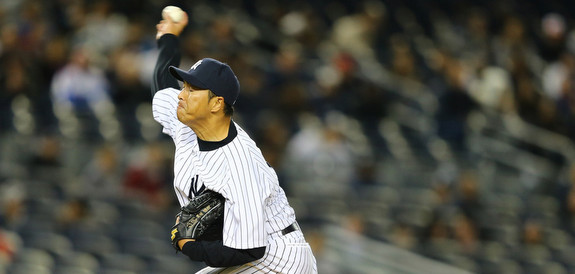
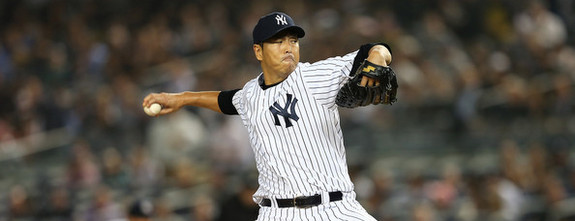
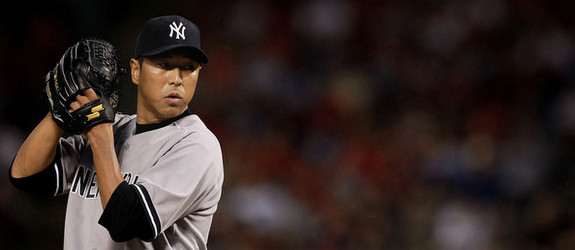
Posted by: | CommentsThe Yankees reportedly operated with a very straight-forward approach this winter, tackling one priority at a time without deviating from their set path. It’s a very odd way for a baseball team to proceed with the offseason, but so be it. The top priority on New York’s winter agenda was the pitching staff, specifically re-signing their own veteran arms. They checked the first item off the list in mid-November, when Hiroki Kuroda turned down more lucrative offers to return to the club on a one-year, $15M deal.
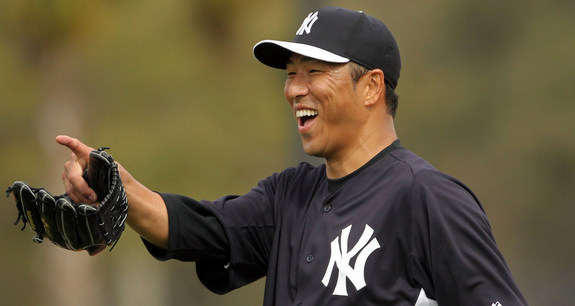
“It was a good decision, but it was hard,” said Kuroda to Bryan Hoch about re-signing with the Yankees. “There were options that I had. There were offers from other teams, but I ended up making the decision to stay with the Yankees … I’m in that stage where I want to play for a team that I really love to play for, and hopefully when I retire, I’ll have time with my family.”
Kuroda, who turned 38 earlier this month, acknowledged the team’s veteran-laden clubhouse was “really appealing” and swayed his decision, saying “especially with the fact that there are players like (Andy Pettitte) and (Mariano Rivera), who are older than me, and who I can look up to … I absorb a lot from them.”
It’s not the first time we’ve heard about a player signing with the Yankees because of their veteran clubhouse, which in some ways is a market inefficiency the team is exploiting. Guys like Derek Jeter, CC Sabathia, Pettitte, and Rivera are very well-respected veterans who other veterans want to play alongside. If that helps the Yankees sign these players to address a need on favorable contract terms, great. I’m not sure any other club can pull that off.
As we learned last summer, Kuroda is pretty much a perfect fit for the Yankees. He’s tough and savvy on the mound, and about as reliable a pitcher as you’ll find. He also comes off as a total pro, taking the blame for losses and crediting his teammates for wins. It’s easy and fun to root for someone like that, and it helped Kuroda fit right in as soon as he put on the pinstripes. “You know if a guy is cut out of the same mold as you are,” said Pettitte to Hoch. “We are.”
Because of the hit the offense took this winter, the Yankees are going to have to rely on their pitching staff more than any other point in the last ten years or so, specifically the veterans Sabathia, Kuroda, and Pettitte. Phil Hughes is already having back trouble and who knows what Ivan Nova and David Phelps can contribute, so it’s those three veterans Joe Girardi & Co. will lean on. Kuroda is coming off a career-high 35 starts and 235.2 innings (including playoffs), and it’s fair to worry about his ability to hold up at that age.
“You’re always a little bit concerned as they put a little bit of age on themselves, but right now he looks good to us,” said Girardi to Hoch. Kuroda ran into a wall of fatigue in early-September last year, so much so that he stopped throwing his regular between-starts bullpen sessions. He told Hoch that he’s adjusted his offseason training program in an effort to stay fresher late in the season and is working closely with strength and conditioning coach Dana Cavalea. Whether it actually works remains to be seen.
Pettitte has always given off this vibe that no matter how much the odds are stacked against him, he’ll figure out a way to get the job done. He’s human and doesn’t always come through, but he’s built up enough good will throughout the years and earned everyone’s confidence. Kuroda gives off a similar vibe, at least to me, which is why I’m confident he’ll overcome that workload to again be a very effective starter for the Yankees in 2013. It’s possible he won’t, but it definitely would surprise me.
Marchand: Kuroda left money on the table to re-sign with Yankees
Posted by: | CommentsVia Andrew Marchand: Hiroki Kuroda turned down offers with multiple guaranteed years and/or more total money to re-sign with the Yankees for one-year and $15M earlier this week. The Dodgers, Red Sox, and Angels were among the clubs courting the veteran right-hander. Ken Rosenthal notes that Kuroda has signed four contracts in his MLB career, and he left money on the table each time. Most guys (understandably) take the biggest payday, but comfort has obviously been a major factor for Hiroki.
Yankees re-sign Hiroki Kuroda
Posted by: | CommentsLast offseason the Yankees didn’t sign Hiroki Kuroda until mid-January. They didn’t wait that long this winter. Kuroda has officially signed a new contract with New York, the team announced. Buster Olney says it’s a one-year deal worth $15M plus incentives that total less than $1M. Pretty sweet deal.
“I am very happy and excited to re-sign with the Yankees,” said Kuroda in a statement. “I am very grateful for all of the interest and all of the offers that I received from the various teams that courted me. It was a tough decision for me to make, but at the end of the day, I wanted to try to win a championship with the teammates that I went to battle with last season.”
Kuroda, 38 in February, pitched to a 3.32 ERA (3.86 FIP) in a career-high 33 starts and 219.2 innings with the Yankees in 2012, his first season in pinstripes. He also tacked on two stellar postseason starts for good measure, bringing his season total to 235.2 innings. That workload is a bit of a concern heading into next year, but at the end of the day, bringing Kuroda back for a year was far too good to pass up.
The one-year contract works well for both sides. The Yankees are trying to get under the $189M luxury tax threshold in 2014 and this deal won’t impact future payroll. It also limits risk stemming from that career-high workload. Kuroda maintains he will finish his playing career back in Japan, so he has the flexibility to go back home after the season. The Yankees made the right-hander a qualifying offer a few weeks ago and would have received draft pick compensation had he signed with a different MLB team.
With Kuroda back in the fold, the next order of business for Brian Cashman & Co. is to re-sign Mariano Rivera and hopefully do the same with Andy Pettitte should he decide to keep playing. Right field and catcher must also be addressed, but shoring up the rotation was a more pressing matter. The Yankees can now move forward with their offseason plan knowing they have a reliable innings guy to slot between CC Sabathia and Phil Hughes in the rotation.
What Went Right: Hiroki Kuroda
Posted by: | CommentsThe American League East is not for every pitcher. The division features four hitter’s parks and four powerful lineups, and over the last five years it’s produced a dozen of baseball’s 40 90-win teams (30%). A pitcher needs to be outstanding at something to pitch there. Outstanding stuff, outstanding command, outstanding know-how, something. Guys with less than stellar stuff who can’t locate well or set hitters up usually don’t last long in this division.
When the Yankees agreed to sign Hiroki Kuroda to a one-year contract worth $10M in January, no one was really sure what he brought to the table. We knew they needed pitching help and we looked at the stats and watched the MLB.com highlights clips, but what made the 37-year-old Kuroda different than all of the other career NL pitchers who failed in the AL East? What was the outstanding trait that he brought to the table? As it turned out, it was pretty much everything.
* * *
When Spring Training opened, eyes seemed to be on everyone but Kuroda. Michael Pineda — who was acquired about an hour before the news of Kuroda’s signing broke — grabbed headlines with his missing velocity. Phil Hughes garnered attention for being in better shape and pitching better than anyone else in camp. CC Sabathia was coming off knee surgery and Andy Pettitte stole headlines by un-retiring. Heck, even former Yankee A.J. Burnett drew more attention than Kuroda after bunting a ball off his face in Pirates camp. Kuroda went about his business and was just kind of there.
The regular season opened and Joe Girardi tabbed Kuroda as his number two starter behind Sabathia, replacing the departed Burnett. His first start in pinstripes didn’t go well at all — he allowed six runs (four earned) in 5.2 innings against the Rays in the eventual loss. Six days later he started the team’s home opener and was brilliant, dominating the Angels with eight shutout innings. Considering all the preseason hype surrounding the Halos, that start was huge. Five days after that, the Twins hung ten hits and six runs on Kuroda in just 4.1 innings. Three starts into his Yankees career, Kuroda was dubbed “inconsistent.”
The tag stuck for a few weeks has Kuroda pitched well (two runs in 6.2 innings) but was outdone by countryman Yu Darvish in his fourth start, then didn’t make it out of the fifth inning against the Royals in his sixth start. Two starts later he allowed seven runs in five innings to the Blue Jays. After his first nine starts, Kuroda owned a 4.53 ERA (4.39 FIP) and was averaging fewer than six innings per start with a sub-2.0 K/BB. He showed outstanding staff at times, outstanding command at times, and outstanding know-how pretty much at all times, but things had yet to really come together for him. Start number ten was when it all started to click.
The Yankees were out on the West Coast in Oakland, the same venue where they started their turn-around and run to the division title in 2011. They took the first two games against the Athletics and Kuroda was brilliant in the finale, twirling eight shutout innings while allowing just four singles and a walk. Five days later he held the Tigers to two runs in seven innings and six days after that he one-hit the Mets across seven scoreless innings. The stuff, command, and know-how had all come together. From late-May through mid-August, a span of 16 starts, Kuroda pitched to a 2.22 ERA (2.77 FIP) in 113.2 innings.
During that 16-start stretch, Kuroda struck out eleven White Sox in seven scoreless innings, threw a complete-game two-hit shutout against the Rangers, and held the pre-blockbuster Red Sox to one run on four hits in eight innings. He allowed one run or less nine times in those 16 starts and allowed three or more runs just four times. Only once did he fail to complete at least six innings and 12 times he threw at least seven full. Following his run of dominance, Kuroda owned a 2.96 ERA (3.61 FIP) in his first 25 starts and 167 inning as a Yankee. He had taken over the role of staff ace as CC Sabathia battled groin and elbow injuries and Andy Pettitte went down with a fractured leg.
Despite Kuroda’s pitching brilliance, the Yankees were stuck in a tight race with the Orioles for the division title in the season’s final month. The workload — Kuroda threw 183.2 innings before the calendar turned to September, more then he’d thrown in two of his four years with the Dodgers overall — started to take a toll on him and his performance suffered. The Rays tagged him for four runs in six innings twice in the season’s final month and the Athletics got him for five runs in 5.2 innings. He held the Blue Jays to just two runs in 5.2 innings in his second-to-last start of the year, but they had ten hits off him.
In seven late-season starts following that great run, Kuroda pitched to a 4.73 ERA (4.43 FIP) in 45.2 innings. He stopped throwing his usual between-starts bullpen session in an effort to stay fresh in September, but the fatigue still effected him. It didn’t show up in his velocity as you’d expect (he actually threw harder at the end of the season), it was in his command. He’d miss out over the plate and get pounded. Kuroda curtained some concern with a strong effort in Game 162, when he held the post-blockbuster Red Sox to two runs in seven innings, but the Yankees still decided to use him as their number three starter in the postseason just to give him two extra days of rest.
The decision worked out very well. Kuroda held the Orioles to two solo homers in 8.1 innings in Game Three, which was good enough to keep the struggling offense in the game long enough for Raul Ibanez to come out of the phone booth wearing his Superman cape to save the day in the eventual win. The Yankees decided to roll the dice and started Kuroda on three days’ rest in Game Two of the ALCS because the playoff schedule was wacky and the only other alternative was to pull David Phelps out of the bullpen and start him. Kuroda responded by striking out eleven Tigers while allowing three runs in 7.2 innings, though it would have been eight innings of one-run ball had second base umpire Jeff Nelson not blown a call. That would have been the final out of the inning and Boone Logan/Joba Chamberlain tag-team never would have allowed the two inherited runners to score.
The season came to an end when Detroit swept the Yankees out of the ALCS, but 2012 was still a smashing success for Kuroda. He logged a career-high 219.2 innings (sixth most in baseball) and pitched to a 3.32 ERA (3.86 FIP). He posted his best walk rate (2.09 BB/9 and 5.7 BB%) in three seasons and saw his ground ball rate jump back over 50% (52.3% to be exact). The strikeout rate (6.84 K/9 and 18.7 K%) dropped just a touch from 2010-2011 (7.23 K/9 and 19.4 K%) and is easily explained by not facing being able to face a pitcher two or three times a game anymore. Perhaps being reunited with former Dodgers batterymate Russell Martin, who got Kuroda to throw more sinkers and sliders and fewer four-seamers as the season progressed, explains the improved walk and ground ball rates despite moving to the tougher league.
Kuroda won’t win the award but we’ll likely learn that he has received a handful of Cy Young votes when the awards are announced tonight. He might even grab a few down-ballot MVP votes. At 3.9 fWAR and 5.2 bWAR, Kuroda was the Yankees best non-Sabathia pitcher since either 2008 Mike Mussina (5.3 fWAR) or 2005 Randy Johnson (5.5 bWAR). Take your pick. He was a stabilizing presence in the rotation from mid-May through the end of the season and regardless of whether he comes back in 2013 — the Yankees made Kuroda a qualifying offer that he rejected, so he will bring draft pick compensation if he signs elsewhere — that one-year, $10M pact will go down as one of the best one-year contracts in Yankees history.
What Went Right: Postseason Pitching
Posted by: | CommentsOver the next few weeks we’re going to spend some time reviewing the entire 2012 season, which featured another division title and unfortunately another disappointing playoff exit.
As we discussed earlier today, the Yankees as a team basically hit like a pitcher in the postseason. They put together a collective .188/.254/.303 batting line in their nine postseason games and scored just two runs in the final three games of the ALCS. It was tough to watch and just flat out pathetic, there’s really no other way to describe it.
The pitching staff, on the other hand, was absolutely stellar up until ALCS Game Four. The starters churned out quality start after quality start, and the bullpen did all it could to preserve leads and keep deficits close. After posting a 3.86 ERA (3.98 FIP) during the regular season, the Yankees received a 2.76 ERA (~3.45 FIP) in 88 postseason innings from the pitching staff.
CC Sabathia
Unfortunately, Sabathia’s season will be remembered for ending on a sour note as the Tigers battered him for six runs on eleven hits (!) in just 3.2 innings in ALCS Game Four. It was an ugly start in a generally ugly postseason showing by the Yankees as whole, but it was also the exception rather than the rule for the pitching staff.
Sabathia, of course, helped get the Yankees to the ALCS with a pair of dominant outings against the Orioles in the ALDS. He allowed two runs in 8.2 innings in Game One against Baltimore, then followed it up by allowing just one run in the decisive Game Five win. All told, Sabathia struck out 19 batters and walked just five in 21.1 playoff innings including the ALCS disaster. He set a new ALDS record with 17.2 innings pitches, nearly two full innings more than the previous record.
Andy Pettitte
A year ago Pettitte was retired back home, but he got the itch to pitch and came back to the Yankees early in the season. He slotted in as their number two starter in the postseason due in large part to the schedule, as the club tried to optimize the amount of rest for each of their starters. Pettitte made two playoff starts, one in each round, and he tossed up a quality start in each. He held the Orioles to three runs in seven innings in ALDS Game Two and the Tigers to two runs in 6.2 innings in ALCS Game One. As per his norm, Andy did allow a lot of baserunners but continually pitched out of jams. For a guy who was out of baseball a year ago, allowing five runs in 13.2 postseason innings is a minor miracle.
Hiroki Kuroda
Kuroda was New York’s best starting pitcher from Opening Day through the end of the season, and he turned in a pair of gems in the postseason. Following Sabathia and Pettitte, the first-year Yankee held the Orioles to two runs in 8.1 innings in ALDS Game One before allowing three runs in 7.2 innings in ALCS Game Two. That second start came on three days’ rest, the first time he’d ever done that in his career. Kuroda struck out a season-high eleven in that game, and it would have been eight innings of one-run ball had second base ump Jeff Nelson not blown an obvious out call on Omar Infante at second base. The bullpen allowed two inherited runners to score (charged to Kuroda) after the error. Sixteen innings (really 16.1) of five-run (really three-run) ball from the number three starter? Sign me up for that every day of the week.
Phil Hughes
Like Sabathia, Hughes ended his season on a down note as a stiff back forced him out of ALCS Game Three after just three innings of work. That shouldn’t erase his ALDS effort however, as he held the Orioles to one run in 6.2 innings while striking out eight in Game Four. Hughes only allowed one run in the ALCS start before exiting with the injury as well, so all told his postseason performance featured just two runs in 9.2 inning of work. As far as number four starters go, you can’t do much better.
The Bullpen
Eight of the nine postseason games were very close into the late innings, and the bullpen stepped up in support of the starters in a big way. They allowed just eight runs (seven earned) in 27.1 total innings (2.30 ERA) while walking just four (!), including one intentionally. The late-inning duo of Rafael Soriano and David Robertson allowed just one run in 9.2 combined innings, striking out seven against zero walks and five hits. The lone run was a solo homer off Robertson in ALCS Game Five, when the game was already out of reach. Boone Logan and Clay Rapada combined to retire 11 of 12 left-handed batters faced, with the one exception being a walk by Prince Fielder. David Phelps, who allowed four runs (three earned) in 3.1 total innings, was the only clear negative on a pitching staff who was absolutely dynamite overall in the postseason.
Kuroda will start Game Two on short rest
Posted by: | Comments4:39pm: Girardi confirmed that Kuroda will indeed start Game Two tomorrow, and he’ll be followed by Phil Hughes in Game Three and CC Sabathia in Game Four (on normal rest) regardless of the series score. If there’s a Game Seven, I assume Sabathia would start on short rest.
4:19pm: Right-hander Hiroki Kuroda will start Game Two of the ALCS tomorrow night according to various reports. Joe Girardi has not confirmed the news, for what it’s worth.
Kuroda, 37, will be starting on three days’ rest for the first time in his career after throwing 105 pitches in Game Three of the ALDS on Wednesday. Pretty much the only other option was pulling long man David Phelps out of the bullpen. The Yankees added an extra reliever (Cody Eppley) to the roster today and will have Monday off, so there will be a full complement of relievers backing Kuroda up.
Ibanez comes off the bench, carries Yankees to Game Three win
Posted by: | CommentsThis was shaping up to be a very bad night. The Yankees looked lifeless for the first eight innings of Game Three and were two outs away from a 2-1 series deficit … but Raul Ibanez. Baseball has a way of making your jaw drop, and Ibanez provided not one, but two jaw-dropping moments on Wednesday night.
There Is Only One #HIROKtober
As hideous as the offense has been, the Yankees have been getting some absolutely stellar work from their pitching staff this series. Hiroki Kuroda followed the lead of CC Sabathia (8.2 innings and two runs in Game One) and Andy Pettitte (seven innings and three runs in Game Two) with 8.1 strong innings in Game Three, allowing just two solo homers and five total hits. Both homers came on first pitch sliders, the first by number eight hitter Ryan Flaherty in the third and the second by number nine hitter Manny Machado in the fifth. Machado hit a hanger up in the zone, but the pitch to Flaherty wasn’t bad at all. It was at the knees and he golfed it out.
Outside of the two homers, Kuroda was pretty dynamite. He pitched out of a defense-created bases loaded jam in the fourth and retired 12 of the final 13 men he faced after Machado’s dinger. Command, especially of the splitter, was a bit of an issue early on, but Kuroda figured things out later on and wound up throwing 65 of his 105 pitches were strikes (62%). That’s usually nothing special, but after the first few innings it was pretty damn good. All told, the Yankees have gotten a 2.63 ERA out of their top three starters in the series. These guys have been brilliant and it seems to be flying under the radar.
Mr. Big Hit
The Yankees plated their first run in the third inning, when Derek Jeter tripled in Russell Martin with two outs. Center fielder Adam Jones deserves a huge assist for the play, I have no idea what the hell he was doing going after the ball. That ball was very catchable and Jones just seemed to be moving in slow motion as he went back to the wall. Whatever, I’m not complaining.
Right-hander Miguel Gonzalez stymied the Yankees after that though, as he retired 13 of the final 15 batters he faced following the triple. After pitching very well in Yankee Stadium during the regular season, the 28-year-old rookie carried it over into the playoffs and held the Bombers to just the one run in seven innings with his fastball-changeup-slider mix. He pitched very well and deserves some credit, but the Yankees looked rather feeble at times.
After Darren O’Day breezed through the eighth inning, closer Jim Johnson entered the game in the ninth and promptly retired Ichiro Suzuki on a fly ball to left. Alex Rodriguez, 0-for-3 with two strikeouts on the night and 1-for-13 with seven strikeouts in the series, was due up next, but Joe Girardi instead pinch-hit with Ibanez. There’s been a lot of talk about moving A-Rod down in the lineup given his lack of production, but the skipper again batted him third to start the game. Down a run with two outs to play, Girardi said told Alex he had been struggling and he wanted to give Raul a shot with the short porch. “My gut told me to make the move … (it) was the best thing to do,” said Joe after the game.
Just like Martin in Game One, Johnson fell behind in the count to Ibanez and left a sinker up the zone. Raul did what he does best, and lately that’s been come up with enormous homers. He tied a game in the 13th inning against the Athletics three weeks ago, tied a game against the Red Sox last week, and tied up Game Three of the ALDS with a solo shot to right. It wasn’t hit particularly deep but it wasn’t a Yankee Stadium cheapie either. The game was tied and the first one to greet Raul with a high five in the dugout was A-Rod. I love and hate that guy so much.
Beat Them At Their Own Game
The Orioles have been lauded for their dominant bullpen all season and rightfully so, as their relief corps have been nailing down one-run wins since Opening Day. The Yankees turned the tables a bit on Wednesday, as three relievers — Boone Logan, Rafael Soriano, and David Robertson — combined to allow just two baserunners in 3.1 innings of work following Kuroda. Logan struck out the only man he faced (Jim Thome), Rafael Soriano finished the ninth and handled the tenth, then David Robertson tossed up zeroes in the 11th and 12th. It’ll be long forgotten come the morning, but the bullpen deserves major props for holding down the fort.
Just Get It To Raul
“Just get it to A-Rod” is a phrase I’ve muttered many, many times through the years whenever the Yankees were losing in the late innings. Just get Alex another at-bat and he could make it alright with one swing. After being lifted in Game Three — A-Rod joked after the game that it was the first time he was pinch-hit for since high school, and I can only assume that coach was fired soon thereafter — things had shifted to “just get it to Raul.”
The bullpen allowed Ibanez to come to bat again in the 12th, an inning he led off against the left-hander Brian Matusz. I’ve been crushing Girardi for leaving Ibanez in against tough southpaws in the late innings of tight games all season, but I am very glad to look like an idiot now. Raul hammered the first pitch of the inning, a high fastball on the outer third, into the second deck in right for a walk-off solo homer. You could see his True Yankee™ wings sprout as he rounded the bases with Yankee Stadium rocking and his teammates waiting at home plate.
At +.827 WPA, Ibanez just had the fifth biggest playoff game in baseball history, and all he saw was three pitches in two at-bats. He also became the first player in baseball history to homer twice in a playoff game he didn’t start. That goes back to 1903. The Orioles had gone 76-0 when leading after seven innings during the regular season, so this was their first loss of 2012 in those situations. Baltimore is also 0-3 against the Yankees in extra innings this year and 16-0 against everyone else. Ibanez made some big things happen in Game Three. Big, big things.
Leftovers
The Yankees only had seven baserunners in the 12 innings … well, eleven innings and one batter. Jeter went 2-for-4 with a triple, Russell Martin went 2-for-4 with a double, and Nick Swisher went 1-for-4 with a single. Ibanez’s two dingers account for the other two baserunners. The Yankees didn’t draw a single walk, so the rest of the team went a combined 0-for-25. Not good, Raul really bailed them out.
Jeter left the game in the ninth inning after fouling a ball off the top of his left foot in the very first inning. He played through it for the next eight innings, but he was clearly hobbled and having a hard time running. For the Cap’n to leave a playoff game, it had to be pretty bad. Jeter was diagnosed with a bone bruise and is day-to-day. I’m sure he’ll be in the lineup in Game Four, even if he’s just the DH. Jayson Nix replaced him at short and made a nice grab on an inning-ending line drive double play in the tenth.
Two very weird random moments in the game worth mentioning. First Nate McLouth got caught stealing second in the first inning, but he made it to the base safely only to over-slide and get tagged out on the shortstop side of the bag. Robertson and Mark Teixeira had a mini-collision in front of the mound on a pop-up in the 12th, which allowed Mark Reynolds to reach base. Baseball, I guess.
Box Score & WPA Graph
The WPA graph doesn’t do this game justice. Nope, not at all. MLB.com has the box score and video highlights, and you should totally watch the highlights even if you saw the entire game.
Source: FanGraphs
Up Next
It’ll be Game Four on Thursday night, as the Yankees will have a chance to eliminate the Orioles and advance to the ALCS for the third time in four years. Phil Hughes will get the ball for New York while the left-hander Joe Saunders will start for Baltimore. That game will start at 7:37pm ET because the Athletics pulled an Ibanez and walked off against the Tigers, forcing a Game Five.