Archive for Nick Johnson
2010 Season Preview: Designated table-setter
Posted by: | CommentsOn a team loaded with older players and bloated contracts, the designated hitter position was one the Yankees often used to hide a particularly decrepit player during the mid-aughts. Hideki Matsui fit that bill in 2009, though unlike many of his predecessors, he was tremendously productive with the bat. However, with his ticking time-bomb knees now residing in Orange County, the Yanks to turned to a familiar face to be their DH, and are also asking him to do something different than be a lumbering run-producer, in the traditional sense of the term.
As a group, Yankee DH’s hit .269-.362-.497 with a .371 wOBA last season, with Matsui receiving approximately three-fourths of the playing time at the position. Among players who came to the plate at least 400 times as a DH, Godzilla hit the most homers (27), was second in RBI (86), batting average (.270), and slugging percentage (.506), and was third in doubles (20), on-base percentage (.361), and OPS (.866). On top of all that, he was the World Series MVP after a .615-.643-1.385 (.815 wOBA) performance against the Phillies. But instead of replacing him with another middle of the order thumper to bat behind Mark Teixeira and Alex Rodriguez, the Yanks grabbed a player to hit in front of them.
Nick Johnson, the former Yankee third round pick, was brought back to town on a one-year deal worth $5.75M (plus some incentives and a mutual option) with the idea of deploying his supreme on-base skills in front of Tex and A-Rod. Johnson is one of just 11 players with an OBP of .400 or better since he made his big league debut in the second half of 2001, yet he’s the only one of the group to never appear in an All-Star Game or earn eight figures in a single season. Like Matsui, the lefty swinging Johnson can more than hold his own against southpaws (.290-.423-.427, .386 wOBA career) and has shown the ability to produce in high leverage situations (.290-.434-.482, another.386 wOBA). With more walks (432) than strikeouts (410) since 2003 and the ability to murder fastballs, Johnson seems like an ideal two-hole hitter for a lineup designed to work the count and grind the opposing starter into a fine powder by the fifth inning.
But there’s a catch. Johnson’s military-style plate discipline and lack of a platoon split and relatively cheap contract comes with the caveat of questionable health. He’s missed 557 of 1,098 possible days (50.7%) due to injury since the Yankees traded him away after the 2003 season, including all of 2007 and most of 2008 with a broken leg and wrist issues. Joe chronicled all of Johnson’s health issues a few months ago, and thankfully it appears most of his ailments were flukes. However, with an injury history that long, it’s impossible to feel comfortable with the idea of Johnson playing 150 games and getting 650 plate appearances next year. The Yankees hope that keeping Johnson away from the rigors of playing the field will help keep them healthy, which sounds great in theory.
That wrist injury from 2008, a torn sheath tendon suffered on a swing that required surgery, could be the culprit behind Johnson’s lack of power in 2009. His eight homers were the fewest he’s ever hit in a season in which he came to plate at least 300 times, majors or minors, and his .114 isolated power was the same as notable noodle-bats Jacoby Ellsbury and Ryan Sweeney. It’s not uncommon for a player to lose some power for a year or so following wrist surgery, and the Yankees are going to have to hope Johnson regains some pop as he gets further and further away from the injury.
Here’s what the projection systems have in store for Johnson…
We have some variation amongst the systems regarding playing time, obviously the result of Johnson’s sketchy medical history. Luckily, they see his power rebounding to essentially league average (.151 IsoP), and his overall .273-.408-.424, .377 wOBA performance is well above average. Combine that with zero defense and -3.0 runs on the bases (Johnson’s average during his three seasons of at least 500 plate appearances), and you’ve essentially got a two win player (1.9 WAR, to be exact). If he managed another 100 or so plate appearances, he’d be worth 2.4 WAR. Remember that DH’s get docked big time because of the complete lack of positional value.
Now, if Johnson were to miss significant time due to injury, his likely replacement would be Triple-A masher Juan Miranda. CHONE projects a .340 wOBA for Miranda in 460 plate appearances, which is above average but not by much. I’ve already said that I don’t think he would be much of a DH option for 2010, and I’m sticking to it. Another name that is sure to pop up is that of superprospect Jesus Montero. CHONE projects over 300 plate appearances of .314 wOBA hitting from the 20-year-old next year, but I can’t see the Yankees rushing him up to occupy a very easy to fill spot when it would be in his and the organization’s best interest to play every day and work on his defense in Triple-A. Montero’s a possibility, but he shouldn’t be considered anything more than an outside one.
The Yankees could have gone a number of ways when filling their vacant DH spot. They could have re-signed Matsui and his chronically bad knees, or they could signed one of the many slugging DH types perpetually available on the open market, or they could have used it as a revolving door to keep some of the older players on their roster fresh. Instead, they opted to bring in a player who’s skill set can help maximize the already immense production of their 3-4 hitters by setting the table near the top of the lineup. Now they just need him to stay healthy.
Photo Credit: Antonelli, NY Daily News
Johnson takes swings, set to play Monday
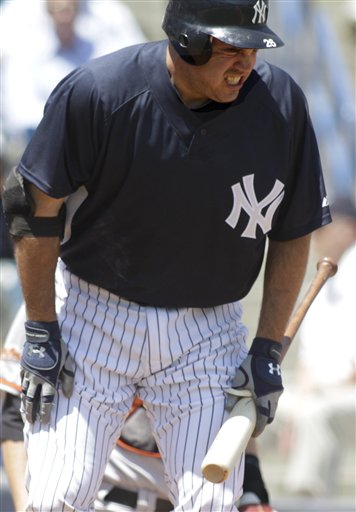
Posted by: | CommentsNick Johnson, the Yanks’ own version of Mr. Glass, became the first casualty of Spring Training last week when his back tightened after he caught his cleat on the turf in the batting cage. While many in the media were up in the arms over the Yanks’ reliance on the fragile lefty, Nick and the Yanks insisted he was fine. The team opted to take it slowly so that the DH would be feeling strong, and he probably could have played had it been the regular season. This morning, we learn via Joe Auriemma that Nick took 50 swings in cage, is feelin’ good just like he knew he would and plans to play Monday. And exhale.
Backing up the brittle DH
Posted by: | Comments
Updated (9:50 a.m.) When Nick Johnson was scratched from the lineup yesterday afternoon with a sore back, the Yankee Universe let out a collective groan. Here it goes again; the injury bug bites Nick Johnson.
Of course, the injury ended up being nothing very much, and the Yankees say the team is just taking it slow during day two of Spring Training. Nick caught his cleat while taking some swings in the cage, and he could have played had it been the regular season. He’ll sit out a day or two and find himself right back in the lineup this week. Lest we forget, Jorge Posada’s surgically repaired shoulder was giving everyone conniptions last spring as well. There’s always a sore something somewhere.
But Johnson’s injury got me thinking. What if Nick were to go down? What would the Yankees do with that DH slot? Johnson has been summoned to replace Hideki Matsui as the Yanks’ go-to guy for DH. The team rightly doesn’t want to use the DH as a rotating half-day rest slot for their veterans because that would necessarily force Ramiro Peña or Francisco Cervelli, weak offensive options, into the lineup nearly every day. So Johnson, a high OBP guy with a lefty swing designed for Yankee Stadium, seemed an ideal choice.
In a sense, the Yankees don’t need a lot from Nick Johnson. Hideki Matsui hit .274/.367/.509 with 28 home runs last year in 142 games, and he put up a WAR of 2.7, eighth best in a powerhouse lineup. If Johnson, a 2.5-win player last year, can give the Yanks a pair of wins for $5.5 million, the team will be quite pleased.
A problem emerges, though, if Johnson can’t do that. If he doesn’t make 135 starts, doesn’t get his 500 plate appearances, doesn’t produce a few wins out of the DH slot. If he gets injured and misses significant time, always a distinct possible with him, the Yankees will be out a DH.
Behind Johnson, the options for designated hitter are slim. The team has Randy Winn, Marcus Thames and Jamie Hoffmann in camp fighting for two roster spots. Last year, Winn was a 1.7-win player based on WAR, but that’s because he was 16.5 fielding runs above average. His offensive output — a .302 wOBA with 2 home runs in 538 plate appearances — makes him a non-option for the DH spot. Marcus Thames had a 0.1 WAR last year. No matter how that breaks down, he wasn’t doing much hitter at all. Jamie Hoffmann has played just 72 games at AAA.
Beyond these guys making waves in camp, Juan Miranda would offer the Yanks another lefty option for DH. He’s the first guy called up when the team needs a bat, and as his prodigious home run in Tampa at the end of 2009 showed us, he can certainly hit. He’s a career .280/.366/.474 hitter in the minors and blasted 19 home runs last year at AAA. He isn’t too vulnerable to lefties either, hitting .291/.367/.507 against them in just under 200 ABs last year. His Major League Equivalents don’t scream out success, but he’s an option.
The Yankees do have a rather tantalizing ace in the hole, but would they dare use it? Jesus Montero is, acccording to a video interview he did with YES, working hard to get to the Majors, and by all accounts, he has put on a hitting clinic in batting practice this spring. In his one in-game at-bat, he singled. He has the power and the stick to DH, but the Yanks shouldn’t rush him. He needs his AAA seasoning, and when the 20-year-old shows he can mash at AAA, the Yanks can begin to think about it. In the meantime, the team has three in-house choices, and Gary Sheffield remains a free agent.
For now, we’ll rely on Nick Johnson to carry the designated hitter slot for six months this year. He gets an Interleague Play break when the Yanks hit the NL in May and June, and with Robo-Tex manning first, Johnson won’t be asked to exert himself in the field. He should be able to withstand the pressures of the season, but if any player can’t stay healthy at DH, it’s Nick Jonson. And, please, no more cleats in the batting cages.
Photo by Kathy Willens/AP
The whole picture for the No. 2 hitter
Posted by: | CommentsOver the past few days we’ve looked at a few aspects of a quality No. 2 hitter. We want someone who will get on base and set the table for the heart of the order, but who also won’t ground into double plays when the leadoff man reaches. As it turns out, the guy who gets on base more grounds into far more double plays. Will those twin killings hurt the team more than his presence on the base paths helps it?
Since we’re working with the theoretical here I’ll use the Bill James projections, mostly because they assume a greater run environment. We really could have used any system, though, since we need only compare the systems to themselves.
Getting on base for Teixeira
Bill James projects Granderson to reach base in 35.3 percent of his plate appearances, and Johnson to reach in 41.4 percent. To make things easier, we’ll scale this to 600 plate appearances, which lies between each of their projections. That means Johnson would reach 248 times to Granderson’s 212. Beyond the obvious observation that Johnson would reach base 36 more times than Granderson, it also represents some fraction of those 36 where Granderson would end an inning.
That last point, I think, is sometimes overlooked when discussing players reaching base. Clearly, Johnson won’t keep 36 innings going where Granderson would end one. But if that’s true for even a third of them, it’s a dozen innings where Teixeira hits with a man on base rather than starting the next inning with the bases empty. Over his career Teixeira has hit .295/.400/.555 with men on base and .285/.357/.535 with the bases empty. Those dozen situations, then, could lead to a few extra runs over the course of a season.
Keeping Jeter on the base paths
Given the same number of plate appearances, we know Johnson will make fewer outs than Granderson. Unfortunately, sometimes the outs Johnson makes count double. He has come to the plate 594 times in his career facing a double play chance, and has hit into it 72 times, or 12.1 percent of the time. How much, then, does this offset his ability to get on base?
The Bill James projections peg Jeter for 152 singles and 64 walks, or 216 times reaching first base. It also projects him to bat 631 times, so we need to scale down the number to 600 PA, which puts it at 205 times. At a 12.1 percent GIDP rate, Johnson would erase Jeter 26 times. Granderson, however, grounds into a double play just 4.4 percent of the time, so he would erase Jeter only 9 times. That’s 17 additional instances, or 34 additional outs, for Johnson.
We often say that the most important thing a player can do at bat is not make an out. Each team gets only 27 outs per game, and only three before they have to clear the bases and start over, so those outs are the most valuable assets in the game. Using straight OBP in a 600 PA environment, we can expect Johnson to make 352 outs and Granderson 388. Once we add in their twin killings, though, we see that Johnson projects to make 378 outs and Granderson 397 — and that’s just considering Jeter’s instances of reaching first base.
More than one way to think about it
Clearly, the double play situation does not bode well for Johnson. He still projects to make fewer outs than Granderson, but the double plays make that a lot closer. Like all baseball issues, however, there are plenty more ways to look at the comparison.
Yes, Johnson might erase Jeter in 26 of the 205 times he reaches first base. No one wants to see that. But the flip side presents the number of times both Jeter and Johnson will reach base. Scaled to 600 PA, Jeter figures to reach base, but not hit a home run, 237 times. Holding consistent Johnson’s .414 OBP, that means that 98 times Teixeira will come to the plate either with both Jeter and Johnson on base, or otherwise with Johnson on base with Jeter sitting on the bench and a run on the board. With Granderson that figure falls to 84 instances.
Granderson, however, has a bit more power than Johnson right now. Scaled to 600 PA, Granderson projects to hit 51 extra base hits, which represents 8.5 percent of his plate appearances. Then again, Johnson projects to hit 49 extra base hits when scaled to 600 PA, so it might not be that big a difference. The enormous caveat here is that we’re scaling down Granderson’s and scaling up Johnson’s. I know it shouldn’t make a huge difference, but I feel a bit more comfortable with the former.
What about their results once they’ve reached base? According to Baseball Prospectus’s EQBRR, Granderson added 1.9 runs on the base paths. That doesn’t seem like a huge amount, especially for a player with his speed. Then again, his OBP fell to .330, which certainly plays a part. In 2008, when his OBP was .365, Granderson generated 5.8 runs on the base paths. Johnson was worth -2.1 runs on the bases, which doesn’t seem that bad considering his lack of speed. Still, we’re looking at something like a seven-run swing at 600 PA.
So who hits second?
From all indications, it’s Johnson. At this point, with a clean slate, I think that’s the right call. Even when factoring in double plays he makes fewer outs than Granderson, which means more opportunities to hit with men on base for Teixeira and A-Rod. At the outset that should be the No. 1 concern.
Of course, if the DPs become a problem, they could consider a swap. Granderson doesn’t figure to be a black hole in the two hole by any stretch. He can get around the bases, and he won’t erase Jeter too many times. But with the presence of Johnson on the roster, he’s the second best man for the job.
Johnson scratched with a stiff lower back
Posted by: | CommentsUpdate (2:20pm): Bryan Hoch says NJ caught a spike during BP and felt something, but he definitely would have played if it was a regular season game. No point in pushing it March 4th.
1:30pm: Via Ben Shpigel, Nick Johnson was scratched from today’s game against the Phillies with a stiff lower back. Jamie Hoffmann took his place at DH and in the two-hole. Most of the time this wouldn’t be news, but NJ’s injury history and previous back trouble (he spent 52 days on the disabled list with a lower back strain back in 2004) makes it worth a mention. More than likely, this is no big deal, and they’re just playing it safe.
Remember, Jorge Posada’s shoulder was barking this time last spring (when he was coming off surgery), and he was fine in the end.
Avoiding the twin killing in the two hole
Posted by: | CommentsIn discussing the merits of a No. 2 hitter, I hit on the value of setting the table. Because Nick Johnson gets on base at a better clip than the other candidates, he’ll create more opportunities for Mark Teixeira and Alex Rodriguez to hit with men on base. But, while getting on base factors prominently into the quality of a No. 2 hitter, other issues can change the situation. For instance, what if the No. 2 hitter, who gets on base at a high clip, also grounds into a lot of double plays? Wouldn’t that sap his value?
About a year ago, while he was working with Team USA, I made a further argument for Derek Jeter the leadoff hitter. Beyond the reasons we’d heard a thousand times — Jeter got on base more than Damon while Damon had more power than Jeter — I thought another factor played prominently. In 2008 Jeter hit into 24 double plays, the highest number of his career. Many times, I’m sure, these double plays came after Damon reached safely. Damon, though, is historically good at avoiding double plays. Flipping the two, then, seemed obvious.
Just a few days after that post, Joe Girardi announced that he would make that very flip. The results, as we saw, reflected the projection. Jeter hit into fewer double plays. Damon hit into more, but that’s going to happen when the guy in front of you gets on base 40 percent of the time. This raises an interesting point. We don’t learn much from raw GIDP numbers, because they’re not placed in any context. What we seek is some kind of rate for GIDP — how many times the player hit into a double play when presented the opportunity. That seems like relevant information for a No.2 hitter.
Thankfully, Baseball Reference does have information about double play opportunities (under More Stats, then Situational Hitting).* So, among Johnson, Curtis Granderson, and Robinson Cano, who has hit into the most double plays per opportunity? We’ll add in Damon for comparison.
*When I originally wrote this article, I had no idea this existed. Thanks to B-R founder Sean Forman for pointing me in the right direction. This table is totally accurate.
| Player | GDP | Opp | Pct. |
|---|---|---|---|
| Johnson | 72 | 594 | 12.1 |
| Granderson | 18 | 410 | 4.4 |
| Cano | 94 | 670 | 14.0 |
| Damon | 84 | 1591 | 5.3 |
Does Johnson’s GIDP propensity offset his better on-base skills? Sound like a good idea for another follow-up article.
Sending Teixeira to bat with men on base
Posted by: | CommentsSimple concepts dictate baseball lineup construction. The top two hitters in the order get in base so that the heavier hitters in the middle of the lineup can drive them in. This is why we typically see the best power bats in the 3-4-5 spots, while the lighter hitting players bat on either side. Teams can run into problems, however, in filling the first two spots.
Again, the primary goal of the first two hitters is to get on base for the power hitters. That gives the heavier bats more opportunities to knock in runs. The problem in filling the first two spots relates back to those power guys. Oftentimes they’re also the best on-base guys on the team. In fact, on-base skills don’t come easy to players who lack power. Among active players, only five have a career OBP over .350 and a career ISO under .120: Luis Castillo, Chone Figgins, Jason Kendall, Mark Loretta, and Ichiro. Raising the ISO to .150 adds only eight names (including Derek Jeter). This is not an easy to find skill, on-base without power.
As a substitute for on-base skill, we often see teams place speedy hitters in the first and second slots. The rationale goes, so I assume, that they can advance more bases, both by stealing and by taking the extra bag on a base hit. The problem, of course, is that they don’t get on base a lot in the first place, so they can’t swipe or take an extra bag very often. Even then, with the heart of the order due up, the most important thing remains having runners on base. I’d far rather have a slow runner on base 40 percent of the time than a fast runner on base 34 percent.
This concept applies to one of the few decisions the Yankees must make in spring training. While Brian Cashman has stated his desire to have Nick Johnson hit second, it doesn’t appear to be a given at this point. It should be, but it’s not. The alternatives include Curtis Granderson and, to a lesser extent, Robinson Cano. Both might be solid No. 2 hitters, but with Johnson on the roster they’re not the best options. WIth Jeter and Johnson setting the table, Mark Teixeira and Alex Rodriguez will come to bat with more men on base.

Photo credit: Eric Gay/AP
To illustrate this point, let’s take an ideal scenario. Jeter and Johnson both hit in front of Teixeira for all of Teixeira’s plate appearances, and they OBP somewhere around their 2009 totals, .400 and .420. Running a quick percentage check, this means that Teixeira would come to bat with both runners on 16.8 percent of the time, and at least one runner on about 65 percent of the time. Given Teixeira’s 707 plate appearances from 2009, that means he’d come to bat with at least one runner on 460 times, and two runners on 119 times.
(This, of course, discounts the double play, but it also discounts the No. 9 hitter getting on. Let’s call it a wash for now, though if someone wants to run the numbers be my guest.)
Last year, with Jeter’s .400 OBP and Damon’s .365, Teixeira had a 14.6 percent chance of coming to the plate with both runners on, or 62 percent with at least one runner on. That gives him a theoretical 438 PA with a runner on base, and 103 with two runners on . His actual number of plate appearances with a runner on base was 371, a bit below the theoretical mark. This is due to double plays — Damon hit into nine last year — instances where Jeter made the last out of the inning, and times when Damon hit a home run. We also can’t expect the numbers to line up exactly.
Assuming an even ratio of theoretical plate appearances with a runner on to the actual number, that would give Teixeira 389 PA this season with at least one runner on, an increase of 18 instances. In other words, that’s 18 more opportunities for a double or home run to plate an extra run. Then there’s the cumulative effect. If Jeter and Johnson getting on base increases Teixeira’s chances of success, that can further increase A-Rod’s chances of success. We can continue passing the buck down the lineup.
If Granderson recovers to his 2008 form, he’s essentially a clone of Damon. While that’s good, and while he’ll be able to take extra bases that Johnson will not, I think that the added plate appearances give the Yankees a bigger advantage. It means more opportunities for Tex and A-Rod. While Granderson might be able to score from second, or even first, in a few more instances than Johnson, he won’t be on base as much and therefore won’t get as many opportunities.
Joe Girardi has many options when filling out his lineup card, especially in the No. 2 spot. The three players who could hit there each bring a different skill to the table. Cano can advance runners with base hits and hit them in with power. Johnson can get on base to set the table and also hits for decent average (hopefully his power recovers a bit). Granderson can clear the bases with power and circle them with speed. Given the number of times he figures to be on base, I think Johnson is the choice here. The thought of Teixeira and A-Rod coming to bat with more runners on base should make any Yankees fan salivate.
New numbers for new players
Posted by: | CommentsThere’s very little official business left for the Yankees to take care of this offseason. They still have to renew the contracts of their 19 pre-arbitration players, but that should happen in the next week or so. Other than that, it’s just show up for Spring Training, assign numbers to the new guys, and get to work.
During his introductory press conference, we learned that Curtis Granderson would be wearing No. 14, giving some credibility to a number that had been used exclusively for spare parts in recent years. The Yankees did make three other significant additions this offseason, though the numbers Nick Johnson, Javy Vazquez, and Randy Winn will sport in 2010 still aren’t listed on the official site.
However, as astute commenter Mo’s Savant noticed, their numbers are listed in MLB.com’s store, available for customizing a shirt or jersey. Of course these aren’t official, but if you’re like me and find a weird satisfaction in these kind of things, it’s worth mentioning. Let’s run through them one by one.
Nick Johnson: No. 26
NJ wore No. 36 during his first stint in the Bronx, but apparently Edwar Ramirez has too firm a grip on it. I suppose Nick could buy it from him in Spring Training, but I’m guessing it’s not that important to him; he wore No. 24 with the Expos/Nationals , and No. 20 with the Marlins. Jose Molina, who will always hold a special place in my heart as the best backup catcher of the Jorge Posada era, was the last to wear No. 26, and before him it belonged to other backup backstops like Wil Nieves, Koyie Hill, and Sal Fasano. The last significant player to wear the number was Orlando Hernandez during the Dynasty Years.
Photo Credit: Linda Kaye, AP
Javy Vazquez: No. 31
A former Yankee like Johnson, Vazquez wore No. 33 during his one season in pinstripes, and did the same with the White Sox and Braves. During the Expo and Diamondback years, Javy rocked No. 23. Nick Swisher is the proud owner of No. 33, and he went out of his way to get the number from Brian Bruney last year, so I don’t think he’s giving it up anytime soon. So Javy is stuck with No. 31, previously worn by Mike Dunn and Ian Kennedy, and Edwar Ramirez and Aaron Small before them. Dave Winfield was the last big time Yankee to wear the number, though Tim Raines also had it during the late-90’s and Steve Karsay during the early-00’s.
Photo Credit: Matthew Gunby, AP
Randy Winn: No. 22
During his time with the Devil Rays, Mariners, and Giants, Winn had always worn No. 2. Obviously, he’s not getting that as a Yankee. Instead, he doubles up on it and takes No. 22 from the departed Xavier Nady. That number has a prominent place in recent Yankee lore, having been worn by Roger Clemens, Robbie Cano, and Jimmy Key with a few LaTroy Hawkinses and Jon Lieberses mixed in. Jorge Posada even wore it for part of the 1997 season, his first full year in the majors as Joe Girardi’s backup.
Photo Credit: Chris O’Meara, AP
Unfortunately, we still don’t have numbers for the likes of Boone Logan or Greg Golson, or any of the prospects added to 40-man after the season either. We’re just going to have to wait for camp to open and see what’s on their backs. I’m happy I can finally buy my Nick Johnson shirt, but damn, did they really raise the price of customizable shirts to $36.99? It’s a recession, you know.
Nick Johnson and the almighty fastball
Posted by: | Comments
As I was perusing Buster Olney’s blog yesterday morning during my daily reading, something caught my eye and piqued my interest. He wrote about Orlando Hudson and how he could be a good fit for Minnesota, where he would likely hit second with Joe Mauer and Justin Morneau backing him up. Long story short, Olney pointed out that Hudson is a good fastball hitter, and he would see more fastballs hitting in front of Mauer and Morneau, therefore it would be a good signing for the Twins.
What caught my attention were the numbers he provided about the percentage of fastballs seen by each team’s number two hitter last season. The second spot in the Yankees’ lineup saw 69.1% fastballs in 2009, the fourth most in baseball and slightly more than the aforementioned Twinkies. Johnny Damon has always been a good fastball hitter, so it’s no surprise that had such a strong offensive season. FanGraph’s pitch values say that his bat was worth 0.53 runs above average per 100 fastballs last year, down a tick from 2008 (1.11) but right in line with his 2006 and 2007 performances (both 0.58).
However Johnny is long gone now, replaced in the two hole by new-old Yankee Nick Johnson, who will assume control the cushiest lineup spot in the game: hitting behind Derek Jeter and ahead of Mark Teixeira and Alex Rodriguez. While he may not see seven fastballs out of every ten pitches like that spot did in 2009, chances are he’ll see more than the 61.4% fastballs thrown to him last season. And that’s good news, because Nick Johnson straight up murders fastballs.
While Damon’s bat has been worth just over half-a-run above average against the old number one in three of the last four years, Johnson’s hasn’t dipped below 1.17 runs above average. I tried to put the difference between Damon and Johnson into words, but I failed in two attempts, so I’m going to cop out and use a table. Check this stuff out…
(wFB is runs above average, /C is per 100 pitches)
Even though he missed all of 2007 and most of 2008 with a busted leg, Johnson still generated more runs above average against fastballs than Damon over the last four years. It’s not even close either. On a rate basis, he’s produced close two runs above average for every 100 fastballs seen, more than double Damon’s output. If NJ sees anywhere near the amount of fastballs this year that the Yanks’ number two hitter saw last year, holy schnikees is he going to do some damage.
Obviously there’s many more factors that go into the number of fastballs a hitter sees, more than I care to account for. Will Jeter get on base more than 40% of the time in front of the number two hitter again next year? What about the nine hitters, will they combine to get on base less than 31% of the time again? Those are the great unknowns, and they’ll all affect the number of fastballs thrown Johnson’s way in 2010. The important part is that in one of the better fastball spots in the lineup, the Yankees now have a tremendous fastball hitter, one that’s far better than Damon ever was.
The massive upgrade in on-base percentage is reason enough to salivate over the idea of Johnson hitting second next year, all of this fastball stuff is just icing on the cake. Johnny Damon did a fantastic job as the Yankees’ number two hitter last year, but Nick Johnson could be even better in 2010.
Photo Credit: Bill Kostroun, AP
Running down Nick Johnson’s myriad injuries
Posted by: | Comments
Nick Johnson, as we know, is not a pillar of health. If he were, he’d have received far more than the one-year, $5.75 million contract he signed earlier this off-season. The Yankees took a gamble, and considering the injuries that have kept him on the bench during his eight-year MLB career it’s a pretty considerable one. Yet Johnson doesn’t appear to suffer any chronic ailments. The Yankees had concerns about Hideki Matsui’s knees, knowing that they could be an issue in 2010. But with Johnson, there’s no single body part that has caused him constant problems.
Chris at The Yankee U pulls up Johnson’s injury history, noting that he’s missed 589 season days to injury over his career. That seems like a staggering number, though it gets skewed because of Johnson’s 2006 and 2008 injuries. Following an otherwise healthy 2006 season, Johnson broke his femur after colliding with teammate Austin Kearns. He missed the final seven days of the season and then the entire 2007 campaign, totaling 193 days. Then, 38 games into his 2008 return, he tore a tendon sheath in his wrist while swinging. That adds another 137 days. The two injuries cost Johnson 330 total days on the disabled list, or 56 percent of his career total.
Of the two injuries, the wrist clearly causes more concern. That he got through 2009 without any wrist problem provides a positive outlook, but there still has to be some concern. In fact, injuries to the right wrist and hand plagued Johnson earlier in his career. In 2002 he missed 26 days with a right wrist contusion, and then missed another 25 days with right wrist soreness in 2003, though that came in training camp. But later that season he missed 70 days with a stress fracture in his right hand. Like the wrist injury that ended his 2008 season, it came on a swing. He suffered no hand or wrist injuries between 2003 and 2008.
The other major injury, the broken femur, resulted from a freak accident. Perhaps his fragility played into the severity, but there’s no way to prove that. It wasn’t the first time Johnson suffered a freak injury that kept him out for a prolonged period. On August 20, 2004, a Royce Clayton ground ball struck Johnson in the face, dropping him face first into the ground. He suffered a fractured right cheekbone, sidelining him for the rest of the season, 44 days. That puts his freak injury total at 237 days, or 40 percent of his total injury time.
In 2009 Johnson missed 24 days due to injury. The first came after fouling a pitch off his foot. The second, a right hamstring strain, landed him on the 15-day DL and caused him to miss 17 days. It must not have been that severe an injury; we’ve seen players miss much more time with hamstring strains. Finally, he missed six days in September with the flu. So, one real injury, and even that was less severe than many of its type.
Nick Johnson is an injury prone player, no matter how many mitigating factors exist. But because of his similarity to other players on the market, specifically Matsui, those mitigating factors probably did play into the decision to sign him. Because his time on the DL is skewed by two freak injuries, and because he had surgery to correct the one recurring injury seemingly make him a better bet than other injury prone DH types. For instance, Carlos Delgado is coming off major hip surgery, and Hideki Matsui has chronic knee problems. The Yankees, it appears, would rather deal with an injury-prone player with no chronic issues than one with a specific area of concern.
If you want to check out Johnson’s injury history, here’s the chart, courtesy of Fantasy Pitch F/X.

Photo credit: AP/Paul Sancya