Archive for A.J. Burnett
What Went Right: The Offseason Pickups
Posted by: | CommentsOver the next week or so, we’ll again break down what went wrong and what went right for the 2009 Yankees. The series this year will be much more enjoyable than the last.
Every season starts with some new faces in Yankee pinstripes. Some are more notable than others, but they’re all expected to produce. The offseason brought three big time free agents to the 2009 Yanks, and after several high-profile flops in recent years, Yankee haters and the MSM were chomping at the bit to tear into the club should they fail. Unfortunately for those folks, they didn’t.
Mark Teixeira joined the Yanks on an eight year deal that will put $180M into his bank account, and his poor start (.182-.354-.338 in his first 99 plate appearances) already had some questioning his ability to play in New York. Tex answered all the doubters in a big way, hitting .308-.388-.598 the rest of the way, tied for the AL lead in homers (39), runs batted in (122), extra base hits (85), and total bases (344). His defense at first was top of the line, whether he was snagging line drives, ranging to his right, or scooping throws from other infielders.
The playoffs weren’t kind to Teixeira, but it seemed like each of his hits came at a crucial time. He singled off Joe Nathan ahead of Alex Rodriguez’s game tying two-run homer in the bottom of the ninth in Game Two of ALDS, winning the same game with a walk-off homerun in extras. Teixeira doubled in three runs to help mount a comeback in Game Five of the ALCS, and his homer off Pedro Martinez in Game Two of the World Series ignited the offense. His 5.1 WAR was the most by a Yankee first baseman since Jason Giambi’s monster first season in pinstripes.
For the first time in history, a team handed out two contracts worth over $100M in the same offseason, and that means Tex wasn’t the only new star in town. CC Sabathia signed on for seven years and $161M, giving the Yankees a sorely needed front-of-the-rotation starter still in his prime. Just like Tex, Sabathia struggled early, posting a 4.85 ERA as the team lost four of his first six starts. After those first six starts, though, Sabathia was everything the Yankees hoped for and then some. He pitched to a 3.06 ERA with a .226-.281-.360 batting line against in his final 28 starts, completing at least seven innings in 22 (!!!) of those starts.
The regular season was a sign of things to come for Sabathia, who was the absolute man in the postseason. He beat the Twins to start off the ALDS, the Angels twice (once on short rest) in the ALCS, and put together two commanding performances (again, once on short rest) against the defending World Champion Phillies in the Fall Classic. Sabathia threw 36.1 IP with a 1.98 ERA in five postseason starts, knocking more than three-and-a-half runs off his career playoff ERA in the process.
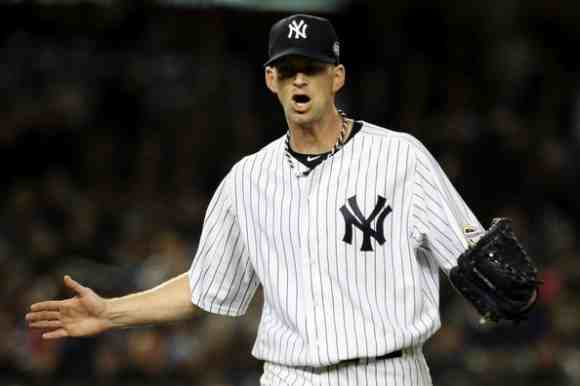
As if Teixeira and Sabathia weren’t enough, the Yankees added another impact player in A.J. Burnett, who inked a five year, $82.5M deal. Given his questionable medical history, Burnett had the highest flame-out potential of the three big free agent signings, but he proved to be the team’s most durable starter. He made every start without incident and didn’t have to leave any games with health concerns (even Sabathia had his little run-in with biceps tendinitis against the Marlins), and pitched into the sixth inning in all but two if his 33 starts.
Burnett may have been Robin to Sabathia’s Batman, but he turned in the biggest performance of the season (and his career) in what was the team’s most important game of 2009, shutting down the Phillies in Game Two of the World Series to tie the series up at one heading to Philly. Sure, he was frustratingly inconsistent, but the Yankees do not get to where they ended up without him.
The Yankees didn’t just stop at the free agent market, however. They also added an impact player via a trade. Long before Teixeira, Sabathia, and Burnett agreed to come to the Bronx, Brian Cashman fleeced Kenny Williams imported Nick Swisher from the White Sox in exchange for Wilson Betemit and two disposable minor league pitchers. Slated to begin the year as the fourth outfielder, Swisher was pressed into full-time duty after Xavier Nady blew out his elbow, and did more than replace Nady’s production.
Swisher hit .249-.371-.498 with 29 homers, seeing the second most pitches per plate appearances (4.27) in the AL. His .869 OPS was the 12th best among all outfielders in the game, better than brand names like Ichiro, Matt Kemp, Bobby Abreu, and Nick Markakis. While Swisher’s defense in the outfield was adventurous at times, he was solid overall and turned in several spectacular, heads-up plays in the postseason.
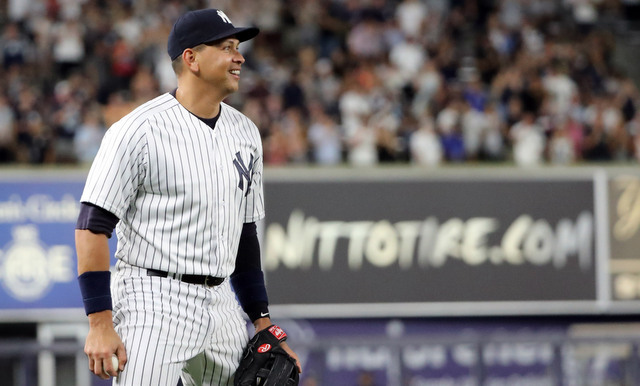
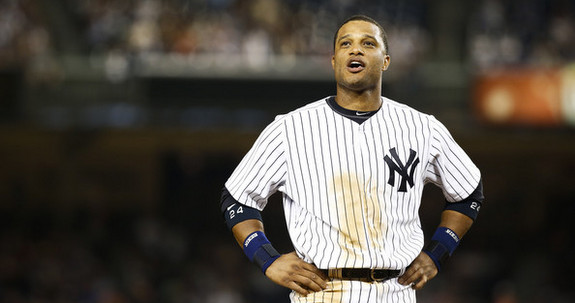
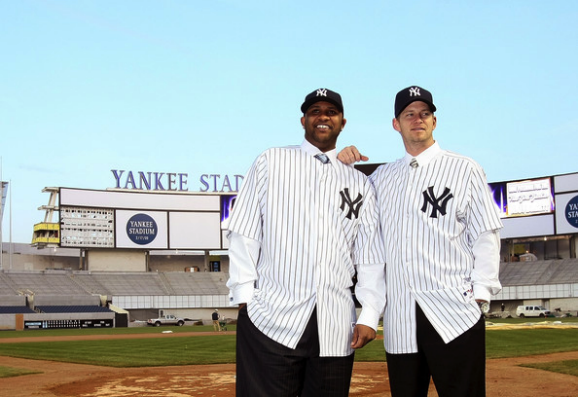
It’s not often that a team is able to bring in four above-average players in one offseason, let alone two that are bonafide franchise cornerstones, yet that’s exactly what the Yankees did last winter. They flexed their financial muscle to grab Tex and CC, used tremendous foresight to target A.J. over the imminently declining Derek Lowe, and flat-out stole Swish in a shrewd move. All four players met or exceeded expectations, and all four were huge reasons why the season ended on the Canyon of Heroes.
Photo Credits: AP, Getty Images, AP
A.J. ready for pen work, just in case
Posted by: | CommentsThe Yankees’ approach tonight — and, if necessary, tomorrow — is a simple one: Get the ball to Mariano with a lead. With the season down to its final two games, Rivera will be ready and willing to leave it on the field, and tonight, he can go two innings. With Joba Chamberlain, Damaso Marte and Phil Hughes ready and seemingly able to pick up the big outs, the Yanks could be looking at a six- or seven-inning affair tonight.
If the Yanks need to go to the pen earlier, if Andy Pettitte can only deliver so many pitches on three days’ rest, the Yanks have a new weapon available to them. Because he threw just 53 pitches on Monday night, A.J. Burnett is available in relief. “I just want the ball again,” Burnett said to reporters. “Hopefully they won’t need me, but I’ll do whatever they need. If I get the ball again, that would be great. Whatever they need, I’m ready.”
Over the years, we’ve seen many pitches come out of the pen on short rest in tight spots. Mike Mussina did it to save the Yanks’ season during the 2003 ALCS, and Randy Johnson did so against the Yankees in the 2001 World Series. Could A.J. be that hero if the Yanks need to strengthen the bridge to Mariano?
For Yankee fans, the idea may not be so comforting right now. We are, after all, still recovering from Burnett’s 2+ IP, 6 ER appearance in Game 5. Yet, A.J. might just be called upon the 6th inning if need be, and we can’t lose sight of the fact that he is, last start notwithstanding, a very good pitcher. In his first inning of work this season, A.J. was at his best. Opponents in the first inning hit just .240/.317/.368 as compared to .247/.336/.393 overall.
Hopefully, Andy Pettitte can be that bridge, and the Yanks won’t need A.J. But as the season turns down it’s final stretch, it’s all hands on deck for the Yankees. Plus, it’s October; stranger things than an A.J. relief appearance have happened.
Game 5 gameplan backfires on Yanks
Posted by: | CommentsA.J. Burnett was atrocious last night. There’s no other way to describe it. He settled down in the first after Dave Eiland gave him an earful, but he fell back into his wild ways before long. With none out in the third inning the Yankees found themselves in a tough spot. They’d have to piece together the game from a bullpen that has failed in the postseason where it thrived during the regular season.
That’s on Burnett. He wanted the ball on short rest in Game 5, and the Yankees decided that was the best tactic. Yet it was clear from the first inning that Burnett didn’t have what he had in Game 2. He left fastballs up in the zone, signaling a mechanical issue. We’ve seen it plenty of times during the 2009 season. Against a lesser team, maybe Burnett gets away with it and makes his way through six innings. Against the Phillies, that wasn’t happening.
In the New York media market, the blame will flow. Some will blame Burnett for not being mentally tough enough to put away the Phillies. Most will blame Girardi and the Yankees organization (because I don’t think Girardi made the decision alone). There was an alternative tactic which would have led to the same result, but would have left the Yankees with their top three pitchers ready to pitch in the final two games. In terms of results, the decision didn’t work out. There’s no denying that.
Does the bad result mean the Yankees made a bad decision? While that’s a question that requires thought and reflection, I’m sure many people already have an answer in mind. It’s either yes, the Yankees made the right move and it backfired, or no, the Yankees made a poor decision and paid for it. In scenarios like this the answer is never black and white, though the result points towards the Yankees making a bad decision.
In order to determine if it was a bad decision, however, we have to rewind to Sunday, before the start of Game 4. That is when the Yankees made the decision to start Burnett in Game 5. The decision was made without knowing that the Yankees would take a 3-1 series lead that night. That’s a wrench in the argument that the Yankees should have started Gaudin when up 3-1 — they would have had to decide it before they had that information.
Since there was time to run an end around after Game 4, let’s explore that path. The Yankees take Game 4, going up 3-1 in the series. Next up is Cliff Lee, followed by Pedro Martinez and then J.A. Happ or Cole Hamels. If the Yankees changed plans after Game 4, they would have lined up their worst starter, Chad Gaudin, against the Phillies best. They then would have had Burnett on five days’ rest against Pedro Martinez on the same, with both Andy Pettitte and CC Sabathia ready for a possible Game 7. That doesn’t sound so bad, does it?
Here’s a statement I think we can all agree on: Chad Gaudin could have done what Burnett did in Game 5. We’re able to agree on this statement because we have the benefit of hindsight. But let’s say Gaudin did post the two-plus innings, six-runs line, and the Yankees still lost 8-6. The results would have been the same, except under that scenario the Yankees are going back to New York with their three best pitchers ready to go. Put that way, it sounds like a better scenario.
Mike put it well in the postgame reaction. “AJ Burnett completely crapped the bed, which had little to do with short rest and almost everything to do with the fact that he’s AJ Burnett.” What if Burnett had this kind of game in Game 6? That could force a Game 7, something the Yankees surely don’t want to face after being up three games to one. If they had punted Game 5 and then Burnett folded in Game 6 as he did last night, that’s where they’d find themselves.
Coming into the playoffs, it was clear the Yankees had a strategy, and that was to ride their best arms as long as they could. Until Game 5, it had worked. The Yankees had used Sabathia, Burnett, Pettitte, and Rivera to cover 84 percent of the team’s postseason innings. Going with Burnett was a tactic consistent with that strategy. If they’d gone with Gaudin, it would have been altering the strategy because they felt comfortable with a 3-1 lead. In the World Series, no team should feel comfortable.
As the game played out, the tactic backfired. The strategy, however, remains strong. They knew that losing tonight was a possibility, but it was a possibility they’d be able to stomach knowing that their other two best pitchers, Pettitte and Sabathia, are waiting to take the ball. That’s the point. Even if the Phillies win a game or two, the Yankees still have their best guys waiting.
I know a lot of smart people who endorsed Gaudin for the Game 5 start, so I’ve given serious thought to the tactic. Each time I think about it, though, I’m less and less convinced. Even the morning after, I still think it was the right call to go with Burnett. Altering a strategy that works is hardly ever a good idea, especially when the alteration makes your team weaker. The Yanks made the right call. Unfortunately, as happens many times, it didn’t work out. Thankfully, the Yankees had planned for this.
(There’s obviously a question of Pettitte pitching on three days’ rest, but that’s another story, one we’ll surely discuss in the next two days.)
Burnett’s history of pitching on three days’ rest
Posted by: | Comments
Tonight, in the first elimination game of the 2009 World Series, the Yankees will send A.J. Burnett to the mound on just three day’s rest. The tactic makes sense. The alternative is Chad Gaudin, who hasn’t started a game since late September and who has a well-documented deficiency when facing left-handed hitters. With such a significant drop-off between the Yankees third best starter, Andy Pettitte, and their fourth, Gaudin, the choice was not a difficult one.
Burnett has experience starting on three days’ rest, and most of it came in the 2008 season with Toronto. His performance in those games might have helped influence Joe Girardi’s decision, so let’s take a look at exactly what happened when Burnett took the mound a day earlier than normally scheduled.
July 4, 2004
Burnett underwent Tommy John surgery in early 2003 and made his return in June, 2004. He had a few blips, including a 4.1-inning, eight-run outing against Cleveland, but generally pitched well in his first month back. Unfortunately, the Marlins could not pick him up, losing each of Burnett’s six starts that month. This included back to back starts in which Burnett allowed just two runs over seven and eight innings.
On July 4, the Marlins called on Burnett to start on three days’ rest against the Tampa Bay Rays, against whom he had thrown the aforementioned eight-inning game. He didn’t pitch quite as well, allowing three runs over 7.2 innings, but it was enough to earn his first win of the season. He struck out six Devil Rays that day, including Carl Crawford to lead off the game. Atypical of Burnett, he also didn’t issue any walks — though Tampa Bay drew the fifth fewest walks of any MLB team that season.
It might seem strange for Burnett to start on three days’ rest so shortly after recovering from elbow surgery. That seems like the kind of move that could lead to a relapse. Burnett, however, had thrown just 30 pitches on June 30, leaving the game two batters into the second inning after allowing five hits and walking two. That light workload made the short-rest start make a bit more sense.
July 13, 2008
Burnett started off July 2008 with two horrible starts. In seven innings against the Angels on Independence Day, Burnett allowed eight runs, six earned, on 12 hits over seven innings. The next time out he allowed seven runs on seven hits and three walks over 5.1 innings to the Orioles. Why, then, would the Blue Jays bring back Burnet on there days’ rest to face the Yankees on July 13?
I’m not quite sure. It was the last game before the All-Star Break, so perhaps Cito Gaston didn’t want Burnett to have such a long layoff. Whatever the reason, it worked. Burnett took a shutout into the ninth inning, though Jason Giambi ruined it with a solo home run. B.J. Ryan came on after a Jorge Posada single to record the final two outs. Still, Burnett was magnificent, and it’s one of the reasons that the players lobbied the team to sign him over the off-season.
September 13, 2008
At the end of August, Burnett found him with quite the challenge. On the ledger for his final three starts of the month: the Yankees twice, with Boston in the middle. While the Blue Jays were out of the race, it was still an audition for both teams. He killed the Yankees, but faltered a bit against the Red Sox. He’d get his chance for redemption against them, though, as Gaston named him the starter on September, just three days after his seven-inning, one-run performance against the White Sox.
It wasn’t an easy six innings for Burnett, as he used 102 pitches, walking three. But at the end of the sixth he had allowed just one unearned run. The Blue Jays went to town, scoring eight runs in support of their free-agent-to-be, helping him pick up his 18th win of the season.
The phantom three days’ rest start — April 16, 2008
When looking up Burnett’s short-rest starts, I first went to his Baseball Reference splits page, where it says he has started four games on three days’ rest. Yet I found only three such games. It comes down to a nitpick: does a start count as being on three days’ rest when the previous appearance was in relief?
On April 16, 2008, then-Blue Jays manager John Gibbons called on Burnett to come into the 14th inning of a game at home against the Rangers. It was tied 5-5, and the Blue Jays needed some more innings out of a dwindling pen. He had last pitched on April 13, also against Texas, and didn’t pitch particularly well in that start, allowing four runs over 5.2 innings. It seemed curious that Gibbons would call on Burnett two days later, but he did and paid for it. Burnett allowed two runs on three hits and a walk in the 14th, leading to a 7-5 Blue Jays loss.
Then, three days later, Burnett came out to start against the Tigers. It was six days after his last start, but just three days after his last appearance. He allowed three runs over five innings, walking six in the game. It was easily his worst start on three days’ rest, yet the Blue Jays offense put him in line for the win, his second of the season (the first was against the Yankees in his first start of the season).
In a way, I don’t want to count it because the start on three days’ rest did not follow another start, but a relief appearance. Then again, Burnett did throw 24 pitches in that span, six short of the 30 he threw on June 30, 2004, which he followed with a start on three days’ rest. Is there much of a difference there? I thought so at first, but I’m not so sure after thinking it over some more.
None of this guarantees Burnett anything tonight. It proves that he’s physically capable of throwing on three days’ rest and succeeding, but that’s about it. Knowing his track record is a bit reassuring, at least.
Yanks announce A.J., on short rest, for Game 5
Posted by: | CommentsOnce again, the winner of the Great Beat Writers’ Race to Twitter is Joel Sherman. He is the first among the Yanks’ crew to report that A.J. Burnett will start Game 5 on three days’ rest. Burnett, dominant in Game 2, will face off against Cliff Lee tomorrow night. This start, the last of A.J.’s season, will be his first for the Yanks on short rest. He has made four career starts on three days’ rest and is 4-0 with a 2.33 ERA in 27 innings. If both pitchers are at their best, Game 5 could be one for the ages.
Dissent in the ranks over Molina-gate
Posted by: | CommentsFor 12 years, the stories about Derek Jeter and Joe Torre told a tale of deference. Jeter, a rookie during Torre’s first year in the Bronx, had a special bond with his manager. He would call him Mr. Torre and rarely, if ever, questioned his decisions in public.
While Torre was managing the Yanks, Jeter played with a back-up catcher named Joe Girardi. Jeter and Girardi captured three rings together, but for Derek, Girardi’s presence on the team and his amount of playing time must have raised an eyebrow or two. After all, the Yankees had Derek’s very good friend Jorge Posada, a far superior offensive catcher to Joe Girardi. In the end, of course, it mattered little, as the Yanks plowed through the opposition during the latter half of the 1990s.
Today, Joe Girardi is Derek’s manager, and for the first time in a while, Jeter is publicly questioning the man who holds the Yanks’ reins. When asked about Girardi’s decision to start Jose Molina in A.J. Burnett’s starts, Jeter had a diplomatically loaded answer. As Jim Baumbach first reported yesterday, Jeter called the situation strange. “It will be kind of awkward not having Jorge in the lineup,” he said.
For Derek, the Yanks’ loyal solider and all around good guy at handling the media, that statement amounts to sheer mutiny. As Baumbach and others have pointed out, Jeter’s statement is also a bit hyperbolic. Posada wasn’t the only catcher during the Yanks’ World Series years, and as recently as 2005, Joe Torre used John Flaherty to catch the ornery Randy Johnson. The Unit lasted just three innings in a disastrous Game 3 start, and Jorge quickly entered the game in the 4th.
I have to wonder then if Joe Girardi is risking his respect by making an unpopular and questionable decision. Does Derek Jeter think Girardi is off his rocker? What about the other younger players who look to Jeter for leadership? Ken Davidoff claims all was calm at Yankee camp yesterday and offers us some translations of the players’ sound bites. Derek, he claims, is just trying to keep Jorge happy while not offending his manager, and Jorge has accepted it.
In a way, then, this move is certainly an experiment. If Burnett comes out and dominates the Twins and the Yanks handily win as they did on Wednesday, Joe Girardi will look good — or at least he won’t be subject to rampant first- and second-guessing. But if Burnett struggles through a start, those around the club — those whose respect Girardi needs — may wonder about the decision. Ken Davidoff doesn’t expect Molina-gate to “blow up these Yankees.” Here’s to hoping.
Molina-Gate: A.J. defends Posada
Posted by: | CommentsAfter six months of baseball day after day after day, this drawn-out schedule for the post-season seems interminable. The Yanks played last night for the first time since Sunday and do not play again for another 27 hours. The waiting, as Tom Petty said, is the hardest part.
With all of the off-days, we have plenty of time to discuss Joe Girardi’s peculiar decision to start Jose Molina in the ALDS when A.J. Burnett takes the mound. Molina will be behind the dish tomorrow night for Game 2 and unless Girardi’s plan is highly illogical, should be back there again for a potential Game 5. Most assumed this decision was inspired by A.J. Burnett who seemed to be more comfortable on the mound with Jose Molina catching. Based on Burnett’s demonstrative attitude during a terrible Fenway outing in August, this wasn’t an unfounded conclusion.
Burnett, though, threw a wrench into this thinking. Prior to Game 1, he told reporters that he did not ask for Molina to catch. Although Burnett appears to be criticizing Girardi, he continually stressed his support for Posada and did so again this afternoon. “It’s a ‘me’ thing,” Burnett said today when asked about his rhythm with Molina. The pitcher, after all, mostly is in control of his own performance.
Burnett’s responses today followed questions concerning Molina and Posada yesterday. The Game 2 starter tried to distance himself from having a preferred catcher. “It was the manager’s decision,” he said yesterday. “I had no part in it. I’ve thrown good to both. My good games, I’m right. My bad games, it’s not the catcher, it’s me. When I’m good, it doesn’t matter which one is behind the plate.”
During that press conference, he spoke about that Aug. 22 outing. Although Burnett was clearly yelling “Why did you throw that?” on the mound, that frustration, the right-hander said, was directed at himself and not his catcher. “It’s making me out to be a bad guy again,” Burnett said, “and it comes down to Boston when I said, ‘Why? Why? Why?’ Over my career, I’ve done that a handful of times. But if you ask people that I played with, I don’t show guys up. I even went to Joe in the past and said, ‘Hey, give me either one.’ It’s his decision.
Burnett, an 11-year veteran, will be making his post-season debut tomorrow night. Although he was a member of the 2003 Marlins, he missed the playoffs — and much of the season, in fact — with an arm injury. He is looking forward to this start, he says, but the Yankees could do without the circus. “I’m just looking forward to getting out there and getting that first pitch out of the way,” he said.
This afternoon, Girardi again spoke about this decision. “I don’t want to get ahead,” he said when asked if Burnett would pitch to Molina through the playoffs. “We talk about Molina catching him tomorrow. He’s been catching him his last four or five starts. I’m not going to get too far ahead.”
This line of thinking makes nearly as little sense as Girardi’s initial decision. If the Yanks aren’t committing to pairing up Burnett and Molina, why would he do it for the second game of a five-game set? “We’re taking things one day at a time,” he said. Girardi also refused to rule out DHing Posada over Hideki Matsui tomorrow.
Meanwhile, on the other side of this debate is Jorge Posada. The embattled catcher did not have his best game early on last night. He and CC couldn’t get on the same page, and one of the two passed balls Jorge allowed resulted in the Twins’ second and final run of the game. Chris at iYankees though makes a very good point: While CC did not have his best fastball, Jorge still coaxed a very good game out of him. Early-inning defensive struggles aside, Posada had a fine night.
But still we discuss, and everyone has theories. Jonah Keri calls Joe Girardi a sentimentalist in so many words. The Yanks’ skipper was a “good-field, little-hit” catcher and earned his fair share of Yankee playoff ABs. Girardi sees himself in Jose Molina and will give the Yanks’ all-field, no-hit catcher a chance. Even in Girardi’s worst offensive season with the Yanks, his 60 OPS+ was still decidedly better than Molina’s 49 mark this year.
Perhaps though it doesn’t matter at all. Tangotiger ran the simulations and found little difference: “With Posada (batting 7th), Yankees score 6.17, allow 4.18 rpg and win 72.15% of the time, in 100,000 games. With Molina (batting 9th), they score 5.85, allow 4.05 rpg and win 71.33% of the time.”
And still we wait for the game to start tomorrow evening.
Molina to catch Burnett during ALDS
Posted by: | CommentsWhen A.J. Burnett takes the mound this week, perhaps on Friday in Yankee Stadium but more likely on Sunday in either Detroit or Minneapolis, Jorge Posada will not be behind the plate. Talking to reporters today at Yankee Stadium, the Yanks’ catcher revealed, in a rather terse exchange, that Jose Molina will catch Burnett this week in the ALDS.
During a workout day interview, Posada and the reporters were chatting about the Yanks and their playoff chances when the discussion turned to A.J. Burnett and Jose Molina. “I think Molina’s probably going to catch A.J,” Posada said when the topic was broached. “So that’s it.”
After a minute of awkward silence, questioning shifted away from Molina only to return to this hot topic a few minutes later. “I just hope we win that game. That’s all. That’s all I got to say,” Posada said in a clipped tone. “Not like I didn’t see this coming.”
For the Yankees and Joe Girardi, this is a particularly risky strategy, and already, fans are debating the wisdom of it. On the season, Jose Molina was absolutely awful. In 155 plate appearances, he hit .217/.292/.268. His .560 OPS was third worst among all AL hitters with at least 150 plate appearances. Jorge Posada, meanwhile, hit .285/.363/.522 with 22 home runs and 81 RBI. He was the best hitting catcher in the AL not named Joe Mauer. I don’t need to break out MLVr to show just how more valuable Posada is offensively.
But Girardi is willing to throw that out the window because of A.J. Burnett’s splits by catcher. In 16 games with Posada as Burnett’s catcher, opponents hit .270/.353/.421. In 11 games with a Molina-Burnett battery, opponents hit .221/.307/.352. There is a difference, but there is no way of knowing if Molina is the cause of it. After all, Burnett is the one pitching, and Burnett is the one who has to make his pitches. A.J. has expressed his willingness to work with Posada this year, and he should certainly embrace that when the season has been reduced to a five-game set.
So here we are with a lineup that will either feature no Jorge Posada or no Hideki Matsui. If Girardi is going to insist on sitting Posada for Molina during A.J.’s starts, he shouldn’t further weaken the lineup by benching Matsui. I’d like to think, however, that the Yankee skipper knows this aspect to lineup construction.
As Jorge said, the Yanks better win that game. They have the lineup to overcome this bad decision, but they shouldn’t need to rely on their offense to compensate for a move that reeks of overmanaging. Otherwise, similar to the decisions to avoid bunting against Curt Schilling in 2004, to bat A-Rod 8th in 2006 and and to leave the team on the field while under attack by midges, this one will be second-guessed to no ened.